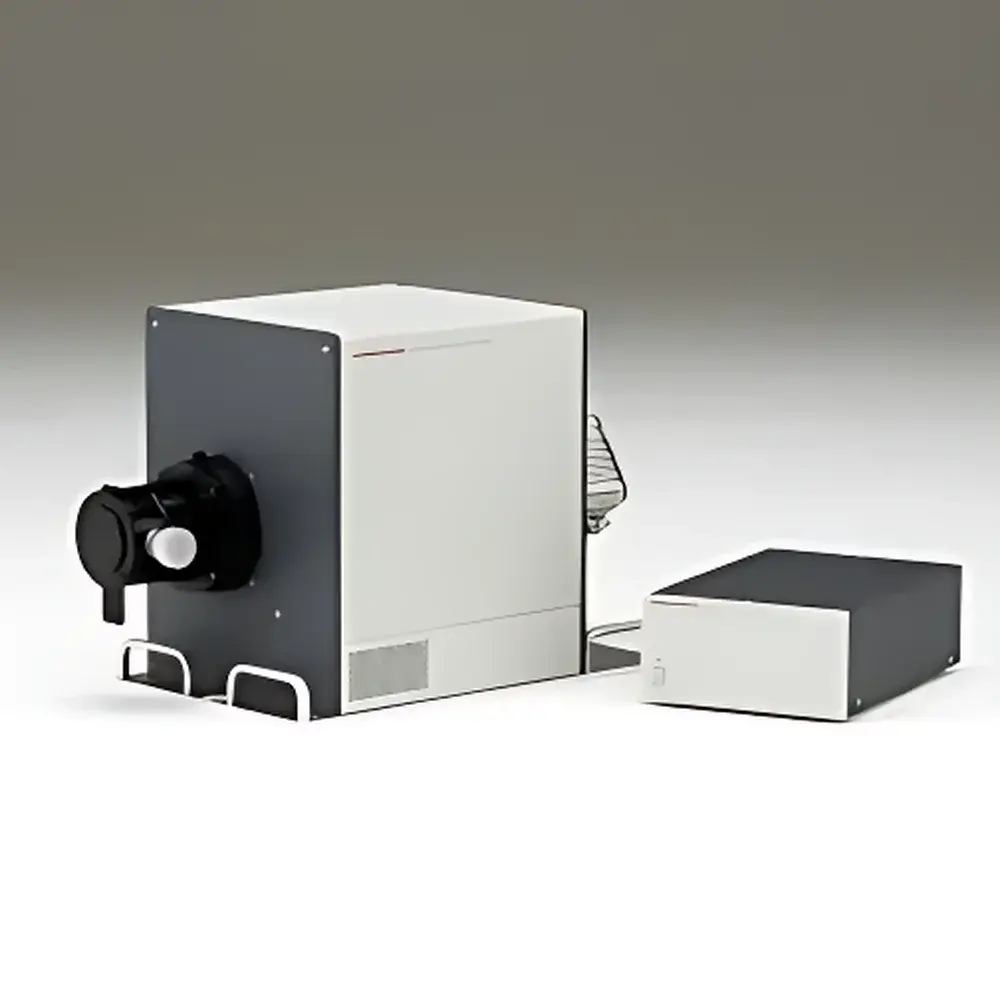
Hamamatsu C6138 FESCA-200 Femtosecond Streak Camera
| Brand | Hamamatsu |
|---|---|
| Origin | Japan |
| Manufacturer Type | Original Equipment Manufacturer (OEM) |
| Import Status | Imported |
| Model | C6138 |
| Pricing | Available Upon Request |
| Spectral Response Range | 280–850 nm |
| Temporal Resolution | 200 fs (typical) |
| Scan Repetition Rate | Single-shot to 100 Hz (max) |
| Dynamic Range | >1:10 |
| Sweep Duration | 20 ps – 1 ns |
| Effective Photocathode Length | 3 mm |
| Power Supply | AC 100–240 V, 50/60 Hz |
| Interface | GPIB (with HPD-TA readout system) |
Overview
The Hamamatsu C6138 FESCA-200 is a high-performance femtosecond streak camera engineered for single-shot, time-resolved optical diagnostics in ultrafast science. Based on the principle of photoelectron deflection in a transient electric field, the instrument converts temporal intensity profiles of ultrashort optical events into spatially resolved streak images on a phosphor screen or CCD sensor. Its core architecture integrates a photocathode with sub-200-fs temporal response, a precisely timed sweep voltage generator, and an electron-optical imaging path optimized for minimal dispersion and transit-time spread. Designed for operation with femtosecond laser sources—including Ti:sapphire, Yb-based, and optical parametric amplifiers—the FESCA-200 enables direct observation of transient phenomena without repetitive scanning or signal averaging, making it suitable for irreversible, low-repetition-rate, or stochastic events.
Key Features
- Typical temporal resolution of 200 fs—validated under standard calibration conditions using synchronized femtosecond laser pulses and autocorrelation reference methods;
- Integrated sweep unit enabling programmable sweep durations from 20 ps to 1 ns, supporting both ultrafast dynamics and slower transient evolution within a single acquisition;
- Photocathode spectral sensitivity spanning 280–850 nm, covering deep UV through near-infrared—compatible with common ultrafast laser harmonics and broadband emission sources;
- Effective photocathode length of 3 mm, ensuring sufficient spatial aperture for high-throughput light coupling while maintaining linearity and uniform sweep fidelity across the active area;
- GPIB-controlled operation via the optional HPD-TA readout system, enabling full remote configuration of sweep parameters, trigger delay, gain, and image acquisition timing;
- Robust mechanical and thermal design compliant with laboratory-grade environmental stability requirements (operating temperature range: 15–30 °C; humidity: <70% RH non-condensing);
- AC power compatibility (100–240 V, 50/60 Hz), eliminating need for external voltage regulation in global laboratory deployments.
Sample Compatibility & Compliance
The C6138 FESCA-200 interfaces with free-space optical beams or fiber-coupled inputs (via optional collimation optics) and supports vacuum-compatible mounting configurations for integration into ultra-high-vacuum experimental chambers (e.g., pump-probe setups, accelerator-based radiation diagnostics). It complies with IEC 61000-6-3 (EMI emission) and IEC 61000-6-2 (immunity) standards. While not certified for medical or industrial process control use, its measurement traceability aligns with ISO/IEC 17025 principles when operated within calibrated laboratory environments. Data integrity is maintained through hardware-synchronized triggering and deterministic GPIB command-response latency (<10 ms), supporting GLP-compliant documentation workflows when paired with timestamped acquisition software.
Software & Data Management
The FESCA-200 operates natively with Hamamatsu’s proprietary streak camera control suite, which provides real-time display, intensity calibration, temporal axis calibration (using known pulse widths or reference delays), and export of raw .bin or TIFF-formatted streak images. When integrated with third-party platforms such as LabVIEW (via GPIB drivers) or Python (using PyVISA), users can implement automated parameter sweeps, multi-trigger sequencing, and batch analysis pipelines. All acquired data retain embedded metadata—including sweep voltage settings, trigger delay, photocathode bias, and acquisition timestamp—enabling audit-ready traceability. The system does not incorporate FDA 21 CFR Part 11-compliant electronic signature functionality; however, externally managed audit trails and secure storage protocols may be applied at the host workstation level per institutional QA policy.
Applications
- Time-resolved photoluminescence decay analysis in quantum-well semiconductors and 2D materials;
- Ultrafast carrier relaxation and recombination kinetics in perovskite photovoltaics and transition metal dichalcogenides;
- Chemical reaction initiation and intermediate formation dynamics in solution-phase photochemistry;
- Diagnostic characterization of mode-locked laser pulse duration, chirp, and pedestal structure;
- Cherenkov radiation timing studies in particle accelerator facilities (e.g., LINAC-based beam diagnostics);
- Plasma ignition and electron density evolution in laser-induced breakdown spectroscopy (LIBS) and inertial confinement fusion experiments.
FAQ
What is the minimum detectable pulse width achievable with the C6138 FESCA-200?
The typical instrumental response function yields a full-width-at-half-maximum (FWHM) temporal resolution of 200 fs under optimal alignment and calibration. Actual resolvable pulse width depends on signal-to-noise ratio, photocathode quantum efficiency at the wavelength of interest, and sweep linearity.
Can the FESCA-200 operate in continuous repetition mode above 100 Hz?
No. The maximum scan repetition rate is 100 Hz. For higher repetition rates, alternative detection strategies—such as asynchronous optical sampling (ASOPS) or upconversion-based streaking—are recommended.
Is vacuum operation supported?
The main streak tube housing is rated for UHV-compatible flange mounting (CF-35 or CF-63 options available upon request), though the standard unit is configured for atmospheric operation with sealed optical input port.
Does Hamamatsu provide NIST-traceable calibration services for this model?
Yes—traceable temporal calibration using autocorrelation and interferometric reference pulses is offered as an optional service (Hamamatsu Calibration Certificate No. STK-TR-001 series).
What are the cooling requirements?
No active cooling is required. The system relies on passive convection and internal thermal management. Ambient temperature must remain within 15–30 °C for specified performance.