
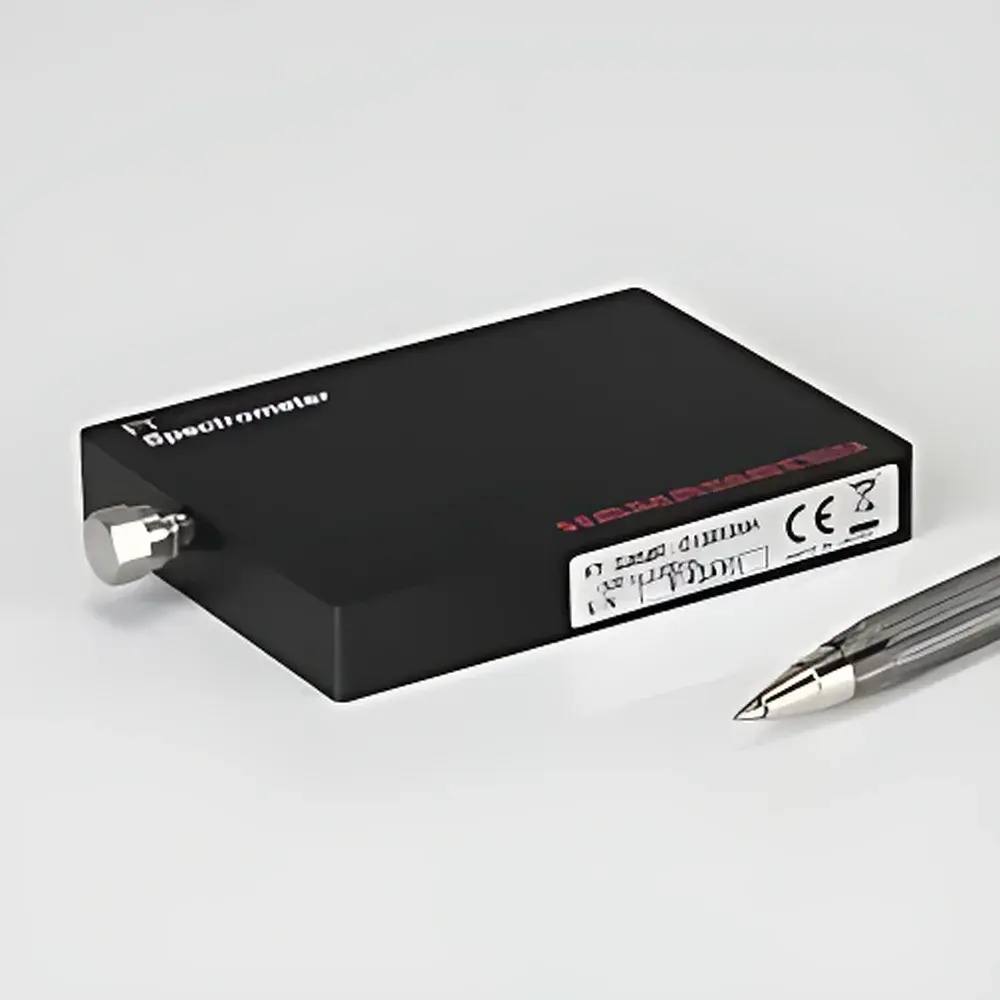
Hamamatsu C13053MA Miniature Flat-Field Spectrometer
| Brand | Hamamatsu |
|---|---|
| Origin | Japan |
| Manufacturer Type | Original Equipment Manufacturer (OEM) |
| Origin Category | Imported |
| Model | C13053MA |
| Pricing | Upon Request |
| Spectral Range | 500–1100 nm |
| Spectral Resolution (FWHM, max) | 3.5 nm |
| Cooling | Uncooled |
| A/D Resolution | 16 bits |
| Interface | USB 2.0 |
| Detector | High-Sensitivity CMOS Linear Image Sensor |
| Pixel Count | 512 pixels |
| Power Supply | USB Bus-Powered |
| Trigger Function | Supported |
| Grating Type | Quartz Transmission Grating |
| Wavelength Calibration Coefficients | Stored Onboard |
Overview
The Hamamatsu C13053MA is a compact, flat-field miniature spectrometer engineered for integration into space-constrained optical systems and portable analytical platforms. Based on a fixed-grating monochromator architecture with a quartz transmission diffraction grating and optimized optical path design, it delivers high-throughput spectral dispersion across the near-infrared (NIR) and visible range (500–1100 nm). Unlike traditional benchtop spectrometers relying on bulky optics and external power supplies, the C13053MA integrates all core components—optical train, 512-pixel high-sensitivity CMOS linear image sensor, analog front-end, and USB 2.0 interface—into a single low-profile housing (dimensions: 45.0 × 35.0 × 12.5 mm). Its uncooled CMOS detector provides quantum efficiency comparable to scientific-grade CCDs in the 600–900 nm band while operating at significantly lower power consumption (<500 mW), enabling true USB bus-powered operation without auxiliary power adapters or thermal stabilization hardware.
Key Features
- Ultra-compact form factor (45 × 35 × 12.5 mm) optimized for OEM integration into handheld analyzers, process monitoring modules, and embedded optical sensors
- High-sensitivity 512-pixel CMOS linear image sensor with 16-bit A/D conversion, delivering dynamic range >60 dB and low read noise (<15 e⁻ RMS)
- Quartz transmission grating ensures high optical throughput and excellent polarization insensitivity across the full spectral range
- Onboard wavelength calibration coefficients stored in non-volatile memory eliminate need for external calibration routines during deployment
- Hardware-triggered acquisition mode supports precise synchronization with pulsed light sources (e.g., LEDs, laser diodes, flash lamps) for time-resolved spectral capture
- Fully USB 2.0 compliant interface with plug-and-play enumeration under Windows, Linux, and macOS; no external power supply required
Sample Compatibility & Compliance
The C13053MA is designed for fiber-coupled operation using standard SMA-905 connectors (fiber core diameter: 50–400 µm recommended). It accepts collimated or focused input beams via 200 µm slit aperture, making it compatible with both free-space and fiber-optic sampling configurations. While not a standalone analytical instrument, it serves as a core optical engine compliant with fundamental requirements of spectroscopic subsystems used in industrial QC, environmental sensing, and academic research. Its design adheres to IEC 61326-1 (EMC for laboratory equipment) and RoHS 2011/65/EU directives. The absence of active cooling and mechanical moving parts contributes to long-term operational stability under GLP-aligned usage conditions.
Software & Data Management
Hamamatsu provides the free “SpectraSmart” application software for immediate spectral acquisition, real-time plotting, baseline correction, peak detection, and data export (CSV, TXT, SPC formats). For system integrators, a documented Windows DLL API—including functions for device initialization, integration time control, trigger configuration, spectrum readout, and wavelength interpolation—is publicly available. This enables seamless incorporation into custom LabVIEW, Python (via ctypes), MATLAB, or C++ applications. All firmware and driver packages support Windows 10/11 (x64), Ubuntu LTS (20.04+), and macOS 12+. Audit trail functionality (user action logging, timestamped metadata embedding) can be implemented at the host-software level per FDA 21 CFR Part 11 requirements when deployed in regulated environments.
Applications
- NIR reflectance and absorbance measurements in agricultural product sorting (e.g., grain moisture, fruit sugar content)
- Real-time LED spectral binning and aging characterization in solid-state lighting manufacturing
- Miniaturized gas sensing platforms utilizing absorption features in the 700–1100 nm window (e.g., O2, CO, CH4)
- Portable Raman excitation monitoring and laser line verification
- Embedded spectral feedback in laser-based material processing systems (e.g., weld pool monitoring, ablation control)
- Teaching laboratories requiring robust, low-cost spectrometers for undergraduate optics and physical chemistry experiments
FAQ
Is the C13053MA suitable for quantitative absorbance measurements?
Yes—when paired with a stable broadband source and calibrated reference, its 16-bit digitization and onboard wavelength coefficients support reproducible relative absorbance calculations. Absolute quantification requires external radiometric calibration.
Can multiple C13053MA units be synchronized?
Hardware triggering supports master-slave configurations via external TTL signals; precise inter-unit timing alignment (<1 µs jitter) is achievable with appropriate FPGA-based controller logic.
What is the typical integration time range?
Integration time is software-configurable from 1 ms to 10 s, with optimal SNR achieved between 10 ms and 2 s depending on incident flux and desired resolution.
Does the device support dark current subtraction?
Yes—the included SpectraSmart software and DLL API provide automatic dark scan acquisition and real-time subtraction; users may also implement custom offset correction routines.
Is OEM customization available?
Hamamatsu offers mechanical housing modifications, custom firmware builds, and volume-order pin-compatible variants (e.g., extended NIR range, different slit widths) under NDA-supported OEM agreements.
Related Products







