
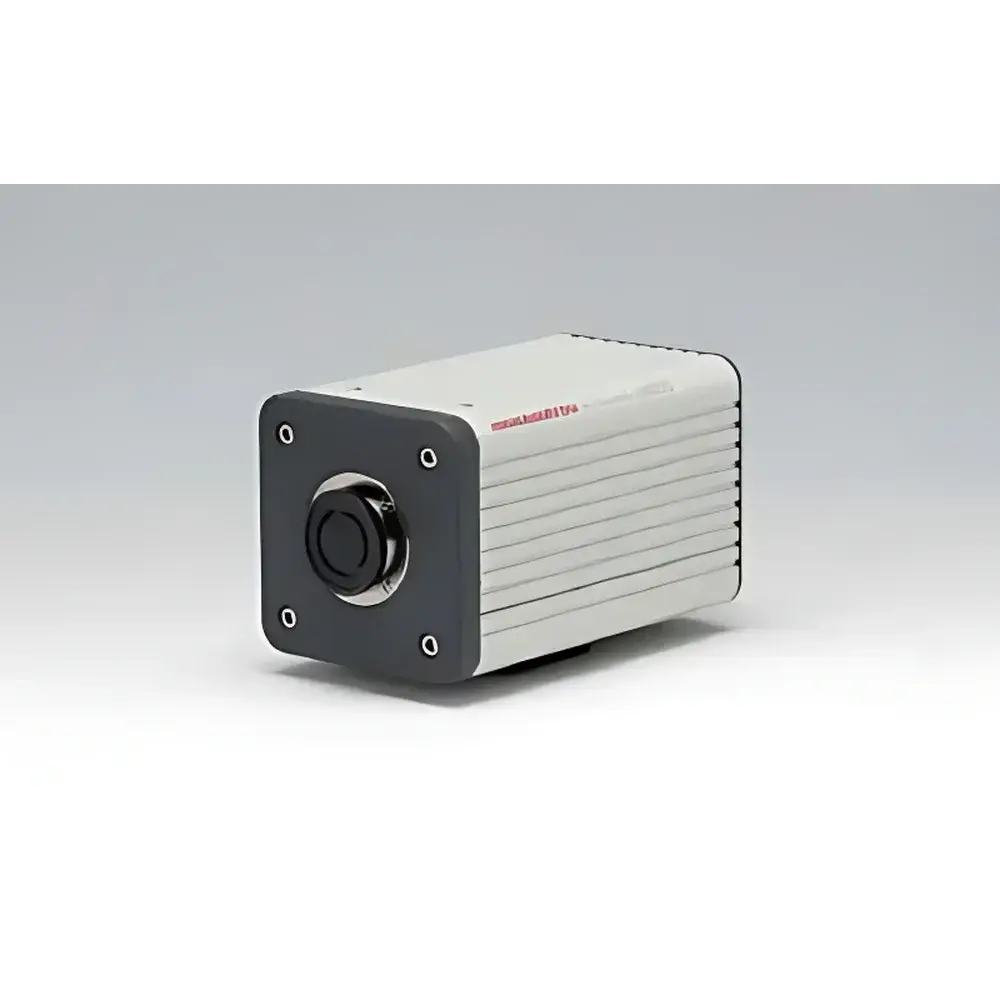
Hamamatsu C8000-30 Back-Illuminated UV-Sensitive CCD Camera
| Brand | Hamamatsu |
|---|---|
| Origin | Japan |
| Manufacturer Type | Original Equipment Manufacturer (OEM) |
| Import Status | Imported |
| Model | C8000-30 |
| Pricing | Upon Request |
Overview
The Hamamatsu C8000-30 is a scientific-grade, back-illuminated charge-coupled device (CCD) camera engineered for high quantum efficiency across the deep ultraviolet (DUV) to near-infrared (NIR) spectrum. Leveraging Hamamatsu’s proprietary back-thinning and anti-reflective coating technologies, this camera delivers exceptional photon detection capability—particularly critical in low-light UV applications where conventional front-illuminated sensors suffer from severe absorption losses in the gate structure. Its spectral response spans 100 nm to 1200 nm, enabling seamless operation from vacuum ultraviolet (VUV) spectroscopy through visible and into short-wave NIR imaging. The sensor architecture is optimized for applications demanding high signal-to-noise ratio (SNR), temporal stability, and radiometric linearity—such as synchrotron beamline diagnostics, UV fluorescence lifetime imaging, and astronomical spectroscopy requiring sub-200 nm sensitivity.
Key Features
- Back-illuminated CCD architecture with enhanced quantum efficiency: >60% at 200 nm and >90% at 650 nm—enabling quantitative UV photon counting without external intensifiers.
- Active pixel array of 640 × 512 pixels, with uniform 14 µm × 14 µm pixel pitch and total imaging area of 8.96 mm × 6.72 mm.
- Deep-depletion silicon substrate design minimizes red response roll-off and reduces etaloning effects in the NIR region.
- Thermoelectric (Peltier) cooling system capable of stabilizing sensor temperature to –20 °C below ambient, suppressing dark current to <0.001 e⁻/pixel/s at –10 °C.
- 16-bit analog-to-digital conversion with programmable gain and offset, supporting both low-noise integration and high-dynamic-range acquisition modes.
- Standard Camera Link or USB 3.0 interface options—fully compatible with industry-standard frame grabbers and third-party acquisition software (e.g., LabVIEW, MATLAB, Python-based PyHamamatsu SDK).
Sample Compatibility & Compliance
The C8000-30 is designed for integration into vacuum-compatible optical setups, including UHV environments down to 10⁻⁷ Pa when equipped with optional quartz or magnesium fluoride (MgF₂) window variants. Its spectral range supports compliance with key international measurement standards—including ASTM E275 for UV-visible spectrophotometer characterization, ISO 15739 for imaging sensor noise evaluation, and IEC 62471 for optical radiation safety assessment. For regulated laboratory environments, the camera firmware supports timestamped metadata embedding and hardware-triggered acquisition—facilitating audit-ready data provenance in GLP- and GMP-aligned workflows. While not inherently 21 CFR Part 11 compliant, its deterministic acquisition behavior and raw data export capability enable integration into validated systems with appropriate software-layer controls.
Software & Data Management
Hamamatsu provides the HCImage Live acquisition suite—a platform-independent application supporting real-time preview, multi-region-of-interest (ROI) analysis, kinetic series capture, and calibrated intensity mapping. All acquired frames include embedded EXIF-style metadata: exposure time, sensor temperature, binning mode, gain setting, and absolute UTC timestamps. Raw 16-bit TIFF and FITS formats are natively supported, ensuring compatibility with ImageJ/Fiji, DS9, and Python-based astropy.io.fits workflows. The Hamamatsu SDK (C/C++, .NET, Python bindings) enables full low-level register access for custom synchronization, shutter control, and non-uniformity correction (NUC) calibration routines—critical for OEM integration into automated spectroscopic or ellipsometric platforms.
Applications
- Vacuum ultraviolet (VUV) and extreme ultraviolet (EUV) plasma diagnostics in fusion research and lithography development.
- Time-resolved UV fluorescence and phosphorescence decay measurements in material science and photochemistry.
- High-resolution solar-blind UV imaging for corona discharge detection and semiconductor wafer inspection.
- Astronomical spectroscopy using echelle gratings and cross-dispersers, especially for faint-object observations below 250 nm.
- Quantitative Raman spectroscopy where UV excitation (e.g., 244 nm, 266 nm) suppresses fluorescence background and enhances resonance effects.
- Beam profiling and wavefront sensing on synchrotron and free-electron laser (FEL) facilities operating in the DUV regime.
FAQ
What vacuum compatibility options are available for the C8000-30?
Standard configurations include fused silica windows rated for 10⁻⁵ Pa; optional MgF₂ windows extend transmission below 115 nm and support UHV operation to 10⁻⁷ Pa.
Is cooling performance sufficient for long-exposure UV astronomy applications?
Yes—the thermoelectric cooler achieves stable sensor temperatures of –10 °C to –25 °C (depending on ambient conditions), reducing dark current by >95% compared to uncooled operation.
Can the camera be synchronized with pulsed UV lasers?
Absolutely—the C8000-30 supports hardware triggering with <100 ns jitter and configurable exposure delay, enabling precise gating for time-resolved pump-probe experiments.
Does Hamamatsu provide NIST-traceable quantum efficiency calibration data?
Yes—each unit ships with a certified QE curve measured at NIST-accredited wavelengths (121.6 nm, 193.4 nm, 253.7 nm, 365 nm, 546 nm, 700 nm, 900 nm, 1050 nm) and referenced to a calibrated photodiode standard.
How is pixel non-uniformity corrected in production?
Each sensor undergoes factory flat-field calibration using monochromatic UV sources; correction maps are embedded in firmware and applied in real time during acquisition.



