
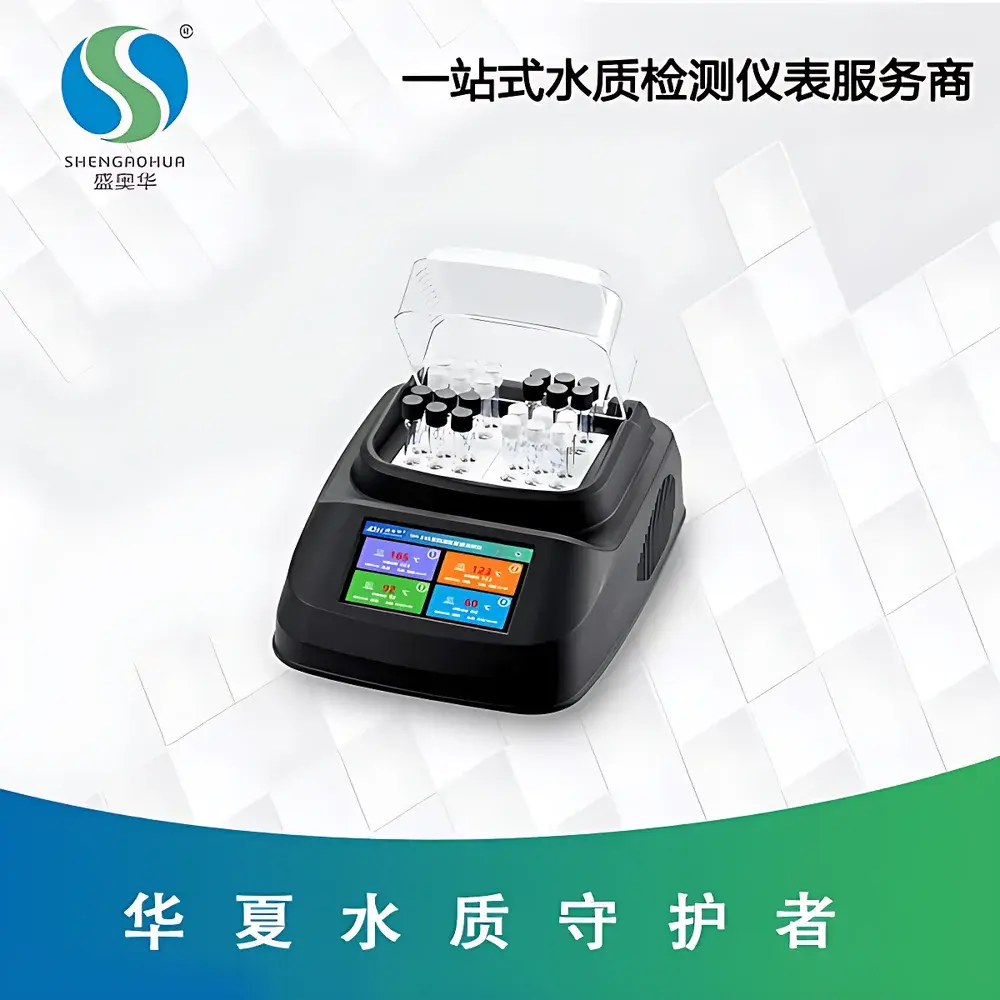
Shengaohua SH-24S Quad-Zone Intelligent COD Digestion System
| Brand | Shengaohua |
|---|---|
| Origin | Jiangsu, China |
| Manufacturer Type | Direct Manufacturer |
| Country of Origin | China |
| Model | SH-24S |
| Digestion Method | Rapid Digestion |
| Heating Module | Independent Quartz-Coated Aluminum Block (4 units) |
| Batch Capacity | 24 samples (4 × 6 configuration) |
| Temperature Range | Ambient to 168 °C |
| Temperature Accuracy | ±0.5 °C |
| Sample Vessel Capacity | 12 mL |
| Timer Resolution | 0.1 s |
| Timer Accuracy | ±0.1 s over 10 min |
| Preloaded Programs | 30 method-specific protocols (COD, Total Phosphorus, Total Nitrogen, Cu, Cr⁶⁺, etc.) |
| Power Supply | AC 220 V ±10%, 50 Hz |
| Average Power Consumption | 500 W |
| Net Weight | 5.8 kg |
Overview
The Shengaohua SH-24S Quad-Zone Intelligent COD Digestion System is a precision-engineered thermal digestion platform designed for standardized, high-throughput pretreatment of aqueous environmental samples in compliance with ISO 6060, EPA 410.4, and HJ 828–2017 methodologies. It operates on the principle of controlled thermal oxidation in sealed digestion tubes under acidic conditions—enabling quantitative conversion of organic carbon (for COD), phosphates, nitrates, and metal species into measurable forms prior to spectrophotometric or ICP analysis. Unlike single-zone digesters, the SH-24S features four thermally isolated heating zones, each independently controllable in real time, allowing concurrent execution of up to four distinct digestion protocols (e.g., COD at 165 °C/120 min, total phosphorus at 120 °C/30 min, total nitrogen at 105 °C/60 min, and hexavalent chromium at 95 °C/20 min) within a single instrument footprint. Its modular block architecture eliminates cross-zone thermal interference, ensuring reproducibility across parallel batches—a critical requirement for accredited water quality laboratories performing multi-parameter compliance testing.
Key Features
- Four independent, quartz-coated aluminum heating blocks with PID-controlled thermal regulation—each zone supports discrete temperature setpoints (ambient to 168 °C) and timer configurations.
- 7-inch capacitive color touchscreen interface with intuitive Chinese-English bilingual navigation, supporting real-time parameter monitoring and graphical progress visualization.
- Preloaded library of 30 validated digestion protocols aligned with standard methods for COD, total phosphorus (HJ 671–2013), total nitrogen (HJ 636–2012), copper (HJ 485–2009), and hexavalent chromium (HJ 609–2011).
- User-definable program editor enabling custom temperature ramps, dwell times, hold steps, and cooling profiles—saved protocols retain calibration metadata and user timestamps.
- Adaptive power modulation: heating output dynamically scales with active zone count to maintain stable thermal equilibrium and minimize energy waste during partial-load operation.
- Triple-mode alarm system—audible beep, visual LED indicator, and on-screen alert—with configurable thresholds for temperature deviation, timer completion, and open-lid detection.
- Air-guided internal convection design ensures uniform airflow around electronics and power components, reducing thermal stress on control circuitry and extending service life.
- Corrosion-resistant internal chassis with directional vapor drainage channels prevents condensate accumulation near PCBs and relay modules—critical for long-term reliability in humid lab environments.
Sample Compatibility & Compliance
The SH-24S accommodates standard 12 mL borosilicate glass digestion tubes (e.g., ASTM D1252–04 compliant) and supports both closed-tube rapid digestion and open-reflux variants per application requirements. Its temperature accuracy (±0.5 °C) and timer resolution (0.1 s) meet the instrumental performance criteria outlined in ISO/IEC 17025:2017 for sample preparation equipment used in accredited environmental testing. The system’s firmware logs all operational parameters—including start/stop times, actual vs. setpoint temperatures, and zone-specific error codes—for audit-ready traceability. While not FDA 21 CFR Part 11 certified out-of-box, its data export capability (via USB) enables integration into LIMS environments supporting GLP/GMP workflows when paired with validated documentation practices.
Software & Data Management
Operation is fully embedded—no external PC required. All programs, logs, and settings reside in non-volatile flash memory with write-protection options. Daily usage records—including operator ID (manually entered), program name, sample count, and thermal profile deviations—are timestamped and exportable as CSV files via USB-A port. Firmware updates are delivered via signed binary packages to ensure integrity; version history and update logs are accessible from the maintenance menu. No cloud connectivity or remote telemetry is implemented—data sovereignty and network isolation are preserved by design.
Applications
- Routine COD determination in municipal wastewater influent/effluent per ISO 6060 and HJ 828–2017.
- Simultaneous digestion of surface water, groundwater, and industrial effluents for multi-parameter regulatory reporting (e.g., TP, TN, heavy metals).
- Method development and validation studies requiring precise thermal profiling across variable matrix compositions.
- Teaching laboratories conducting APHA Standard Methods 5220D-based experiments with emphasis on procedural reproducibility.
- Third-party environmental testing labs maintaining CNAS accreditation where documented thermal stability and inter-zone independence are auditable requirements.
FAQ
What standards does the SH-24S support for COD analysis?
It complies with HJ 828–2017 (China), ISO 6060 (international), and EPA 410.4 (US) for dichromate-based closed-tube digestion.
Can different digestion temperatures run simultaneously across the four zones?
Yes—each of the four heating blocks operates independently with full control over temperature setpoint, ramp rate, dwell time, and cooling logic.
Is calibration traceable to national metrology institutes?
Temperature sensors are factory-calibrated against NIM-traceable reference standards; users may perform field verification using certified RTD probes per JJF 1171–2007.
Does the system support automatic shutdown after program completion?
Yes—program termination triggers audible/visual alerts and defaults to standby mode with residual heat dissipation safeguards.
What maintenance is required for long-term accuracy?
Annual verification of thermal uniformity across all blocks using a 4-point probe kit is recommended; no consumable parts require replacement under normal operation.







