
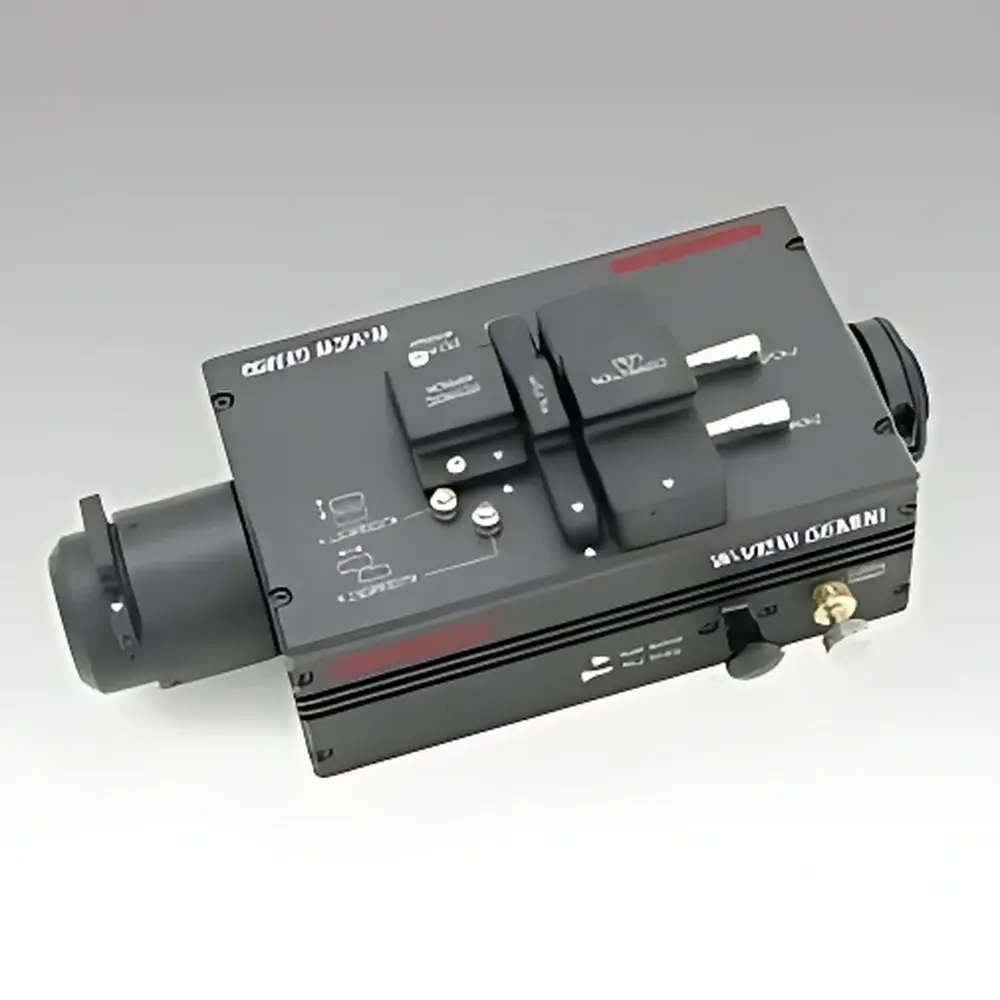
Hamamatsu W-VIEW GEMINI Dual-Channel Emission Splitter
| Brand | Hamamatsu Photonics (BHP) |
|---|---|
| Origin | Japan |
| Model | A12801-01 |
| Mounting | C-mount to C-mount (linear configuration) |
| Input Mount | C-mount (female) |
| Output Mount | C-mount (male) |
| Relay Lens Magnification | 1.0× |
| Field of View (W-VIEW mode) | 13 mm × 6.4 mm |
| Field of View (Bypass mode) | 13 mm × 13 mm |
| Transmission Wavelength Range | 400–800 nm |
| Peak Transmission (Bypass mode) | ≥97% |
| Dichroic Mirror Compatibility | 25.2 mm × 35.6 mm (±0.1 mm, max thickness 2.0 mm) |
| Bandpass Filter Compatibility | Ø25.4 mm (−0/+0.6 mm tolerance, max thickness 6.0 mm) |
| Chromatic Aberration Correction | Integrated achromatizing lens unit for magnification matching between channels |
| Operating Temperature | 0–40 °C |
| Storage Temperature | −10–50 °C |
| Relative Humidity (non-condensing) | ≤70% |
| Mode Switching | Manual dichroic insertion/removal for W-VIEW ↔ Bypass operation |
| Optical Path Geometry | Collinear, symmetric design for upright and inverted microscopes |
Overview
The Hamamatsu W-VIEW GEMINI (Model A12801-01) is a high-fidelity, dual-channel emission splitter engineered for quantitative, simultaneous two-color fluorescence imaging in life science applications. It operates on the principle of spectral beam splitting via a precisely aligned dichroic mirror, enabling spatially registered, temporally synchronized acquisition of two distinct emission bands onto a single sCMOS or EM-CCD sensor. Unlike sequential filter wheel-based approaches, the GEMINI eliminates temporal lag and mechanical vibration-induced misregistration—critical for dynamic processes such as FRET, calcium transients, membrane potential shifts, and co-localization kinetics in live specimens. Its optical architecture is optimized for minimal photon loss across the visible to near-infrared spectrum (400–800 nm), with peak transmission exceeding 97% in bypass configuration and consistent throughput across both split channels under calibrated dichroic loading. Designed for integration into research-grade inverted and upright microscopes, the GEMINI maintains strict collinearity between microscope output and camera input, preserving native magnification scaling and simplifying alignment workflows.
Key Features
- Simultaneous Dual-Channel Imaging: Projects spectrally separated images side-by-side onto one sensor—enabling pixel-registered, frame-synchronized acquisition without time interleaving or motion artifacts.
- High-Throughput Optical Design: Proprietary relay lens system delivers >97% peak transmission (bypass mode) and uniform illumination across the full field; optimized for compatibility with high-NA objectives and wide-field sCMOS sensors (e.g., ORCA-Flash4.0 V2).
- Flexible Filter Integration: Accepts standard 25.2 mm × 35.6 mm dichroic mirrors and Ø25.4 mm bandpass/ND filters—fully compatible with industry-standard imaging-grade optics from vendors including Semrock, Chroma, and Omega.
- Bypass Mode (Patent Pending): Allows rapid reconfiguration to native microscope-to-camera coupling by mechanically removing the dichroic mirror—no realignment or hardware disassembly required.
- Chromatic Aberration Compensation: Integrated correction lens unit minimizes magnification mismatch between long- and short-wavelength paths, ensuring sub-pixel spatial registration (<0.5% magnification difference) across the 400–800 nm range.
- Compact, Symmetric Mechanical Layout: Linear C-mount–to–C-mount geometry enables drop-in installation on both upright and inverted platforms; total optical path length: 112 mm; weight: 480 g.
Sample Compatibility & Compliance
The W-VIEW GEMINI supports live-cell and small-animal in vivo imaging modalities requiring precise ratiometric or kinetic quantification—including FRET biosensors (e.g., YC3.60, YC15), voltage-sensitive dyes (e.g., Di-4-ANEPPS), and genetically encoded indicators. Its 13 mm × 6.4 mm field in W-VIEW mode accommodates full-frame sCMOS sensors (2048 × 1024 pixels), enabling whole-neuron imaging in C. elegans ASER neurons or confluent HeLa monolayers at up to 33 fps with EM-CCD detection. The device complies with ISO 10110-7 (optical element surface quality), JIS B 7151 (mounting interface tolerances), and RoHS Directive 2011/65/EU. While not a regulated medical device, its optical stability and repeatability support GLP-aligned experimental protocols where traceable, audit-ready image acquisition is required.
Software & Data Management
The GEMINI itself is hardware-only and requires no embedded firmware or driver stack. Image registration and channel alignment are performed post-acquisition using open-format TIFF stacks or through Hamamatsu’s optional “W-VIEW Calibration” plugin for Micro-Manager and HCImage Live—tools that provide corner-magnified preview overlays for manual fine-tuning of lateral registration. When used with compliant acquisition software (e.g., NIS-Elements AR v5.0+, ZEN Blue 3.4+), the system supports metadata embedding per channel (wavelength, exposure, gain), facilitating MIAME-compliant dataset curation. For regulatory environments, raw dual-channel TIFFs may be archived alongside instrument configuration logs to satisfy FDA 21 CFR Part 11 requirements when paired with validated electronic lab notebook (ELN) systems.
Applications
- FRET-Based Biosensing: Quantitative ratiometric tracking of conformational changes in Cameleon YC3.60 during histamine-induced Ca2+ flux in HeLa cells, with sub-second temporal resolution and pixel-precise channel alignment.
- Membrane Potential Dynamics: Dual-band imaging of hiPSC-derived cardiomyocytes stained with Di-4-ANEPPS, resolving action potential propagation across syncytial networks without motion-induced channel drift.
- Multi-Color Co-Localization: Simultaneous GFP/DsRed or CFP/YFP acquisition in fixed and live tissue sections—eliminating z-drift errors inherent in sequential channel capture.
- Small Animal Functional Imaging: Paired with stereomicroscope-compatible adapters, enables dual-wavelength epifluorescence monitoring of reporter expression or metabolic activity in murine tumor xenografts.
FAQ
Does the W-VIEW GEMINI include dichroic mirrors or emission filters?
No. All dichroic mirrors, bandpass filters, and ND filters must be selected and purchased separately. Hamamatsu recommends imaging-grade optics (e.g., Semrock FFxx-FDi01 series) for optimal performance.
Can the GEMINI be used with non-Hamamatsu cameras?
Yes. It is fully compatible with any C-mount camera, though Hamamatsu’s calibration plugin is only available for select Hamamatsu camera models and supported acquisition platforms.
What is the maximum allowable filter thickness?
Dichroic mirrors: ≤2.0 mm; bandpass/ND filters: ≤6.0 mm total thickness (including substrate and coatings).
Is chromatic correction effective for all wavelength pairs?
The correction lens unit specifically addresses longitudinal chromatic aberration-induced magnification differences between channels—not lateral shift from distortion or field curvature. Optimal correction is achieved within the 400–800 nm operational window.
Can the GEMINI be used for confocal or light-sheet microscopy?
It is designed for widefield epifluorescence and transmitted-light applications. Integration into point-scanning confocal systems is not supported due to pupil plane constraints and lack of telecentric design.
Related Products




