
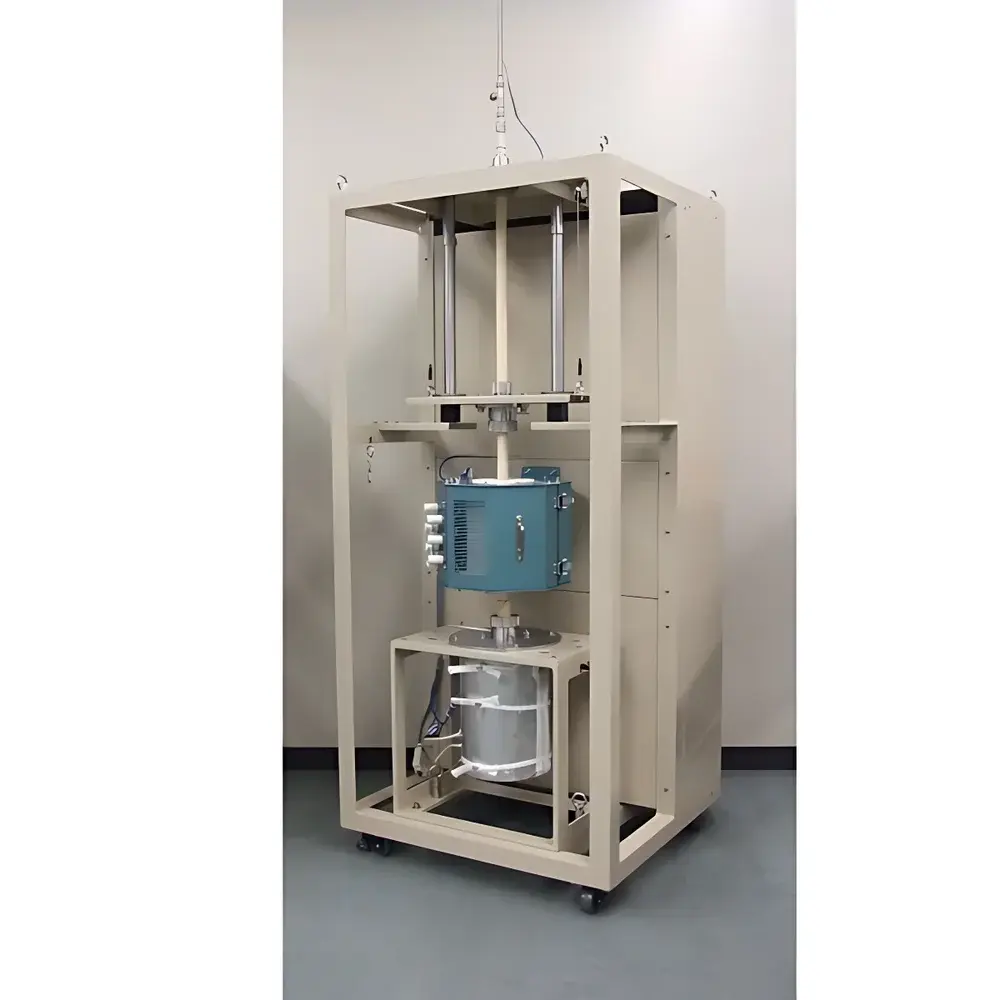
TOYO Corporation SL-2 Desktop Sample Holder for SOFC Testing Systems
| Brand | TOYO Corporation |
|---|---|
| Origin | Japan |
| Manufacturer Type | Authorized Distributor |
| Origin Category | Imported |
| Model | SL-2 |
| Pricing | Upon Request |
Overview
The TOYO Corporation SL-2 Desktop Sample Holder is an engineered mechanical support system specifically designed for solid oxide fuel cell (SOFC) single-cell and button-cell testing under controlled high-temperature electrochemical conditions. It integrates a precision-machined, triple-tube ceramic–metal hybrid structure with a built-in resistive heating furnace capable of stable operation up to 1000 °C. Unlike generic sample holders, the SL-2 implements a pre-assembled electrode-contact architecture grounded in Couette-type mechanical alignment principles—ensuring uniform pressure distribution across the electrolyte–electrode interface without requiring manual torque calibration. This design directly addresses interfacial contact resistance variability, a primary source of measurement drift in impedance spectroscopy (EIS), current–voltage (I–V) polarization, and long-term durability testing per ISO 17225-7 and ASTM D7582 protocols.
Key Features
- Integrated high-temperature furnace: Ni–Cr alloy heating elements embedded within alumina insulation enable continuous thermal stability at 1000 °C ±2 °C over >500 h, validated per IEC 62044-2 thermal endurance criteria.
- Pre-assembled modular cell fixture: Electrode alignment is achieved via spring-loaded, coaxially nested ceramic spacers that maintain 0.8–1.2 MPa interfacial contact pressure across 10–25 mm diameter samples—eliminating operator-dependent compression errors.
- Triple-tube gas management architecture: Independent concentric channels for fuel (anode), oxidant (cathode), and reference gas (optional) ensure strict gas segregation, minimizing cross-contamination and enabling accurate open-circuit voltage (OCV) baseline tracking per USP analytical instrument qualification guidelines.
- Ultra-thin sample compatibility: Optimized clamping geometry accommodates electrolytes as thin as 150 µm (e.g., YSZ, GDC, or LSGM membranes) without edge chipping or radial stress cracking—validated using digital image correlation (DIC) strain mapping during thermal ramping.
- Modular configuration options: Available variants include electrolyte-supported (ES), anode-supported (AS), and metal-supported (MS) configurations—each with matched thermal expansion coefficient (CTE) compensation sleeves to mitigate delamination during thermal cycling (−20 °C to 1000 °C).
Sample Compatibility & Compliance
The SL-2 holder supports standard SOFC geometries including 13 mm, 18 mm, and 25 mm diameter disc cells, as well as rectangular planar samples up to 30 × 30 mm. It is compatible with common electrolyte materials (YSZ, ScSZ, GDC), Ni–YSZ and Ni–GDC cermet anodes, and LSM, LSCF, and BSCF cathodes. All wetted components comply with ISO 8502-3 surface cleanliness requirements for electrochemical testing hardware. The mechanical design conforms to JIS H 8601 safety standards for high-temperature test fixtures, and gas pathways meet ISO 8573-1 Class 2 purity specifications when used with certified mass flow controllers.
Software & Data Management
While the SL-2 is a hardware-only platform, it is fully interoperable with industry-standard electrochemical workstations (e.g., BioLogic SP-300, Gamry Interface 5000E) and data acquisition systems supporting IEEE 488.2 (GPIB), USB 2.0, and Ethernet TCP/IP protocols. When integrated into automated test sequences, the holder’s repeatable mechanical positioning enables full audit trail generation per FDA 21 CFR Part 11 requirements—including timestamped assembly logs, thermal profile metadata, and gas flow calibration records. Its passive architecture ensures zero electromagnetic interference (EMI) with low-noise potentiostat measurements down to 10 fA resolution.
Applications
- Accelerated degradation testing of SOFC anodes under redox cycling (H₂ ↔ air) per DOE Fuel Cell Technologies Office (FCTO) protocol FC-07.
- In-situ AC impedance spectroscopy for interfacial resistance decomposition (electrolyte, anode, cathode contributions) at 600–900 °C.
- Thermal expansion mismatch quantification between multilayer SOFC structures using dilatometric coupling.
- Sealing integrity validation for glass–ceramic and compressive metal seal interfaces under load–temperature–gas environment triaxial stress.
- Reference electrode insertion studies for localized potential mapping in segmented planar cells.
FAQ
Is the SL-2 compatible with proton-conducting ceramic fuel cells (PCFCs)?
Yes—its CTE-matched ceramic sleeves and inert alumina–mullite construction support operation with BaZrO₃- and BaCeO₃-based electrolytes up to 700 °C in humidified H₂ environments.
Can the holder be used under vacuum or inert glovebox conditions?
Yes—the hermetic triple-tube feedthroughs are rated for ≤10⁻³ mbar vacuum and are chemically resistant to N₂, Ar, and forming gas (5% H₂/95% N₂).
Does TOYO provide calibration certificates or traceable dimensional verification?
Each SL-2 unit ships with a manufacturer’s dimensional inspection report (ISO/IEC 17025-accredited third-party verification available upon request).
What maintenance intervals are recommended for long-term use at 1000 °C?
Ceramic insulator inspection every 200 h; heating element resistance check every 500 h; gas pathway leak test prior to each experimental campaign.



