
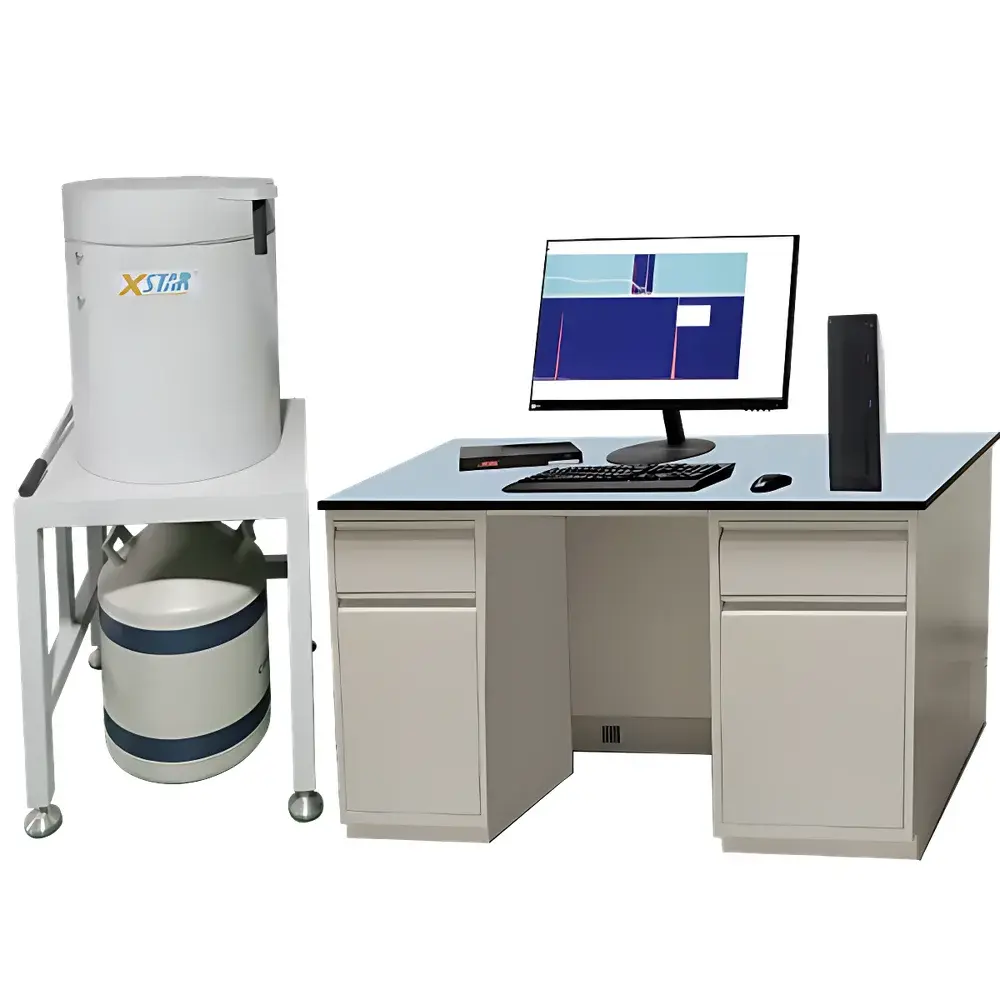
NewSenda CIT-3800 HPGe Gamma Spectrometer
| Brand | NewSenda |
|---|---|
| Origin | Sichuan, China |
| Model | CIT-3800 HPGe |
| Instrument Type | Laboratory Gamma-Ray Spectrometer |
| Detector Type | High-Purity Germanium (HPGe) |
| Measurement Range | 5 keV – 10 MeV |
| Energy Resolution | ≤1.8 keV FWHM at 1.332 MeV (⁶⁰Co) |
| Peak Area Precision | <3% RSD (0–50,000 cps) |
| Sample Form | Solid |
| Cooling Method | Liquid Nitrogen or Electromechanical Cryocooler |
| Shielding | Low-Background Lead Castle (≥10 cm Pb + Cu/Cd liners) |
| Digitization | Digital Pulse Processing (DPP) with 14-bit ADC, 100 MS/s sampling |
Overview
The NewSenda CIT-3800 HPGe Gamma Spectrometer is a laboratory-grade gamma-ray spectrometry system engineered for high-resolution nuclear spectroscopy and quantitative radionuclide analysis. It operates on the principle of semiconductor-based gamma-ray detection using a cryogenically cooled high-purity germanium (HPGe) detector, where incident photons generate electron-hole pairs proportional to their energy. This enables precise determination of gamma-ray energy spectra with sub-keV resolution—critical for distinguishing closely spaced photopeaks (e.g., ²¹⁰Pb at 46.5 keV and ²³⁴Th at 63.3 keV) in complex environmental matrices. The system integrates a low-background shielded enclosure, digital pulse processing electronics, and calibrated spectral acquisition software, delivering trace-level sensitivity and metrologically traceable activity quantification per ISO/IEC 17025 and ASTM D3648-22 guidelines.
Key Features
- High-resolution HPGe detector with energy resolution ≤1.8 keV FWHM at 1.332 MeV (⁶⁰Co), enabling unambiguous nuclide identification in multi-isotope samples.
- Dual cooling options: standard liquid nitrogen Dewar (4–5 day hold time) or optional closed-cycle electromechanical cryocooler for continuous unattended operation.
- Low-background shielding architecture comprising ≥10 cm lead, 1–2 mm copper, and 0.5 mm cadmium layers—reducing intrinsic background counts by >95% compared to unshielded configurations.
- Digitally stabilized signal chain featuring 14-bit analog-to-digital conversion and 100 MS/s real-time pulse processing, minimizing dead time and pile-up distortion up to 50,000 cps.
- Modular design supporting field-deployable variants (e.g., CIT-3800C mobile configuration) with shock-mounted detector assembly, ruggedized power management, and GPS-synchronized timestamping for emergency response applications.
Sample Compatibility & Compliance
The CIT-3800 accepts solid samples in standardized geometries (e.g., 50–500 mL Marinelli beakers, planchets, soil cores) with minimal preparation—no chemical separation required for gross activity screening. It complies with IEC 61452:2020 (performance testing of gamma spectrometers), ANSI N42.14-2022 (calibration of HPGe systems), and supports audit-ready documentation per GLP and ISO/IEC 17025 requirements. All spectral calibrations are traceable to NIST SRM 4350B and IAEA RGU-1 reference materials. The system meets radiation safety standards per IAEA Safety Standards Series No. GSR Part 3 and national regulatory frameworks governing environmental radioactivity monitoring (e.g., EPA Method 901.1, EU Council Directive 2013/59/Euratom).
Software & Data Management
Acquisition and analysis are performed via NewSenda GammaVision-compatible software suite, supporting full-spectrum deconvolution, peak search with automated ROI assignment, efficiency calibration using point/geometry-specific Monte Carlo models, and uncertainty propagation per ISO/IEC Guide 98-3 (GUM). Raw data are stored in industry-standard CNF/PA format with embedded metadata (detector ID, calibration date, operator ID, sample ID, acquisition time). Audit trails, user access controls, electronic signatures, and 21 CFR Part 11-compliant electronic records are enabled through optional secure mode licensing—ensuring data integrity for regulatory submissions and inter-laboratory comparison studies.
Applications
- Environmental radioactivity monitoring: quantification of ¹³⁷Cs, ⁴⁰K, ²²⁶Ra, ²¹⁰Pb, and transuranics in soil, sediment, air filters, and biota.
- Nuclear facility effluent and waste characterization per IAEA Technical Reports Series No. 438 and US NRC Regulatory Guide 4.15.
- Geological survey and uranium exploration via natural decay series equilibrium analysis.
- Food and agricultural product screening for post-accident contamination (e.g., Fukushima-derived isotopes).
- Forensic nuclear analysis and safeguards verification including isotopic ratio measurements (e.g., ²³⁵U/²³⁸U) in swipe samples.
FAQ
What is the typical energy resolution specification for the CIT-3800 HPGe detector?
The detector achieves ≤1.8 keV full-width at half-maximum (FWHM) at the 1.332 MeV gamma line of ⁶⁰Co under standard operating conditions.
Can the system operate without liquid nitrogen?
Yes—optional electromechanical cryocoolers provide continuous cooling with no consumables, though initial cooldown requires ~4 hours.
Is the software compliant with FDA 21 CFR Part 11 for regulated laboratories?
When configured with Secure Mode license, the software provides role-based access control, electronic signatures, and immutable audit logs meeting Part 11 requirements.
What sample geometries are supported for quantitative analysis?
Standard geometries include 100–500 mL Marinelli beakers, 50–100 mm diameter planchets, and cylindrical soil cores (up to 15 cm height × 7 cm diameter); custom efficiency calibrations available upon request.
Does the system support automated nuclide identification against international libraries?
Yes—the software includes built-in nuclide libraries aligned with IAEA NuDat 3.0 and ENSDF databases, with configurable matching thresholds and interference correction algorithms.







