
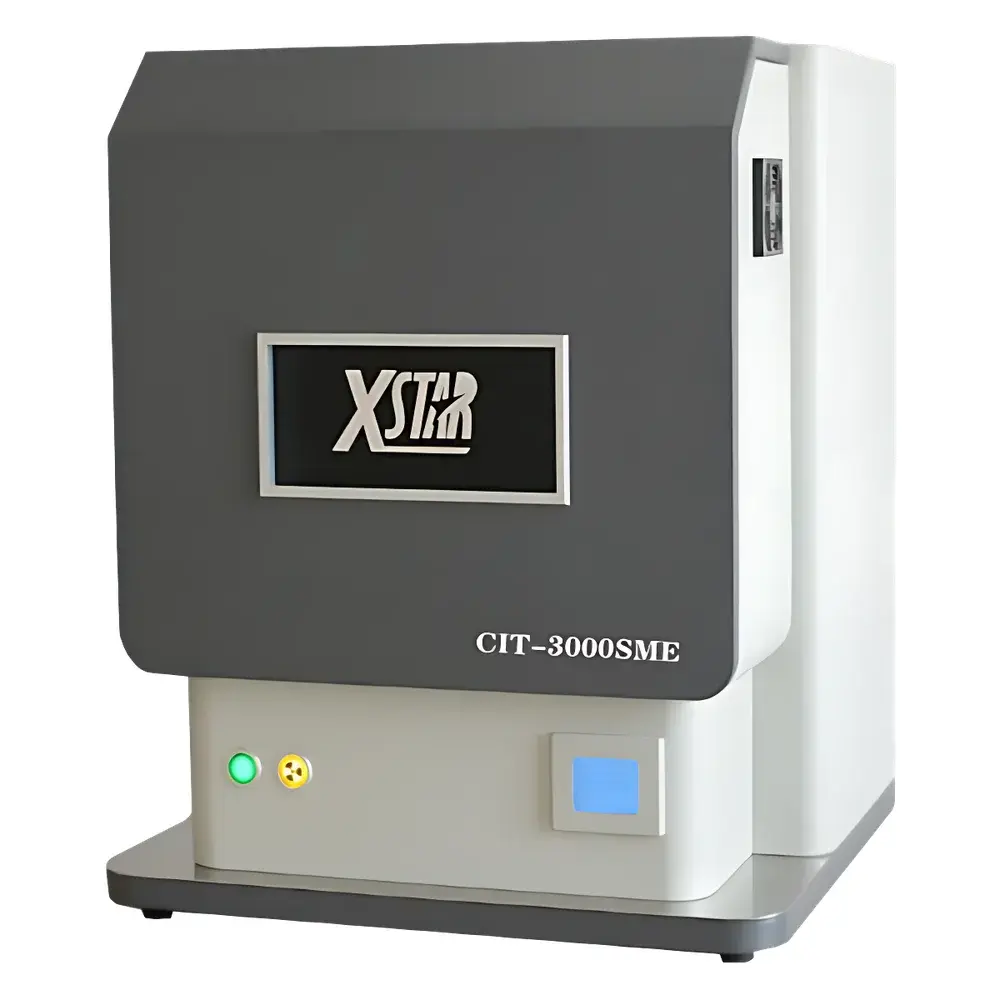
Xinxianda CIT-3000SME Energy Dispersive X-Ray Fluorescence Spectrometer
| Brand | Xinxianda |
|---|---|
| Origin | Sichuan, China |
| Model | CIT-3000SME |
| Element Range | Na (11) – U (92) |
| Detection Limit | 1 ppm |
| Quantification Range | 1 ppm – 99.99% |
| Energy Resolution | 100 eV (at Mn Kα) |
| Repeatability | ≤0.1% RSD |
| Detector | Silicon Drift Detector (SDD), Peltier-cooled |
| Excitation Source | Ag-anode microfocus X-ray tube, Be window (50 µm), 0–50 kV / 1–1000 µA adjustable |
| Measurement Atmosphere | Air or vacuum (down to 10⁻² Pa) |
| Sample Form | Powdered solids |
| Multi-channel Analyzer | 2048-channel digital MCA |
| Simultaneous Elements | ≥30 |
| Analysis Time | 60–180 s per sample |
| Dimensions | 650 × 600 × 730 mm |
| Weight | 65 kg |
Overview
The Xinxianda CIT-3000SME Energy Dispersive X-Ray Fluorescence (ED-XRF) Spectrometer is a benchtop-to-floor-standing analytical instrument engineered for precise, non-destructive elemental quantification in powdered solid matrices. It operates on the fundamental principle of energy-dispersive X-ray fluorescence: incident X-rays from a silver-target microfocus tube eject inner-shell electrons from sample atoms; upon electron relaxation, characteristic secondary X-rays are emitted and resolved by a high-resolution silicon drift detector (SDD). The resulting spectrum—digitally acquired via a 2048-channel multichannel analyzer—is processed using physics-based algorithms including fundamental parameter (FP) modeling, empirical coefficient calibration, and theoretical alpha correction. Designed specifically for industrial quality control and geological materials analysis, the CIT-3000SME delivers trace-level sensitivity (1 ppm detection limit) across the full periodic range from sodium (Na, Z=11) to uranium (U, Z=92), with enhanced light-element performance enabled by its ultra-high vacuum chamber (<10⁻² Pa).
Key Features
- High-performance SDD detector with 100 eV energy resolution at Mn Kα (5.9 keV), enabling clear separation of overlapping peaks (e.g., Si Kα/P S Kα, Ca Kα/Ti Kα)
- Ag-anode X-ray tube with adjustable voltage (0–50 kV) and current (1–1000 µA), optimized for both light-element excitation (Na–Cl) and heavy-element sensitivity (Pb, U)
- Dual-atmosphere measurement capability: ambient air for routine heavy-element analysis; automated high-vacuum mode (<10⁻² Pa) for improved signal-to-background ratio of Na, Mg, Al, Si, P, and S
- Digital pulse processing architecture with zero dead-time correction, ensuring high count-rate fidelity (>100,000 cps) without spectral distortion or pulse pile-up
- Integrated sample handling system featuring motorized stage rotation, automatic Z-axis elevation, and programmable vacuum/purge cycles
- Triple-layer radiation safety architecture: hardware interlocks, software-controlled beam gating, and labyrinth-style shielding compliant with IEC 61010-1 and GBZ 117–2020 standards
- Thermally stabilized optical path and active temperature compensation circuitry ensure long-term spectral stability (drift <0.05 channel/hour)
Sample Compatibility & Compliance
The CIT-3000SME is validated for pressed powder pellets, fused beads, and loose powders with particle size ≤75 µm. Its vacuum-compatible sample chamber accommodates standard 32-mm or 40-mm diameter cups. Method validation follows ISO 21043:2021 (XRF — General requirements for calibration and verification) and ASTM E1621–22 (Standard Guide for XRF Elemental Analysis). Instrument compliance includes CE marking (EMC & LVD directives), RoHS Directive 2011/65/EU, and exemption under China’s Environmental Protection Administration Notification No. 10 (2018) for analytical X-ray equipment. Data integrity meets ALCOA+ principles, with audit trail functionality supporting GLP and ISO/IEC 17025:2017 laboratory accreditation requirements.
Software & Data Management
The proprietary ED-XRF analysis suite runs natively on Windows OS and supports both Chinese and English language interfaces. Core modules include: (1) Real-time spectral visualization with auto-peak identification and interference deconvolution using Fast Fourier Transform (FFT) filtering; (2) Multi-method quantification engine integrating FP, empirical coefficient, and theoretical α-factor models; (3) Open API architecture enabling integration with LIMS (e.g., LabWare, STARLIMS) via ODBC and XML export; (4) Role-based user management with password-protected method editing, result modification, and report generation; (5) Fully customizable reporting templates exportable to PDF, Excel (.xlsx), CSV, and CDF formats. All raw spectra (.spe), processed results (.xls), and audit logs are timestamped, digitally signed, and stored in a relational SQLite database compliant with FDA 21 CFR Part 11 electronic record requirements.
Applications
The CIT-3000SME serves as a primary elemental analyzer in metallurgical QC labs (iron ore, sinter, slag, titanium concentrate), non-ferrous smelting (copper, lead, zinc, molybdenum concentrates), refractory material certification (alumina, magnesia, silica bricks), and regulatory testing for restricted substances (Br, Cl, Cr, Pb, Cd, Hg per IEC 62321-5). It is routinely deployed in national metrology institutes for reference material characterization, in geological survey laboratories for whole-rock geochemistry (XRF-based major/minor/trace element profiling), and in PCB and coating manufacturing for halogen screening (Cl, Br) and alloy composition verification. Its robust mechanical design—featuring military-grade power supplies, minimal moving parts, and 3D thermal management—ensures stable operation in continuous-shift industrial environments.
FAQ
What sample preparation methods are supported?
Powder pressing (with binder), borate fusion (for silicates), and direct loose-powder analysis with vibration compaction.
Does the system support quantitative analysis without matrix-matched standards?
Yes—via Fundamental Parameters (FP) mode with optional empirical correction using certified reference materials (CRMs) such as NIST SRM 278, GBW 07103, or USGS standards.
Is vacuum operation required for light-element analysis?
Vacuum is mandatory for reliable quantification of Na, Mg, Al, Si, P, and S due to strong X-ray absorption by atmospheric nitrogen and oxygen.
How is instrument stability maintained over extended use?
Through automatic peak position tracking (auto-stabilization), real-time background subtraction, and periodic S-source (Mn Kα) reference measurements integrated into every analytical sequence.
Can the software be validated for regulated environments (e.g., pharmaceutical QA)?
Yes—the software architecture supports IQ/OQ/PQ documentation packages, electronic signature workflows, and full 21 CFR Part 11 compliance when configured with network authentication and encrypted database storage.
Related Products





