
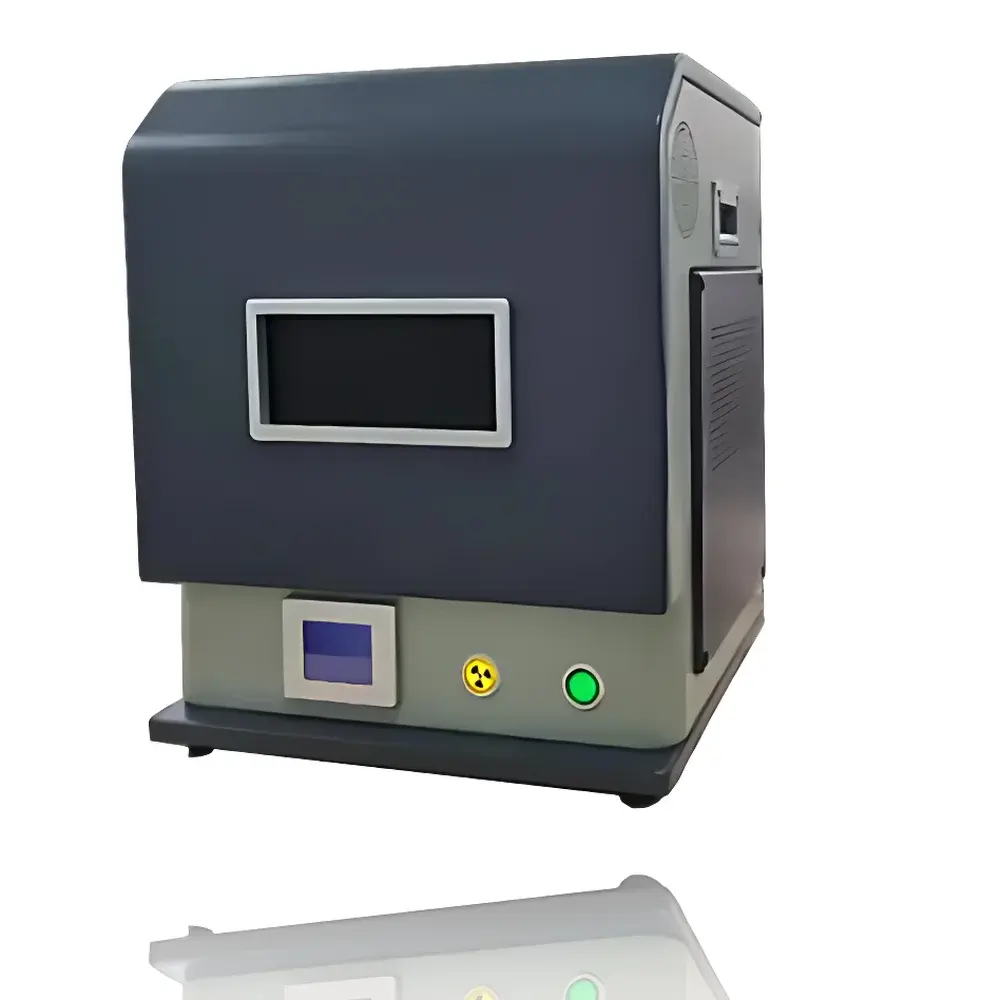
Sichuan Xinxianda CIT-3000SM Energy Dispersive X-Ray Fluorescence Spectrometer
| Brand | Sichuan Xinxianda |
|---|---|
| Origin | Sichuan, China |
| Model | CIT-3000SM |
| Form Factor | Benchtop/Floor-Standing |
| Instrument Type | Conventional ED-XRF |
| Application Scope | Universal (Industrial & Laboratory) |
| Elemental Range | Na (Z=11) to U (Z=92) |
| Quantification Range | 1 ppm – 99.99% (matrix-dependent) |
| Energy Resolution | < 110 eV (with SDD or FAST-SDD detector) |
| Repeatability (RSD) | < 0.1% |
| Detector | Silicon Drift Detector (SDD) or FAST-SDD |
| High Voltage Supply | 0–50 kV (adjustable), 0–1 mA (adjustable) |
| Measurement Time | 100–300 s |
| Sample Mass | 3–8 g |
| Vacuum Level | ≤ 10⁻² Pa (stable for ≥30 min) |
| Dimensions | 480 × 420 × 660 mm (D×W×H) |
| Weight | 70 kg |
Overview
The Sichuan Xinxianda CIT-3000SM Energy Dispersive X-Ray Fluorescence (ED-XRF) Spectrometer is a benchtop/floor-standing analytical instrument engineered for precise, non-destructive elemental quantification in solid, powdered, and liquid samples. It operates on the fundamental principle of X-ray fluorescence: primary X-rays from a high-stability end-window X-ray tube excite inner-shell electrons in sample atoms; upon relaxation, characteristic secondary (fluorescent) X-rays are emitted, with energies uniquely corresponding to atomic number (Z). These photons are collected by a Peltier-cooled silicon drift detector (SDD or FAST-SDD), digitized via a 2048-channel multichannel analyzer, and processed using peak deconvolution algorithms to resolve overlapping spectral lines. The system supports both air and vacuum measurement environments—vacuum operation significantly enhances sensitivity and detection limits for light elements (Na–F), extending effective analysis down to sodium (Z=11) without cryogenic cooling. Designed for long-term stability in industrial settings, the CIT-3000SM incorporates automatic spectrum stabilization to compensate for thermal drift and electronic gain shifts, ensuring consistent calibration over extended operational cycles.
Key Features
- Digital pulse processing architecture enabling high count-rate capability (>500,000 cps) with negligible dead-time losses and no spectral pile-up artifacts
- Adjustable high-voltage power supply (0–50 kV, 0–1 mA) with digital feedback control for optimized excitation across light-to-heavy element ranges
- Peltier-cooled SDD or FAST-SDD detector offering energy resolution <110 eV at Mn Kα (5.9 keV), eliminating dependency on liquid nitrogen
- Upward-illumination optical geometry minimizing dust accumulation in the sample chamber and protecting the detector window from particulate contamination
- Motorized vertical sample stage with repeatable positioning (±5 µm) and optional sample rotation to mitigate heterogeneity and surface texture effects
- Real-time 2048-channel spectral acquisition with automated peak identification, background subtraction, and interference correction
- Auto-stabilization routine maintaining spectral centroid alignment within ±0.5 eV over 8-hour continuous operation
Sample Compatibility & Compliance
The CIT-3000SM accepts heterogeneous solids, pressed pellets (without binder), fused beads, and homogeneous liquids—requiring no chemical digestion or derivatization. Sample preparation follows ISO 29258:2012 (XRF — Preparation of solid samples) and ASTM E1621–22 (Standard Guide for XRF Analysis of Ceramic Whiteware Materials). Vacuum compatibility enables compliant analysis of low-Z elements per ISO 21043-1:2021 (XRF — Light element measurement protocols). Radiation safety conforms to GBZ 115–2002 (Chinese national standard for XRF instrumentation shielding and leakage limits) and is registered with China’s Ministry of Ecology and Environment. While not pre-certified for FDA 21 CFR Part 11, the firmware supports audit-trail logging and user-access controls compatible with GLP/GMP-aligned data integrity frameworks when deployed with validated software configurations.
Software & Data Management
The instrument runs on a Windows-based application platform supporting full spectral visualization, quantitative analysis via fundamental parameters (FP) and empirical calibration methods, and customizable method templates. The software architecture allows creation of multi-matrix calibration libraries—including geological, metallurgical, ceramic, and battery-material profiles—with built-in uncertainty propagation per ISO/IEC 17025:2017 Annex A.3. Data export formats include CSV, XML, and PDF reports compliant with LIMS integration requirements. Raw spectra (.spe), processed results (.xls), and configuration logs (.cfg) are timestamped and stored with SHA-256 checksums. Optional modules enable pattern recognition for material classification, outlier detection based on Mahalanobis distance, and trend monitoring across batch sequences.
Applications
- Geological & mining: Quantitative analysis of major, minor, and trace elements (e.g., Si, Al, Fe, Ca, Mg, K, Na, Ti, Mn, Ba, Sr, P, S) in clays (kaolinite, bentonite), carbonates (limestone, dolomite), silicates (quartz, feldspar), and industrial minerals (gypsum, barite, talc)
- Refractory materials: Multi-element profiling of Al₂O₃–SiO₂, MgO–CaO, ZrO₂–Al₂O₃, and Cr₂O₃–MgO systems for compositional compliance and phase stability assessment
- Fuels & residues: Ash composition analysis of coal, coke, and coal gangue to predict slagging/fouling behavior and optimize combustion efficiency
- Battery materials: Verification of LiFePO₄ and NMC (LiNiₓMnᵧCo_zO₂) stoichiometry, detection of transition-metal impurities (e.g., Fe, Cu, Ni) at sub-ppm levels
- Metallurgy: Grade verification of iron ores, base metal concentrates (Pb–Zn–Cu), and rare-metal ores (W, Mo, Sn, Nb, Ta) per ISO 12742 and GB/T 6730 series standards
FAQ
Does the CIT-3000SM require liquid nitrogen cooling?
No. It employs a thermoelectrically cooled SDD or FAST-SDD detector, enabling continuous operation without cryogen handling or dewar maintenance.
Can it analyze light elements such as sodium or magnesium in ambient air?
Sodium (Na) and magnesium (Mg) can be measured in air mode, but detection limits improve significantly under vacuum (≤10⁻² Pa), particularly for Na, Mg, Al, and Si.
What sample preparation methods are supported?
Powder pressing (with or without binder), fusion bead preparation (for silicate matrices), and direct liquid analysis in sealed cells—all compliant with ISO 29258 and ASTM E1621.
Is the software compliant with regulatory data integrity requirements?
The base software provides user authentication, activity logging, and result immutability; full 21 CFR Part 11 compliance requires deployment within a validated IT environment with documented SOPs and change control.
What is the typical measurement precision for repeated analysis of a homogeneous pellet?
Under standardized conditions (n=11, same pellet, identical geometry), RSD is ≤0.08% for major elements (e.g., Fe, Al, Si) and ≤0.1% for trace elements ≥100 ppm, per GB/T 20127.2–2006.
Related Products





