
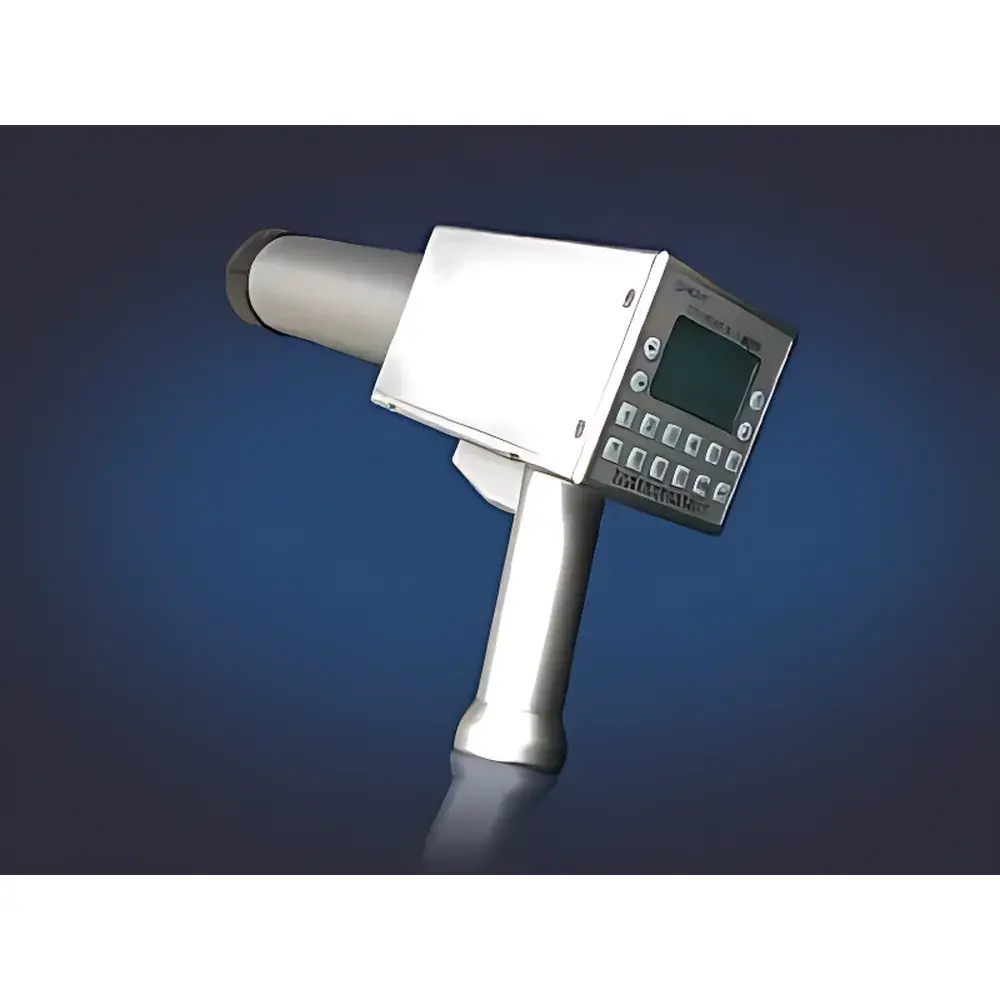
Xinxianda CIT-2000F Portable Gamma Spectrometer and Dose Rate Meter
| Brand | Xinxianda |
|---|---|
| Model | CIT-2000F |
| Instrument Type | Gamma Spectrometer |
| Detector | 50 mm × 50 mm NaI(Tl) Scintillation Crystal |
| Energy Range | < 4 MeV |
| Energy Resolution | < 8% @ 662 keV (¹³⁷Cs) |
| Dose Rate Range | 0–9999 µSv/h (Environmental Monitoring) / 0–9999 γ (Uranium Exploration) |
| Sensitivity | ≥350 cps per µSv/h |
| Stability | ≤±7% over 8 h operation |
| Accuracy | Absorbed Dose Rate Deviation ≤±10% vs. Theoretical Value |
| Operating Temperature | –10°C to +50°C |
| Relative Humidity | ≤95% RH |
| Dimensions | 360 mm × 90 mm × 220 mm |
| Weight | 2.0 kg |
| Power Consumption | <160 mW |
| ADC | 16-bit, 1 MSPS |
| Data Storage | Up to 2 million spectral records |
| Measurement Modes | Timed & Manual |
| Display Units | µSv/h, γ, µSv, CPS, ppm, % |
| Housing | Anodized Aluminum Alloy |
| Battery | Rechargeable Li-ion with Low-Voltage Warning |
Overview
The Xinxianda CIT-2000F is a field-deployable, battery-powered gamma spectrometer and dose rate meter engineered for simultaneous real-time radiation monitoring and radionuclide identification. It operates on the principle of scintillation spectroscopy, utilizing a 50 mm × 50 mm thallium-doped sodium iodide [NaI(Tl)] detector coupled with high-fidelity pulse processing electronics. The instrument delivers calibrated absorbed dose rate measurements in µSv/h across an energy range up to 4 MeV, while concurrently acquiring full gamma-ray spectra for isotopic analysis. Its design complies with national standards for energy response linearity and angular dependence—critical for environmental and regulatory applications where trace-level quantification of naturally occurring radioactive materials (NORM) such as 238U, 232Th, and 40K is required. The CIT-2000F is not a survey-only device; it integrates multichannel analyzer (MCA) functionality into a handheld platform, enabling on-site spectral deconvolution without reliance on external PCs.
Key Features
- Integrated dual-mode operation: continuous dose rate monitoring + timed gamma spectroscopy acquisition
- High-speed 16-bit analog-to-digital conversion at 1 MSPS, eliminating pulse pile-up and ensuring zero-count-loss MCA performance
- Onboard spectral analysis engine supporting peak search, region-of-interest (ROI) integration, and nuclide library matching against IAEA-referenced gamma-line databases
- Direct quantitative reporting in ppm (for U/Th/K in geological samples) and % (for relative activity concentration)
- Internal real-time clock with timestamping for all spectral records; supports chronological data reconstruction during post-processing
- Configurable measurement duration—from 1 second to 24 hours—with automatic post-acquisition dose calculation and spectral normalization
- Low-power architecture (<160 mW typical draw) and rechargeable lithium-ion battery with state-of-charge indication and under-voltage warning
- Rugged anodized aluminum housing rated for field use: IP54 ingress protection, shock-absorbing elastomer bumpers, and ergonomic grip design
Sample Compatibility & Compliance
The CIT-2000F is optimized for direct measurement of environmental media—including soil, sediment, rock cores, building materials, and air filter samples—without sample preparation when used in gross gamma mode. For quantitative NORM analysis, standardized geometries (e.g., Marinelli beakers or cylindrical containers) are recommended to maintain counting efficiency consistency. The instrument’s energy response has been validated per GB/T 10257–2021 (Chinese National Standard for Radiation Protection Instrumentation) and aligns with ISO 4037-3:2019 reference radiation fields for calibration traceability. While not certified to IEC 62327 or ANSI N42.34, its detector response characteristics meet the technical requirements for field screening in accordance with IAEA Safety Standards Series No. RS-G-1.8 (Application of the System of Radiological Protection to the Management of Naturally Occurring Radioactive Material).
Software & Data Management
Data export is supported via USB-C interface to Windows-based desktop software (included), which provides spectral visualization, nuclide identification confidence scoring, efficiency calibration curve management, and customizable report generation (PDF/CSV). All spectral files adhere to the IAEA-compatible .CNF format, ensuring interoperability with third-party analysis tools such as Genie 2000, GammaVision, or custom Python-based libraries (e.g., PyMCA). Audit trails include operator ID, GPS coordinates (when connected via Bluetooth GNSS module), measurement start/stop time, ambient temperature, and detector high-voltage settings. The firmware supports GLP-compliant metadata tagging and allows user-defined project folders with hierarchical storage indexing—essential for laboratories subject to CNAS-CL01 or ISO/IEC 17025 documentation requirements.
Applications
- Environmental radiation baseline surveys and long-term monitoring networks
- Geological uranium/thorium prospecting and grade estimation in exploration campaigns
- Regulatory compliance checks at nuclear facilities, scrap metal yards, and border control points
- Routine contamination screening in hospitals, radiopharmaceutical production units, and veterinary clinics
- Radioecological studies involving natural radionuclide distribution in soils, sediments, and groundwater systems
- Emergency response deployment for rapid source identification following radiological incidents
- Quality assurance in construction material certification (e.g., granite, fly ash, phosphogypsum)
FAQ
Does the CIT-2000F require annual factory recalibration?
Yes. To maintain traceability to national primary standards, biennial energy calibration and annual dose rate verification using 137Cs and 60Co reference sources are recommended per manufacturer guidelines and aligned with ISO/IEC 17025 clause 6.5.2.
Can the instrument distinguish between 226Ra and 214Bi in secular equilibrium?
It resolves the 609.3 keV (214Bi) and 1764.5 keV (214Bi) peaks but cannot directly separate 226Ra from its progeny without decay correction algorithms; quantitative Ra assessment assumes equilibrium unless disequilibrium modeling is applied externally.
Is GPS logging built-in or optional?
GPS is not integrated; however, the USB-C port supports connection to external Bluetooth GNSS receivers (e.g., Garmin GLO 2 or u-blox C94-M8P), and position data is embedded in exported spectral headers.
What spectral processing methods are implemented onboard?
Real-time processing includes trapezoidal digital filtering, automatic baseline restoration, and centroid-based peak detection; full deconvolution and least-squares fitting occur in the desktop software.
How is detector resolution specified and verified?
Resolution is defined as FWHM (Full Width at Half Maximum) at 662 keV (¹³⁷Cs photopeak), measured under standard conditions (25°C, 500 V bias); factory test reports document individual unit performance prior to shipment.
Related Products







