
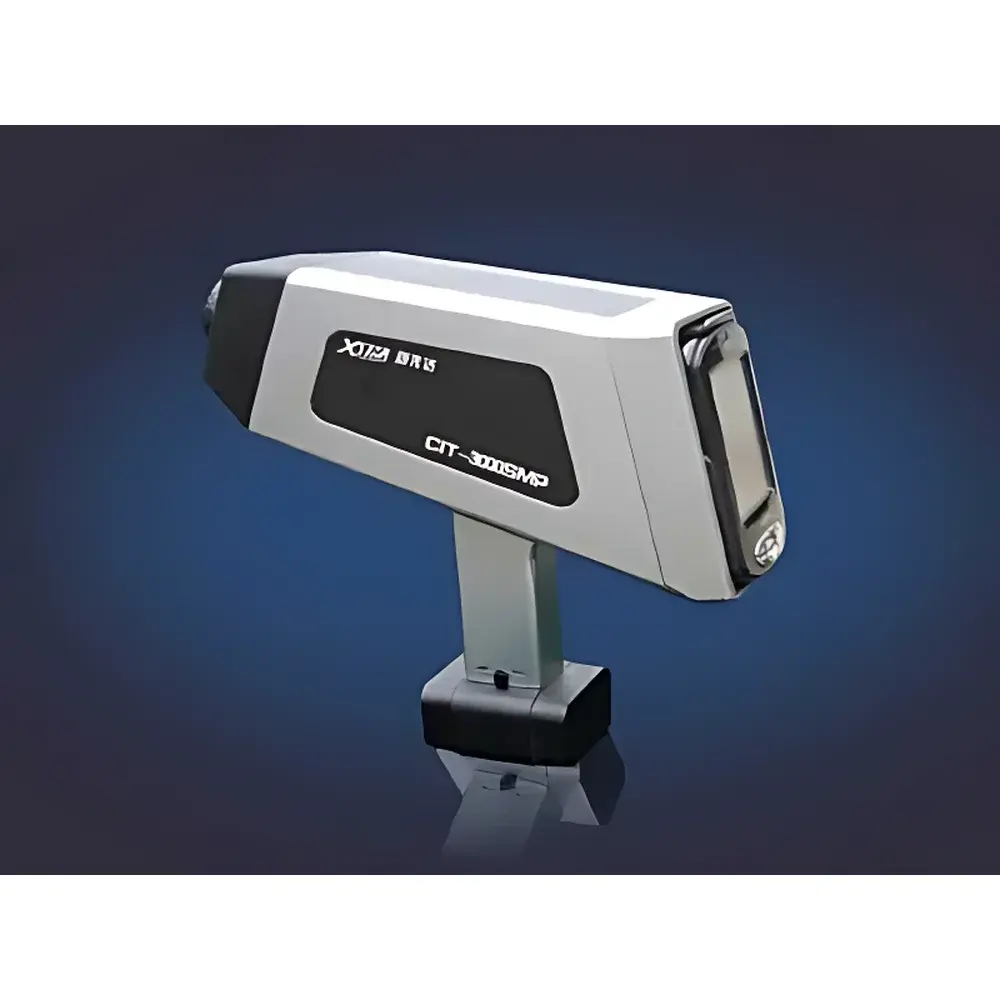
Xinxianda CIT-3000SMP Portable Energy Dispersive X-Ray Fluorescence (ED-XRF) Spectrometer
| Brand | Xinxianda |
|---|---|
| Model | CIT-3000SMP |
| Detector | Si(Li) semiconductor, energy resolution ≤150 eV (at 5.9 keV, ⁵⁵Fe) |
| Excitation Source | Miniature air-cooled X-ray tube |
| Measurable Elements | S, P, Ca, Ti, V, Mn, Fe, Ni, Cu, Zn, Mo, As, Sn, W |
| Detection Range | 0.001–99.99 wt% |
| Measurement Time | <200 s |
| Operating Voltage Range | 2–30 keV |
| Power Consumption | 4 W |
| Weight | 1.75 kg |
| Battery Life | ≥8 h (full-load operation) |
| Data Interface | Bluetooth, GPS, USB |
| Safety Indicators | Dual-color LED (green = power on |
| Compliance | CE, RoHS, IEC 61010-1, IEC 62471 |
Overview
The Xinxianda CIT-3000SMP is a field-deployable, battery-powered Energy Dispersive X-Ray Fluorescence (ED-XRF) spectrometer engineered for rapid, non-destructive elemental analysis of solid and powdered geological, metallurgical, and industrial samples in situ. Unlike benchtop XRF systems requiring sample preparation and laboratory infrastructure, the CIT-3000SMP integrates a high-stability miniature X-ray tube, an electrically cooled Si(Li) semiconductor detector, and real-time digital pulse processing into a single ergonomic unit weighing only 1.75 kg. Its measurement principle relies on primary X-ray excitation of sample atoms, followed by detection and multichannel energy discrimination of characteristic fluorescent photons—enabling quantitative determination of elements from sulfur (S, Z=16) to tungsten (W, Z=74) within the 2–30 keV range. Designed specifically for resource exploration and process control, it delivers laboratory-grade repeatability (standard deviation ≤0.08%) under variable environmental conditions—including ambient temperature fluctuations, dust exposure, and intermittent sunlight—without compromising spectral integrity or count-rate linearity.
Key Features
- High-resolution Si(Li) detector with energy resolution ≤150 eV at the Mn Kα line (5.9 keV), ensuring reliable separation of overlapping peaks (e.g., V Kβ/Cr Kα, As Kα/Se Kα, Pb Mα/Sb Kα)
- Digital multi-channel analyzer (1024-channel MCA) with zero dead-time correction and real-time pile-up rejection, supporting high count rates (>50,000 cps) without spectral distortion
- Patented multi-parameter automatic classification algorithm that identifies sample matrix type (e.g., iron ore, bauxite, sulfide concentrate, slag) and selects optimal excitation conditions and calibration models without user intervention
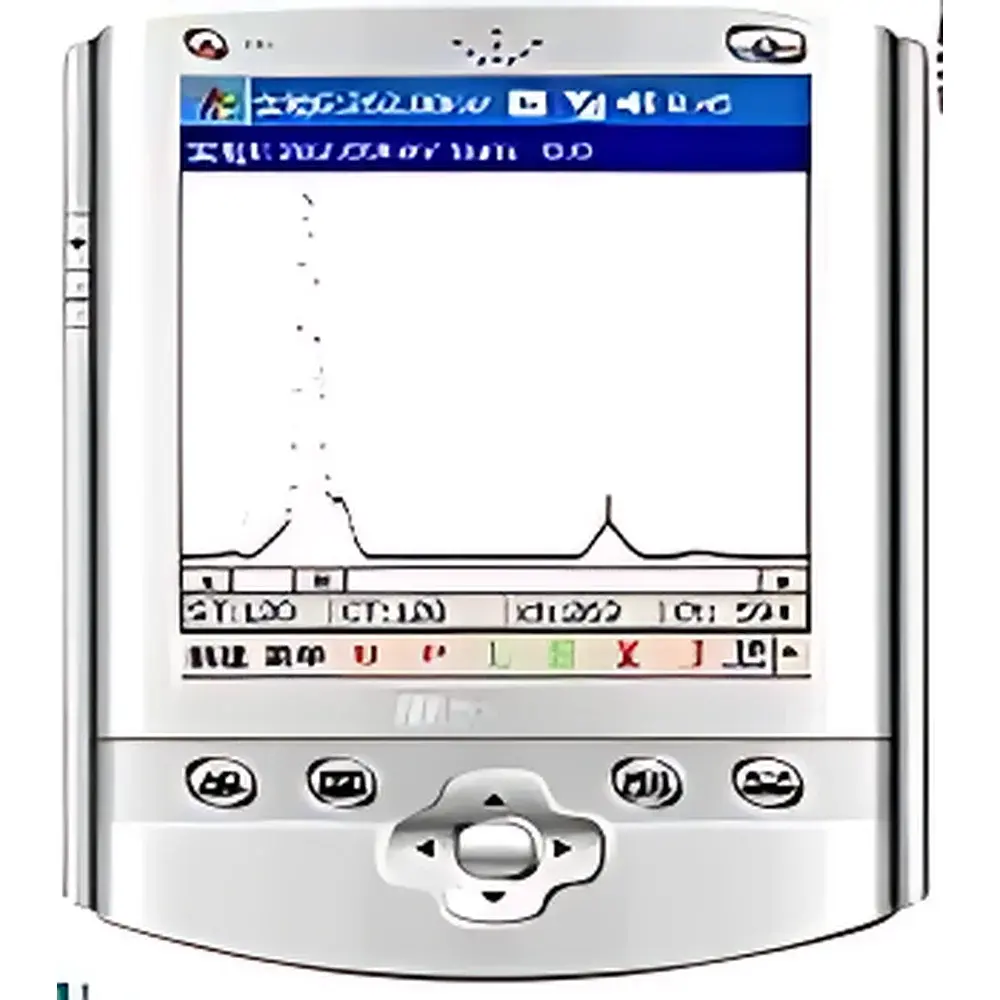
- Integrated PDA platform running embedded Windows CE OS with full Chinese GUI support, onboard data editing, 8 GB internal storage, and GPS-tagged result logging
- Low-power architecture (4 W typical draw) enabling >8 hours of continuous operation on a single charge of the built-in Li-ion battery; hot-swappable battery option available for extended campaigns
- Hardware safety interlocks including dual-color status LEDs (green = system powered; red = X-ray beam active), shutter-controlled beam path, and automatic beam termination upon lid opening or tilt angle exceedance
Sample Compatibility & Compliance
The CIT-3000SMP accommodates heterogeneous solids—including drill core segments, outcrop surfaces, mine face sections, and pressed pellets—without grinding or fusion. Its collimated 3 mm diameter beam minimizes scatter interference while maintaining sufficient flux for sub-second dwell time per point. Powdered samples are analyzed directly in low-background polypropylene cups; no binder or pressing is required for routine assays. The instrument complies with international radiation safety standards IEC 61010-1 (safety requirements for electrical equipment) and IEC 62471 (photobiological safety of lamps and lamp systems), and meets EU directives CE and RoHS. All firmware and measurement protocols are structured to support audit-ready documentation in accordance with ISO/IEC 17025:2017 (general requirements for competence of testing and calibration laboratories) and ASTM E1621–22 (standard guide for elemental analysis by ED-XRF).
Software & Data Management
The proprietary Xinxianda XRF Analyzer Suite provides complete workflow control—from acquisition and spectrum deconvolution to quantification and report generation. Calibration models are stored as encrypted XML files with traceable metadata (date, operator ID, instrument serial number, detector gain settings). Each measurement record includes GPS coordinates, timestamp, ambient temperature/humidity (via optional external sensor), and full raw spectrum (1024-channel counts). Data export supports CSV, PDF, and XML formats compatible with LIMS integration. Audit trail functionality logs all user actions—including method edits, calibration updates, and result modifications—with timestamps and operator credentials, satisfying FDA 21 CFR Part 11 requirements for electronic records and signatures when deployed in regulated QA/QC environments.
Applications
- Field-based grade control in open-pit and underground mining operations—real-time Fe, Cu, Zn, Pb, and Au-associated element mapping on drill chips and blast fragments
- Rapid screening of exploration targets during geochemical surveys, including lithogeochemical discrimination of altered vs. unaltered host rock using Ti/V/Zr ratios
- On-site verification of feedstock composition at beneficiation plants and smelters—monitoring SiO₂, Al₂O₃, CaO, and impurity levels in iron ore fines or nickel laterite concentrates
- Scrap metal sorting and alloy identification in recycling facilities, distinguishing stainless steel grades (304 vs. 316), aluminum series (1xxx–7xxx), and copper alloys (brass vs. bronze)
- Environmental site assessment—detection of heavy metals (As, Cd, Cr, Pb, Hg) in soil and sediment samples at regulatory action levels defined by EPA Method 6200 and ISO 12847
FAQ
Does the CIT-3000SMP require radioactive isotopic sources?
No. It uses a factory-sealed, low-power X-ray tube (≤50 kV, ≤1 mA) as the excitation source—eliminating licensing, transport restrictions, and disposal concerns associated with ²⁴¹Am or ¹⁰⁹Cd sources.
Can it analyze light elements such as Mg, Al, or Na?
Not natively. The Si(Li) detector’s beryllium window and atmospheric path limit detection to elements ≥S (Z=16). Light element analysis requires vacuum/purge capability and specialized detectors (e.g., SDD with ultrathin window), which are not part of this configuration.
How is calibration maintained across changing field conditions?
Calibration stability is ensured via internal reference channel monitoring, automatic detector gain stabilization, and periodic verification using certified reference materials (CRMs) traceable to NIST or BAM standards. Field recalibration is performed using a single-point check standard prior to each sampling shift.
Is the GPS data synchronized with spectral acquisition?
Yes. Each spectrum file embeds EXIF-style geotags (latitude, longitude, altitude, UTC timestamp) acquired simultaneously with X-ray detection, enabling GIS-integrated spatial visualization of elemental distributions.
What software licenses or annual subscriptions are required?
None. The embedded operating system and analytical software are fully licensed for perpetual use with no subscription fees. Firmware updates and basic technical support are included for three years from date of shipment.




