
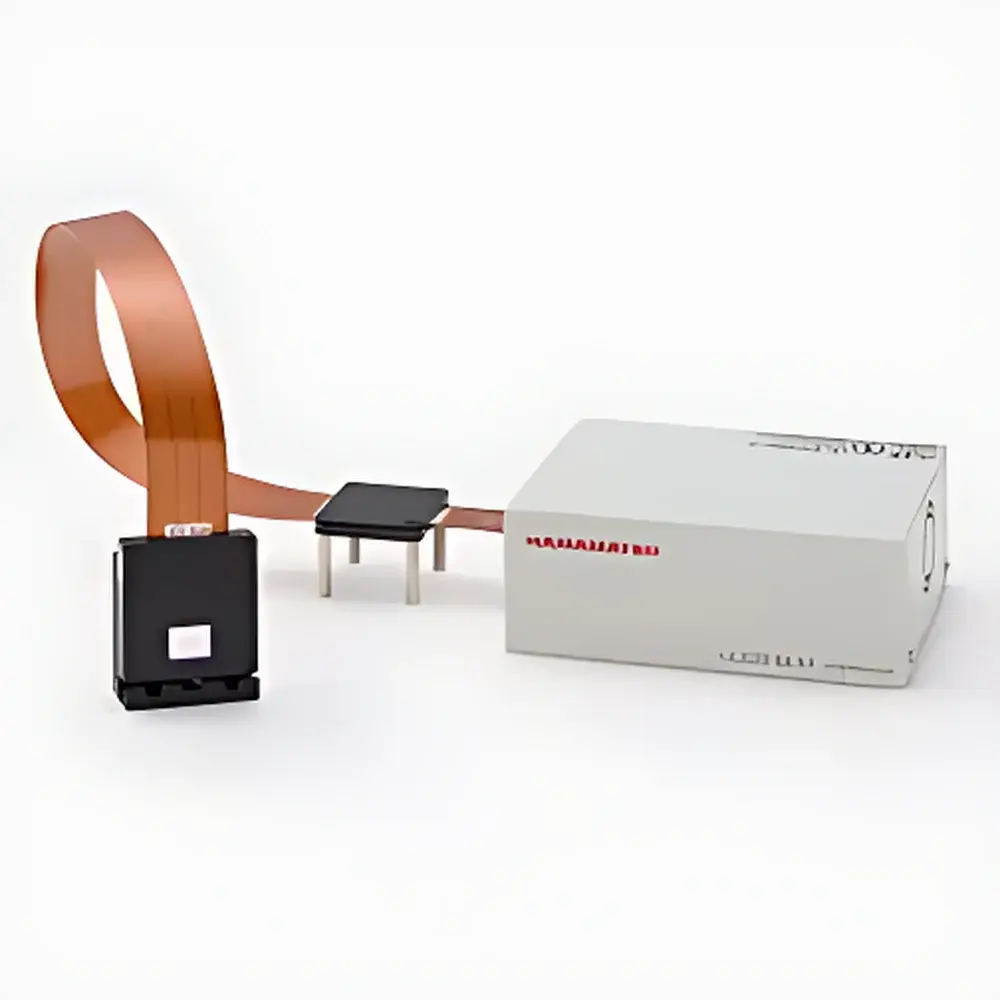
Hamamatsu LCOS-SLM X15213-12 Reflective Pure-Phase Spatial Light Modulator
| Brand | Hamamatsu |
|---|---|
| Origin | Japan |
| Manufacturer Type | Original Equipment Manufacturer (OEM) |
| Import Status | Imported |
| Model | X15213-12 |
| Pricing | Upon Request |
| Pixel Pitch | 12.5 µm |
| Input Interface | DVI-D / USB-B (USB 2.0 High-Speed) |
| DVI Resolution | SXGA (1280 × 1024) |
| DVI Frame Rate | 60 Hz |
| Gray Levels | 256 (8-bit) |
| Active Pixel Count | 1272 × 1024 |
| Active Area | 15.9 × 12.8 mm |
| Maximum Spatial Resolution | 40 lp/mm |
| Fill Factor | 96% |
| Rise Time | 38 ms |
| Fall Time | 109 ms |
| Operating Wavelength Range | 850–1000 nm |
| Optical Efficiency | 97% (measured at λ = 940 nm) |
Overview
The Hamamatsu X15213-12 is a reflective, pure-phase spatial light modulator (SLM) based on silicon-on-insulator liquid crystal on silicon (LCOS) technology. Engineered for high-fidelity wavefront manipulation in demanding optical systems, it operates across the near-infrared spectral band (850–1000 nm), with peak optical efficiency of 97% at 940 nm. Unlike transmissive SLMs or binary diffractive elements, the X15213-12 implements analog voltage-driven liquid crystal alignment to induce continuous, sub-wavelength phase shifts—enabling precise control over beam shape, focus, and interference conditions without amplitude modulation artifacts. Its reflective architecture minimizes thermal load under high-power illumination and supports integration into folded-path interferometers, adaptive optics testbeds, and holographic optical trapping platforms. The device is not a generic display panel; it is a calibrated optical component with factory-characterized phase response, pixel crosstalk, and temporal response profiles—designed for reproducible, metrology-grade use in research and industrial photonics applications.
Key Features
- Pure-phase modulation: Zero-intensity modulation across full 2π phase range; eliminates intensity-based artifacts in interferometric and holographic setups.
- High optical efficiency: 97% measured reflectivity at 940 nm—achieved through optimized anti-reflection coatings, high-fill-factor pixel design (96%), and minimized inter-pixel diffraction noise.
- SXGA resolution & precision addressing: 1272 × 1024 active pixels with 12.5 µm pitch yield 40 line pairs/mm maximum resolvable spatial frequency—supporting fine-grained wavefront correction and complex hologram synthesis.
- DVI-native control interface: Compatible with standard PC graphics outputs via DVI-D; eliminates need for proprietary frame grabbers or FPGA-based drivers—reducing system complexity and latency.
- Integrated calibration support: Built-in USB-B (2.0 HS) port enables real-time firmware updates and pixel-wise nonlinearity compensation; factory-provided phase-response lookup tables (LUTs) ensure linearized 8-bit (256-level) phase mapping.
- Robust thermal architecture: Designed for continuous-wave operation at optical power densities up to 10 W/cm² (CW, λ = 940 nm); substrate heat-sinking compatible with active temperature stabilization mounts.
Sample Compatibility & Compliance
The X15213-12 is compatible with collimated, polarized input beams aligned to its designated incidence angle (typically 45° ± 2°). It requires linearly polarized light oriented parallel to the pixel rows for optimal phase fidelity. While not certified to a specific ISO or IEC standard as a standalone component, its performance metrics—including phase uniformity (±0.05π RMS over active area), temporal stability (<0.01π drift over 1 hour at 25°C), and repeatability—are documented per Hamamatsu’s internal QC protocol compliant with JIS Z 8000 series guidelines for optical measurement instrumentation. When integrated into larger systems, it supports traceable calibration workflows required under ISO/IEC 17025-accredited laboratories and aligns with optical safety practices defined in IEC 60825-1:2014 for Class 3B/4 laser system components.
Software & Data Management
Hamamatsu provides the SLM Control Studio software suite (Windows 10/11, 64-bit), which delivers direct DVI signal generation, LUT management, and real-time phase pattern sequencing. The software supports import of common formats including BMP, TIFF, and HDF5-encoded phase maps, and includes built-in tools for Gerchberg-Saxton algorithm iteration, Zernike mode decomposition, and kinoform generation. All phase patterns are timestamped and logged with metadata (exposure time, ambient temperature, firmware version), enabling GLP-compliant experiment documentation. USB-B interface supports audit-trail recording of parameter changes—meeting foundational requirements for FDA 21 CFR Part 11 electronic record integrity when deployed in regulated R&D environments.
Applications
- Adaptive optics: Real-time correction of atmospheric turbulence in astronomical imaging and free-space optical communication links.
- Holographic optical tweezers: Dynamic 3D trapping and manipulation of microspheres, cells, and colloidal particles using computer-generated holograms (CGH).
- Structured illumination microscopy (SIM): Generation of high-contrast, multi-angle sinusoidal patterns for super-resolution imaging beyond the diffraction limit.
- Ultrafast pulse shaping: Spectral phase modulation in 4f pulse shapers for coherent control of molecular dynamics and attosecond science.
- Quantum optics: Programmable mode conversion for spatial-mode entanglement distribution and high-dimensional quantum state engineering.
- Laser materials processing: Beam homogenization, multi-focus array generation, and Bessel beam formation for precision micromachining.
FAQ
Is the X15213-12 suitable for pulsed laser applications?
Yes—provided pulse energy density remains below 100 mJ/cm² (for ns pulses) and peak power does not exceed 1 GW/cm². Thermal lensing and LC response saturation must be evaluated case-by-case; Hamamatsu provides application-specific damage threshold reports upon request.
Can multiple X15213-12 units be synchronized?
Yes—via external trigger input (TTL-compatible, SMA connector) supporting frame-locked operation with jitter < 100 ns. Synchronization requires shared DVI clock source or master-slave configuration using Hamamatsu’s optional timing controller module.
Does the device require polarization conditioning of the incident beam?
Yes—optimal phase fidelity requires linear polarization aligned parallel to the pixel rows (horizontal orientation relative to DVI input). A broadband half-wave plate and polarizer are recommended upstream for polarization control.
What is the warranty and calibration policy?
Hamamatsu offers a 24-month limited warranty covering material and workmanship defects. Factory calibration certificates (including phase uniformity map and wavelength-dependent efficiency curve) are provided with each unit. Recalibration services are available annually through authorized service centers.





