
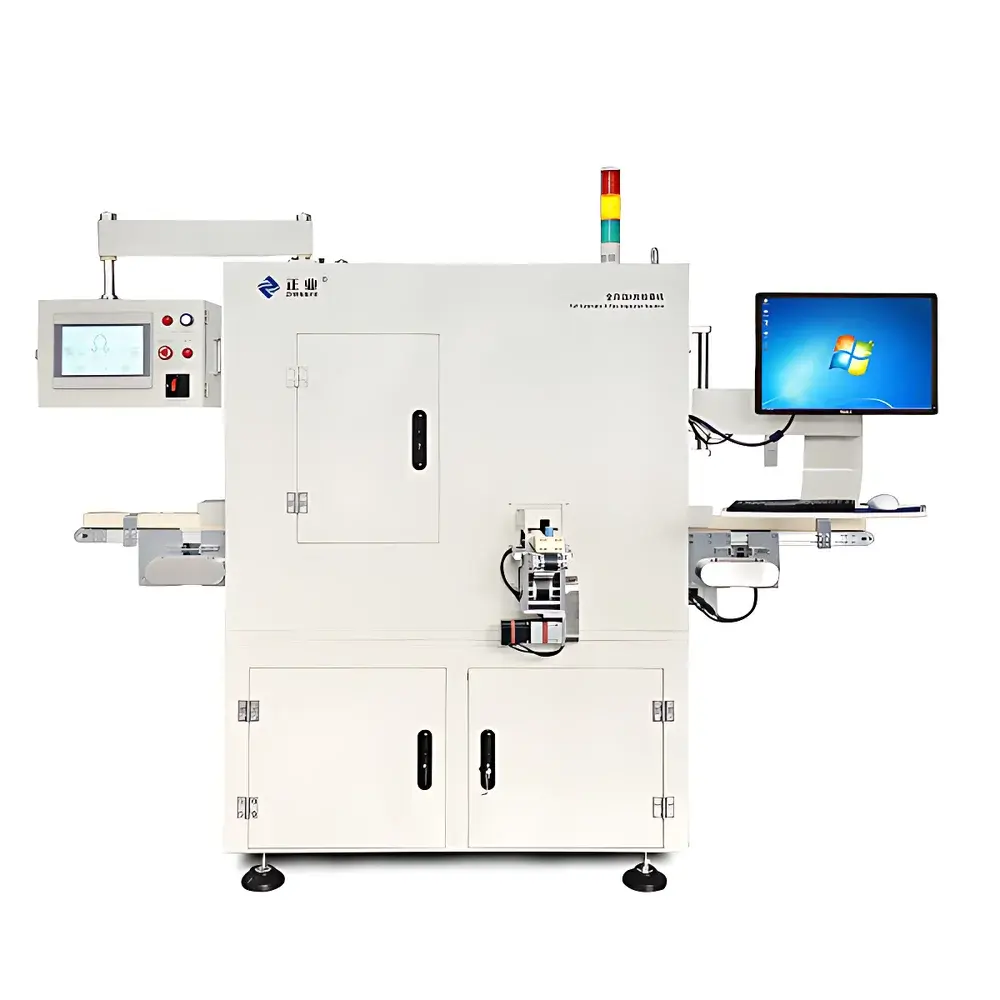
Zhengye TDI Line-Scan X-ray Inspection System for Cylindrical Lithium-ion Batteries
| Brand | Zhengye |
|---|---|
| Model | XG5600 |
| X-ray Tube Voltage | Up to 130 kV |
| X-ray Tube Current | Up to 309 µA |
| Focal Spot Size | 5–7 µm |
| Imaging Method | Time-Delay Integration (TDI) Line-Scan Detector |
| Repeatability Accuracy | ±60 µm |
| Throughput | ≥120 ppm |
| False Positive Rate | ≤3% |
| Miss Detection Rate | 0.0% |
| Overall Yield Rate | ≥99.5% |
| Radiation Leakage | ≤1 µSv/hr (compliant with IEC 61000-6-4 & IEC 62471) |
| Power Supply | AC 220 V / 50 Hz |
| Operating Environment | 23 °C ±5 °C, Relative Humidity ≤10% RH |
Overview
The Zhengye XG5600 is an industrial-grade, fully automated TDI (Time-Delay Integration) line-scan X-ray inspection system engineered specifically for high-throughput quality assurance of cylindrical lithium-ion batteries. It operates on the principle of transmission radiography: a microfocus X-ray source emits a collimated beam that penetrates the battery assembly; transmitted radiation is captured in real time by a high-speed, multi-tap TDI linear detector array synchronized precisely with conveyor motion. Unlike area-scan systems, TDI architecture enables continuous, motion-compensated imaging without frame blur—critical for maintaining sub-100 µm spatial resolution at production-line speeds exceeding 120 parts per minute. The system delivers quantitative grayscale projection images optimized for detecting internal structural anomalies—including electrode misalignment (anode/cathode step-out), separator wrinkles, weld defects, foreign metallic particles, and voids within jelly-roll windings. Designed for integration into Tier-1 battery cell manufacturing lines, it supports both inline process monitoring and offline 100% final inspection under ISO 9001 and IATF 16949-aligned quality workflows.
Key Features
- Microfocus X-ray source with stable output up to 130 kV and 309 µA, featuring focal spot size tightly controlled between 5–7 µm for high-resolution edge definition.
- TDI line-scan imaging architecture enabling pixel-level synchronization between detector readout and conveyor velocity—eliminating motion artifacts and ensuring consistent image sharpness across full field-of-view.
- Automated dual-lane sorting mechanism with independent OK/NG discharge paths, including NG buffer staging capacity for up to 100 units with traceable batch logging.
- Integrated radiation shielding enclosure certified to IEC 61000-6-4 (EMC) and IEC 62471 (photobiological safety), with real-time dosimetry monitoring and interlocked access doors meeting Class I radiation device requirements.
- Modular mechanical design accommodating standard cylindrical formats (18650, 21700, 26650, 32135) via quick-change cup carriers and adaptive centering guides.
- Real-time image processing engine executing proprietary algorithms for electrode alignment metrology (±60 µm repeatability), density gradient analysis, and multi-threshold defect classification.
Sample Compatibility & Compliance
The XG5600 accommodates cylindrical cells ranging from 14 mm to 35 mm in diameter and 40–135 mm in length, mounted in standardized plastic or composite carrier cups. All mechanical interfaces—including input transfer belt, inspection stage, and output diverters—are dimensionally referenced to SEMI E19-02 and JIS B 7021 standards for semiconductor and battery handling equipment. Software-generated inspection reports comply with FDA 21 CFR Part 11 requirements for electronic records and signatures when configured with audit trail logging and user role-based access control. System validation documentation supports IQ/OQ/PQ protocols aligned with ISO/IEC 17025 and GMP Annex 11 expectations for regulated battery manufacturing environments.
Software & Data Management
The proprietary Zhengye VisionInsight™ software suite provides a deterministic, deterministic workflow environment with deterministic image acquisition triggers, calibrated intensity normalization, and geometric distortion correction using embedded fiducial markers. Defect classification logic is configurable via rule-based thresholds (e.g., pixel intensity variance >3.5σ over baseline ROI, edge displacement >±80 µm) and supports machine-learning-assisted model retraining using annotated historical datasets. All image metadata—including timestamp, conveyor speed, tube parameters, and pass/fail verdicts—is stored in SQLite-backed local databases with optional OPC UA or MQTT export to MES platforms (Siemens Opcenter, Rockwell FactoryTalk, or custom SCADA). Raw DICOM-compliant image archives are retained for ≥90 days unless purged per site-specific data retention policy.
Applications
- Electrode alignment verification: Quantitative measurement of anode-to-cathode offset along axial and radial cross-sections.
- Jelly-roll integrity assessment: Detection of separator folds, core buckling, and winding tension inconsistencies.
- Weld quality screening: Identification of incomplete tab welds, spatter contamination, and thermal damage zones in nickel-plated steel leads.
- Foreign object detection (FOD): Localization of metallic debris ≥25 µm equivalent spherical diameter (ESD) embedded in electrode stacks.
- Fill-level consistency monitoring: Density profiling of electrolyte distribution in pre-formation and post-filling stages.
- Process capability analysis: SPC charting of critical dimensions (e.g., cathode overhang) across shifts using Minitab-compatible CSV exports.
FAQ
What safety certifications does the XG5600 hold for industrial deployment?
The system complies with IEC 61000-6-4 (EMC immunity), IEC 62471 (LED/X-ray optical radiation safety), and national radiation protection regulations (GBZ 138–2002). Full Type Examination Report available upon NDA execution.
Can the system be integrated with existing factory automation infrastructure?
Yes—standard EtherNet/IP, Profinet, and Modbus TCP interfaces are provided; custom PLC integration kits support Siemens S7-1500, Allen-Bradley ControlLogix, and Mitsubishi Q-series controllers.
Is remote diagnostics and software update support available?
Secure remote access via TLS-encrypted VNC tunnel is enabled with customer-configurable firewall rules; firmware updates follow signed package verification and rollback-safe dual-bank flash architecture.
How is measurement traceability maintained for quality audits?
Each inspection event logs calibrated geometry parameters, X-ray source drift compensation values, and reference phantom scan data; all traceable to NIST-traceable X-ray dosimetry standards via annual third-party calibration certificate.
Does the system support multi-shift operation without performance degradation?
Thermal management subsystem maintains detector temperature stability within ±0.3 °C over 24-hour cycles; X-ray tube anode heat dissipation is actively monitored and throttled to preserve focal spot integrity and image SNR consistency.



