
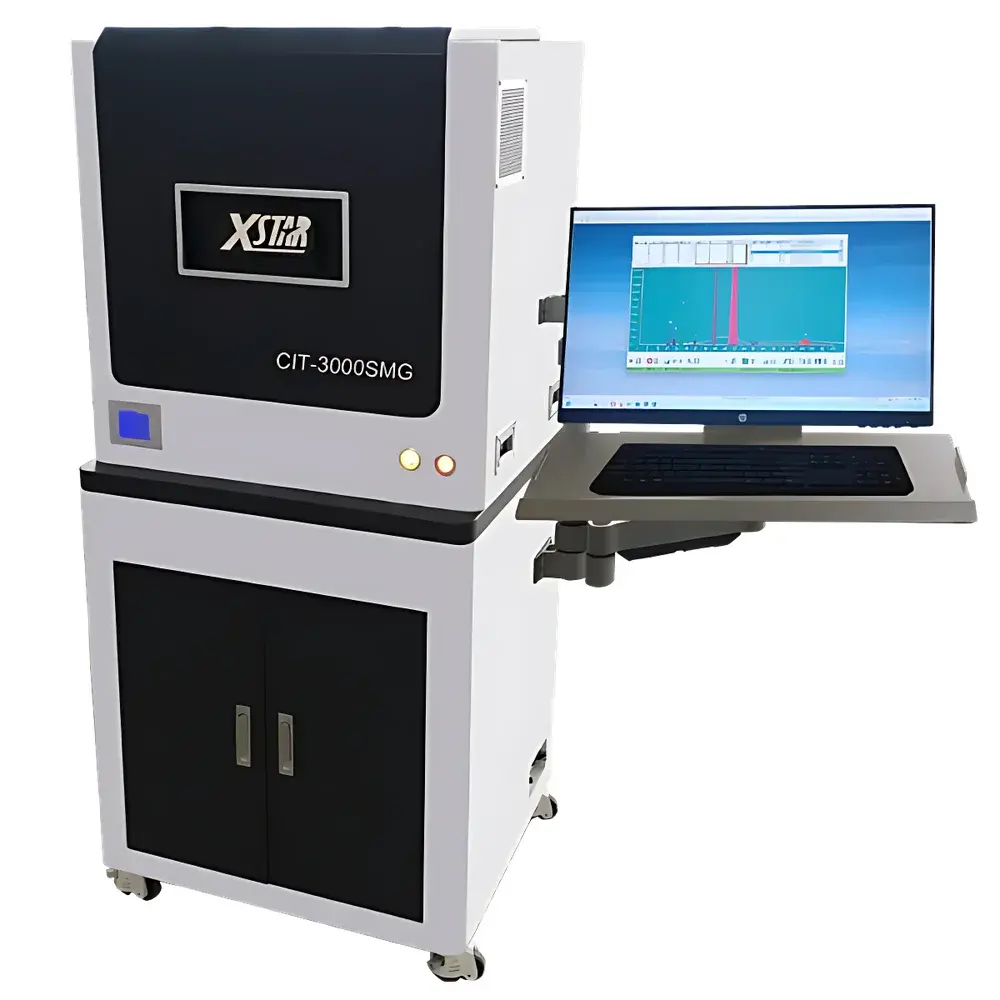
X-Ray Fluorescence Spectrometer (EDXRF) CIT-3000SMG by Sichuan Xinxianda
| Brand | Sichuan Xinxianda |
|---|---|
| Origin | Sichuan, China |
| Model | CIT-3000SMG |
| Element Range | Na (11)–U (92) |
| Detection Limit | 0.1 ppm |
| Quantification Range | 0.1 ppm–99.99% |
| Energy Resolution | <100 eV (@5.89 keV) |
| Repeatability (RSD) | ≤0.05% |
| Detector | FAST SDD (Silicon Drift Detector) |
| Sample Chamber | Top-illumination geometry with vacuum capability (10⁻²–10⁻⁵ Pa) |
| X-ray Tube | 0–50 kV, 1–1000 µA |
| Measurement Time | 100–300 s |
| Sample Mass | 3–8 g |
| Dimensions | 750 × 670 × 1620 mm (D×W×H) |
| Weight | 135 kg |
| Compliance | GBZ 115–2002, registered with Ministry of Ecology and Environment of PRC |
Overview
The CIT-3000SMG is a benchtop-to-floor-standing Energy Dispersive X-Ray Fluorescence (EDXRF) spectrometer engineered for non-destructive, multi-element quantitative analysis of solid, powdered, and pressed pellet samples. It operates on the fundamental principle of X-ray fluorescence: primary X-rays from a high-stability end-window tube excite inner-shell electrons in sample atoms; upon relaxation, characteristic secondary (fluorescent) X-rays are emitted, with energies uniquely identifying elemental species and intensities correlating quantitatively with concentration. The instrument integrates a high-power microfocus X-ray tube (0–50 kV, 1–1000 µA), a cryogen-free FAST Silicon Drift Detector (SDD) delivering <100 eV resolution at Mn Kα (5.89 keV), and a fully digital 4K pulse processor for high-count-rate fidelity. Its top-illumination optical geometry eliminates dust accumulation in the detector path—critical for long-term spectral stability—and supports both ambient air and high-vacuum (10⁻²–10⁻⁵ Pa) measurement environments to enhance sensitivity for light elements (Na–F).
Key Features
- Automated Sample Handling: Motorized vertical sample stage ensures precise, repeatable positioning; integrated sample rotation minimizes heterogeneity-induced bias in particulate or inhomogeneous matrices.
- Vacuum-Optimized Light-Element Analysis: Dual-mode vacuum system enables reliable detection and quantification of elements from sodium (Na, Z=11) through uranium (U, Z=92), with sub-ppm detection limits for key analytes under optimized conditions.
- Robust Hardware Architecture: Air-cooled, Peltier-based SDD detector with real-time pulse processing; no liquid nitrogen required. High-voltage generator features active current stabilization and arc suppression for extended tube lifetime.
- Trace-to-Bulk Quantification: Validated linear dynamic range spanning 0.1 ppm to 99.99 wt%, supported by matrix-matched calibration standards and fundamental parameter (FP) algorithms with optional empirical correction.
- Radiation Safety Compliance: Fully shielded cabinet design meets GBZ 115–2002 national standard for XRF instrumentation; certified and publicly listed in the Ministry of Ecology and Environment’s radiation device registry.
Sample Compatibility & Compliance
The CIT-3000SMG accommodates a broad spectrum of sample forms—including loose powders (3–8 g), fused beads, pressed pellets (diameter up to 40 mm), and flat solid specimens—without requiring destructive preparation. Its top-illumination configuration avoids cross-contamination risks associated with horizontal sample chambers and simplifies cleaning between analyses. For regulatory traceability, the system supports audit-ready operation per GLP and ISO/IEC 17025 requirements: all measurement parameters (tube voltage/current, live time, vacuum status, detector temperature) are logged with timestamps; raw spectra and processed results are stored with immutable metadata. While not pre-certified for FDA 21 CFR Part 11, its data architecture allows integration with validated LIMS or ELN platforms supporting electronic signatures and change control protocols.
Software & Data Management
Controlled via Windows-based analytical software, the CIT-3000SMG provides intuitive workflow management—from method setup and calibration curve generation to batch analysis and report export. Quantitative routines include empirical calibration (linear/non-linear regression), Fundamental Parameters (FP), and FP-empirical hybrid models. Spectral deconvolution employs iterative least-squares fitting with peak shape modeling (Gaussian + tailing functions) and background subtraction (SNIP algorithm). All raw spectra (.spe or .rtd format), processed results (.csv, .xlsx), and instrument logs are archived with SHA-256 hash integrity verification. Export options include ASTM E1361-compliant data exchange templates and customizable PDF reports with embedded spectral overlays and uncertainty estimates (k=2, based on repeatability and calibration error propagation).
Applications
- Geological & Mining: Rapid assay of base metal ores (Pb, Zn, Cu, Sn, Ag, Mo, W), iron ores (Fe, Ti, V), and rare-metal concentrates (Nb, Ta, REEs) directly from drill core pulps or milled samples.
- Metallurgical Process Control: In-line monitoring of slag composition (CaO, SiO₂, Al₂O₃, MgO), ferroalloys (Mn, Cr, Si, Ni, Ti), and industrial dusts (Zn, Pb, As, Cd) for furnace optimization and environmental compliance.
- Environmental Remediation: Field-deployable soil screening for heavy metals (Pb, As, Cd, Hg, Cr) and metalloids in contaminated land assessments, meeting EPA Method 6200 and China’s HJ 680–2013 requirements.
- Construction Materials: Compositional verification of cement clinker (Ca, Si, Al, Fe), glass batches (Na, K, Ca, Mg), refractories (Al₂O₃, SiO₂, ZrO₂), and ceramic glazes (Pb, Cd, Cr, Sb).
- Quality Assurance & Forensics: Precious metal fineness testing (Au, Ag, Pt group elements), RoHS screening (Br, Cl, Cr, Hg, Pb, Cd), and counterfeit material identification in electronics and jewelry supply chains.
FAQ
What is the minimum detectable limit for sulfur (S) in air versus vacuum mode?
In vacuum mode, the typical MDL for sulfur is ≤2 ppm (100 s counting, 1 g pressed pellet); in air, it rises to ~50 ppm due to absorption losses.
Can the CIT-3000SMG analyze liquids or pastes?
Yes—using specialized low-background sample cups with Mylar or polyimide film windows; however, viscosity and volatility must be controlled to prevent film rupture or evaporation during measurement.
Is spectral library matching supported for unknown material identification?
The software includes a built-in reference spectral database (NIST SRM, geological standards, alloy libraries); users may also import custom libraries for qualitative phase screening and outlier detection.
How is calibration maintained across different operators or laboratories?
Calibration transfer is enabled via standardized drift correction using certified reference materials (CRMs); inter-laboratory reproducibility studies show RSD <1.2% for major oxides when using NIST 6xx series standards.
Does the system support remote diagnostics or preventive maintenance alerts?
Yes—the embedded controller logs operational parameters (tube hours, detector temperature variance, vacuum pump cycle count) and transmits anonymized health metrics to authorized service portals for predictive maintenance scheduling.



