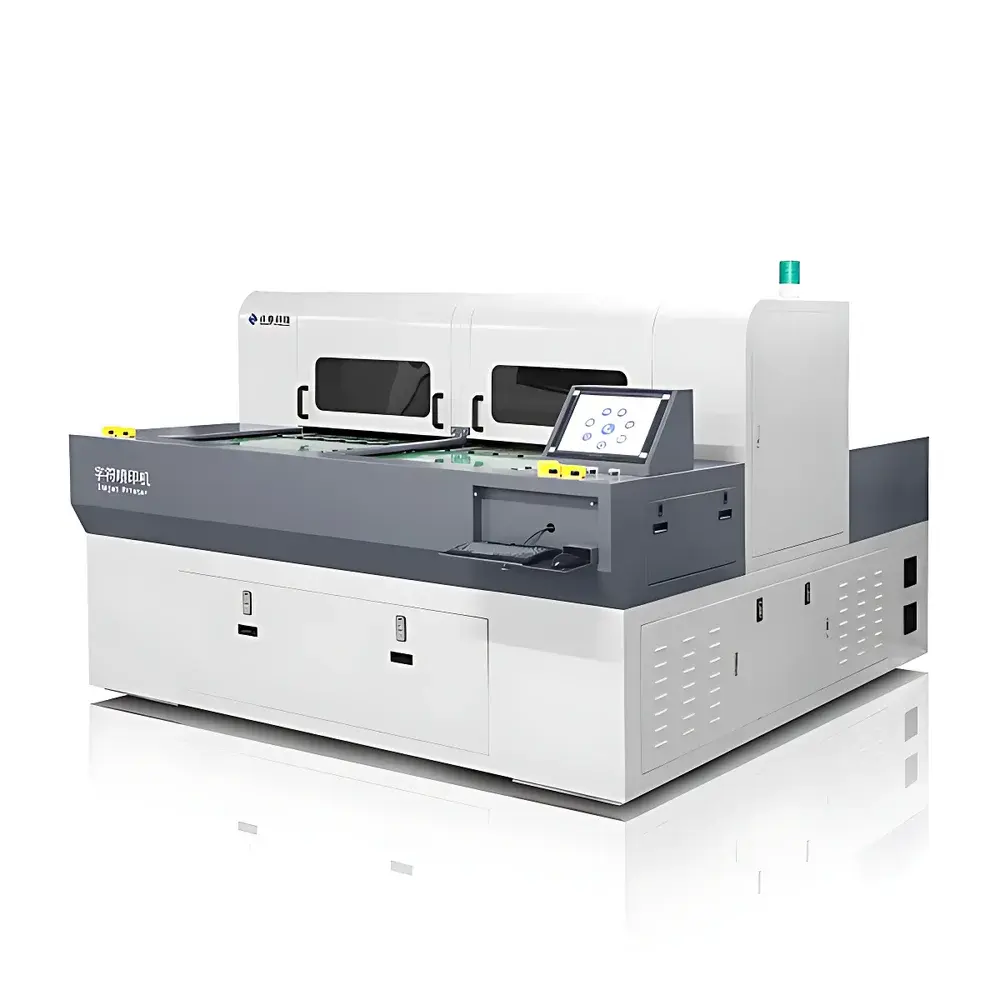
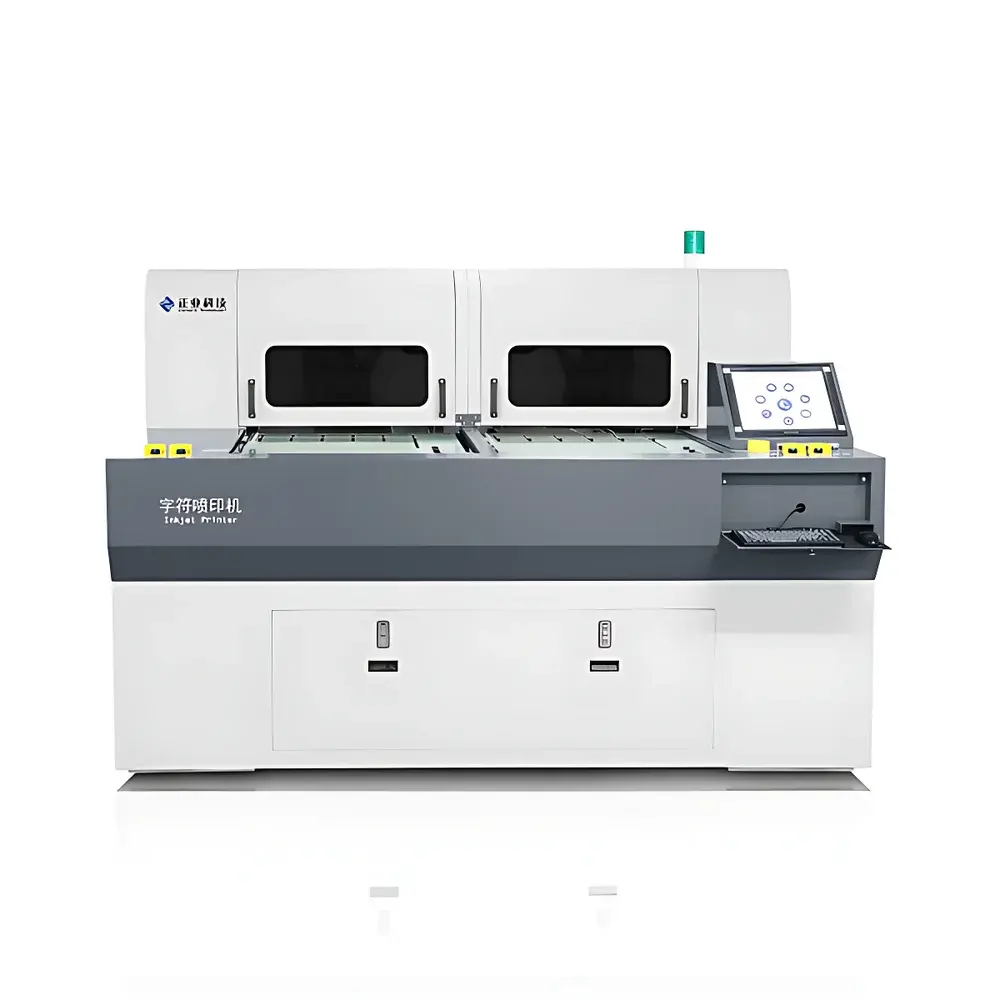
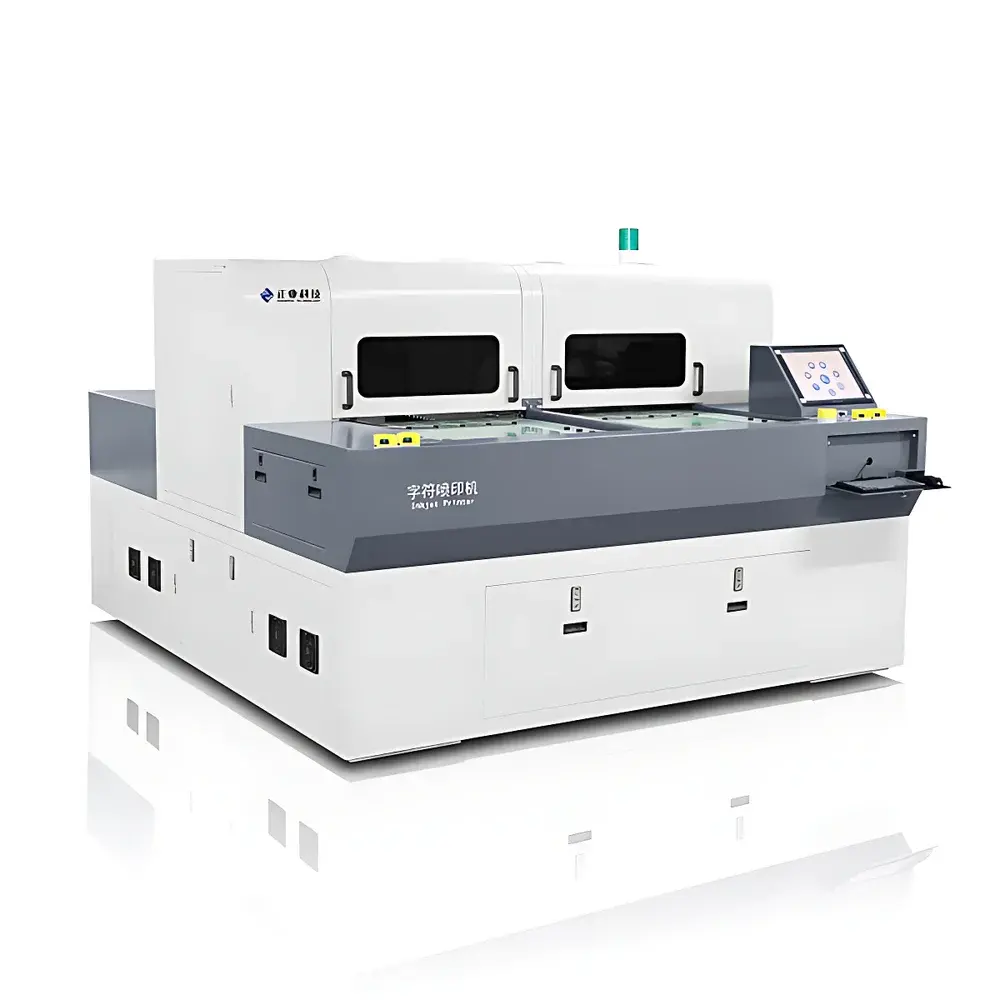
PY600E Five-Head High-Speed PCB Legend Inkjet Printer by Zhengye
| Brand | Zhengye |
|---|---|
| Origin | Guangdong, China |
| Manufacturer Type | OEM/ODM Manufacturer |
| Country of Origin | China |
| Model | PY600E |
| Pricing | Upon Request |
| Print Heads | 5 × 1024-nozzle industrial piezoelectric printheads |
| Max. Board Size | 730 mm × 621 mm (28″ × 24″) |
| Board Thickness Range | 0.1–6.0 mm (4–236 mil) |
| Positioning Accuracy | ±38 µm |
| Repeatability | ±5 µm |
| Print Resolution Options | 720 / 1080 / 1440 dpi |
| Minimum Line Width | 75–100 µm (3–4 mil) |
| Minimum Character Height | 0.5 mm |
| Cycle Time (Mass Production Mode) | 15 s/panel (2-pass, ≥0.5 mm char height, incl. 4 s loading/unloading) |
| Cycle Time (High-Precision Mode) | 20 s/panel (3-pass) |
| UV Pre-Curing System | Integrated inline LED-UV lamp array |
| Machine Dimensions (L×W×H) | 2670 × 2400 × 1790 mm |
| Weight | 4300 kg |
| Optional Integration | Automated dual-machine inline configuration (front/back side printing) or robotic flip station |
Overview
The Zhengye PY600E Five-Head High-Speed PCB Legend Inkjet Printer is an industrial-grade, non-contact digital marking system engineered for precision legend printing on rigid and flexible printed circuit boards (PCBs and FPCs). Unlike traditional silkscreen processes—which require stencil fabrication, solvent-based inks, and manual alignment—the PY600E employs advanced piezoelectric inkjet technology with five synchronized high-density printheads (1024 nozzles per head) to deposit UV-curable ink directly onto solder mask surfaces. Its core architecture integrates linear motor-driven gantry motion, real-time board registration via optical fiducial recognition, and dynamic scaling compensation to accommodate thermal and mechanical expansion during production. Designed for Class II–III electronics manufacturing environments, the system delivers repeatable placement accuracy (±5 µm) and positional fidelity (±38 µm), meeting critical requirements for fine-pitch component labeling, UL traceability marks, and IPC-A-600/IPC-6012-compliant identification.
Key Features
- Precision Motion Control: Dual-axis linear motor stage with high-resolution encoders and active vibration damping ensures sub-10 µm trajectory repeatability across full 730 × 621 mm work envelopes.
- Multi-Resolution Printing Engine: Selectable native resolutions—720, 1080, or 1440 dpi—enable optimization between throughput and legibility; minimum printable line width ranges from 75 to 100 µm depending on solder mask topography and ink rheology.
- Integrated UV Pre-Curing: Synchronized LED-UV lamp array activates ink crosslinking immediately post-deposition, minimizing smearing and enhancing adhesion on both epoxy-based and polyimide substrates.
- Adaptive Board Handling: Vacuum-assisted clamping platform accommodates boards from 0.1 mm (flexible circuits) to 6.0 mm (multilayer power modules); Z-axis auto-height sensing compensates for warpage up to ±1.5 mm.
- Open Architecture Control: Real-time firmware supports custom G-code extensions and third-party MES integration via Ethernet/IP and Modbus TCP protocols.
Sample Compatibility & Compliance
The PY600E accepts standard FR-4, high-Tg laminates, polyimide FPCs, metal-core PCBs (MCPCBs), and ceramic substrates. It is compatible with industry-standard UV-curable white, black, and yellow legend inks (e.g., DuPont™ CB-100 series, Taiyo Yuden LPI-1000) meeting IPC-SM-840 Class T qualifications. All motion control algorithms and ink deposition logic comply with ISO 9001:2015 manufacturing process validation frameworks. The system’s onboard audit trail logs—including operator ID, timestamp, job parameters, and calibration history—support GLP/GMP documentation requirements and are exportable in CSV/JSON formats for external QA review.
Software & Data Management
Zhengye’s proprietary LegendJet Studio software provides offline job preparation, fiducial-based board registration, multi-layer alignment mapping, and real-time print preview with ink density simulation. It supports direct import of Gerber RS-274X, ODB++, and IPC-2581 data formats, with automatic font vectorization and stroke-width optimization for characters as small as 0.5 mm in height. All print jobs are digitally signed and version-controlled; revision history and parameter lock-down functionality prevent unauthorized changes during production runs. Software updates are delivered via secure HTTPS with SHA-256 signature verification, and local database backups meet IEC 62443-3-3 SL2 cybersecurity guidelines.
Applications
- UL-certified component identifiers and safety markings on automotive ECUs and ADAS modules
- Traceability codes (2D Data Matrix, QR, alphanumeric) compliant with IPC-2581 Rev. D and JEDEC JESD22-A117 standards
- High-contrast legends on matte-finish solder masks used in medical PCBs (IEC 60601-1 environments)
- Low-volume, high-mix prototyping without screen changeover downtime
- Double-sided printing via optional inline dual-station or robotic flip configurations
FAQ
What substrate types and thicknesses does the PY600E support?
It handles rigid PCBs (FR-4, Rogers, aluminum base), flex circuits (polyimide), and hybrid constructions within 0.1–6.0 mm thickness range.
Is the system validated for use in FDA-regulated medical device manufacturing?
While not pre-certified, its audit log structure, user access controls, and electronic record retention align with FDA 21 CFR Part 11 Annex 11 expectations when deployed under a qualified QMS.
Can the printer integrate into existing SMT lines using SMEMA or Hermes protocols?
Yes—via optional industrial gateway module supporting SMEMA 2.0 handshake signals and bidirectional status reporting.
How is ink viscosity and temperature managed during continuous operation?
Printhead cartridges include integrated thermal regulation (±0.5°C) and pressure-controlled ink recirculation to maintain Newtonian flow characteristics over 8-hour shifts.
Does the system support IPC-D-356 netlist-driven legend placement?
LegendJet Studio accepts IPC-D-356 netlists for automated coordinate mapping of test points and node labels, reducing manual annotation errors.