
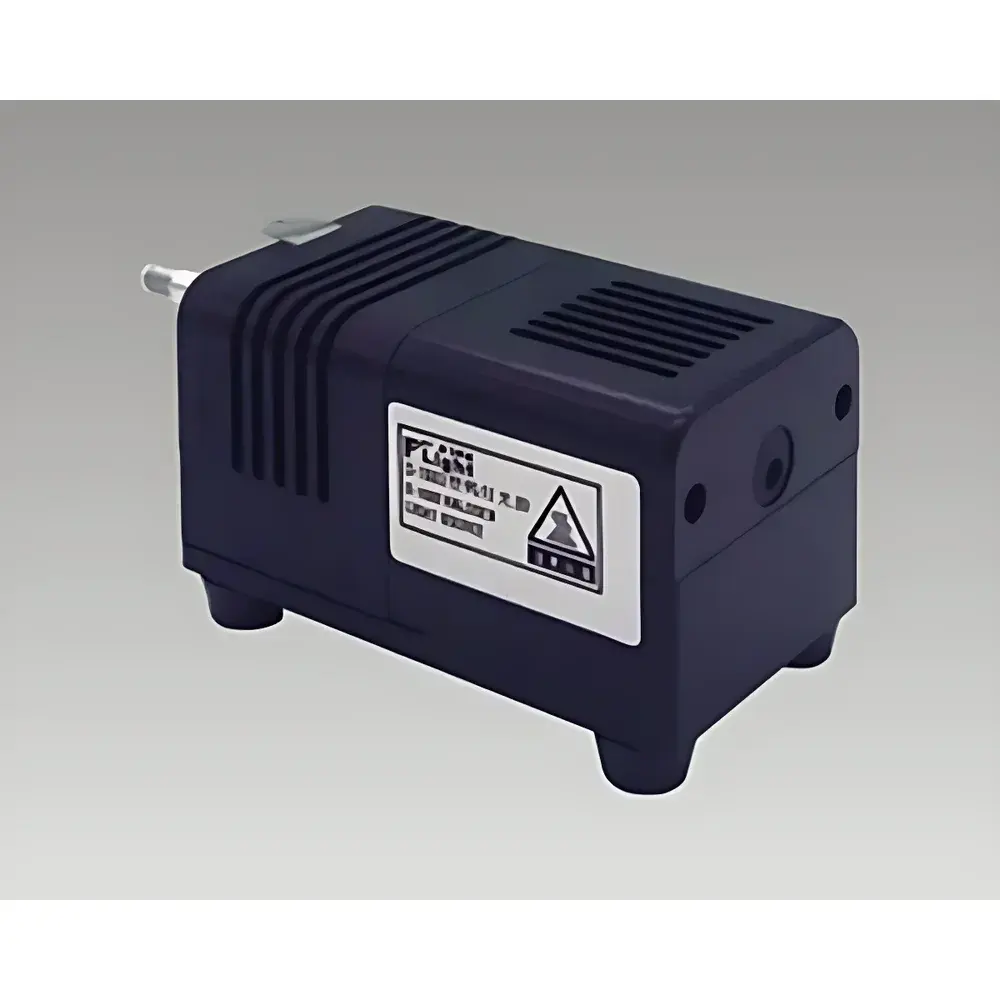
FLE1003 Tungsten-Halogen Light Source by Jingfei Technologies
| Brand | Jingfei Technologies |
|---|---|
| Origin | Zhejiang, China |
| Manufacturer Type | OEM Manufacturer |
| Country of Origin | China |
| Model | FLE1003 |
| Light Source Type | Tungsten-Halogen Lamp |
| Illumination Mode | External Illumination |
| Wavelength Range | 380–2500 nm |
| Power Supply | 9 V DC / 2.55 A |
| Output Stability | ±0.3% (RMS, over 8 hours) |
| Rated Lifetime | >1000 h (at rated power, continuous operation) |
| Output Interface | SMA905 |
| Cooling | Integrated heatsink with external PWM-controlled DC fan |
| Control Interface | TTL-compatible electronic shutter (BNC input, rise/fall time <10 µs) |
Overview
The FLE1003 Tungsten-Halogen Light Source is a precision-engineered broadband illumination system designed for demanding optical laboratory applications requiring stable, continuous-spectrum output across the visible and near-infrared (VIS-NIR) spectral region. Operating on the principle of incandescent thermal radiation from a vacuum-enclosed tungsten filament, the FLE1003 delivers spectrally smooth and predictable irradiance from 380 nm to 2500 nm—covering UV-Vis, visible, and extended NIR bands critical for spectroscopic calibration, reflectance/transmittance measurements, and hyperspectral system validation. Its thermally optimized architecture integrates the lamp driver, constant-current regulation circuitry, and thermal management subsystem into a single monolithic heatsink block, minimizing thermal drift and enabling long-term radiometric stability. Unlike pulsed or arc-based sources, the FLE1003 provides inherently low-noise, flicker-free DC illumination—essential for high-dynamic-range imaging, lock-in detection, and quantitative photometric workflows.
Key Features
- Ultra-stable output with ≤±0.3% RMS intensity fluctuation over 8-hour continuous operation—achieved via precision constant-current regulation and active thermal feedback control
- Integrated monoblock heatsink design with embedded driver electronics, eliminating interconnect-induced noise and thermal interface resistance
- Dedicated external PWM-controlled DC cooling fan ensures consistent junction temperature below 75°C under full-load conditions
- Fast-response electronic shutter (TTL-triggered, BNC input) with <10 µs rise/fall time—enabling synchronization with CCD/CMOS cameras, spectrometers, or chopper wheels
- SMA905 fiber-coupled output port compliant with industry-standard optical fiber interfaces (e.g., Ocean Insight, Avantes, Hamamatsu)
- No warm-up delay: reaches 95% nominal output within 30 seconds; minimal spectral shift (<0.2 nm peak drift) during stabilization
Sample Compatibility & Compliance
The FLE1003 is compatible with standard 400–600 µm core silica optical fibers (NA 0.22), integrating seamlessly into reflectance probe assemblies, integrating sphere setups, and custom collimated beam paths. Its spectral continuity and lack of emission lines make it suitable as a primary reference source for NIST-traceable instrument calibration—particularly in applications governed by ASTM E308 (computing CIE tristimulus values), ISO/CIE 11664 (colorimetry), and USP (spectrophotometer qualification). The unit complies with IEC 61000-6-3 (EMC emission limits) and IEC 61010-1 (safety requirements for electrical equipment for measurement, control, and laboratory use). While not certified for Class I laser product compliance, its optical output is classified as Class 1 under IEC 60825-1 when coupled into standard multimode fiber (no accessible hazardous radiation).
Software & Data Management
The FLE1003 operates as a hardware-controlled peripheral without proprietary software dependency. Shutter timing is managed externally via TTL logic signals, supporting integration with LabVIEW, Python (PyVISA), MATLAB, or custom DAQ systems using standard digital I/O modules. Radiometric characterization data—including relative spectral power distribution (SPD), angular output profile, and long-term stability logs—is provided in CSV and XML formats upon request for traceability and GLP-compliant recordkeeping. Firmware-level shutter diagnostics (pulse count, error flags) are accessible via optional UART debug interface for audit-ready system validation under FDA 21 CFR Part 11 environments.
Applications
- Calibration of VIS-NIR spectroradiometers, hyperspectral imagers, and multispectral sensors
- Reference illumination in goniophotometric and BRDF measurement systems
- Benchmark source for LED and OLED spectral comparison studies
- Stable excitation source in fluorescence lifetime decay analysis (when filtered to avoid excitation band overlap)
- Validation of optical filter transmission curves and dichroic mirror performance
- Teaching laboratories for radiometry, photometry, and color science curricula
FAQ
What is the recommended operating duty cycle to maximize lamp lifetime?
For rated lifetime (>1000 h), continuous operation at nominal voltage (9 V DC) is supported. Intermittent use with ≥5-minute cooldown periods between cycles does not extend lifetime meaningfully due to tungsten filament recrystallization kinetics.
Can the FLE1003 be used with liquid light guides?
Yes—provided the guide’s input NA ≤0.22 and maximum input irradiance rating exceeds 15 W/cm² at the coupling plane. Thermal load at the guide face must be actively monitored to prevent epoxy degradation.
Is spectral recalibration required after extended use?
No routine recalibration is needed; however, users performing metrology-grade work should verify SPD against a NIST-traceable reference lamp every 200 operational hours or per internal quality protocol.
Does the unit support analog intensity modulation?
No—intensity control is strictly digital (on/off via shutter). Analog dimming is not implemented to preserve spectral fidelity and stability; output level is fixed at factory-set current.
What safety certifications does the FLE1003 hold?
It conforms to IEC 61010-1:2010 (Edition 3) for laboratory electrical safety and IEC 61000-6-3:2019 for conducted/radiated emissions. CE marking is applied under the Low Voltage Directive (2014/35/EU) and EMC Directive (2014/30/EU).




