
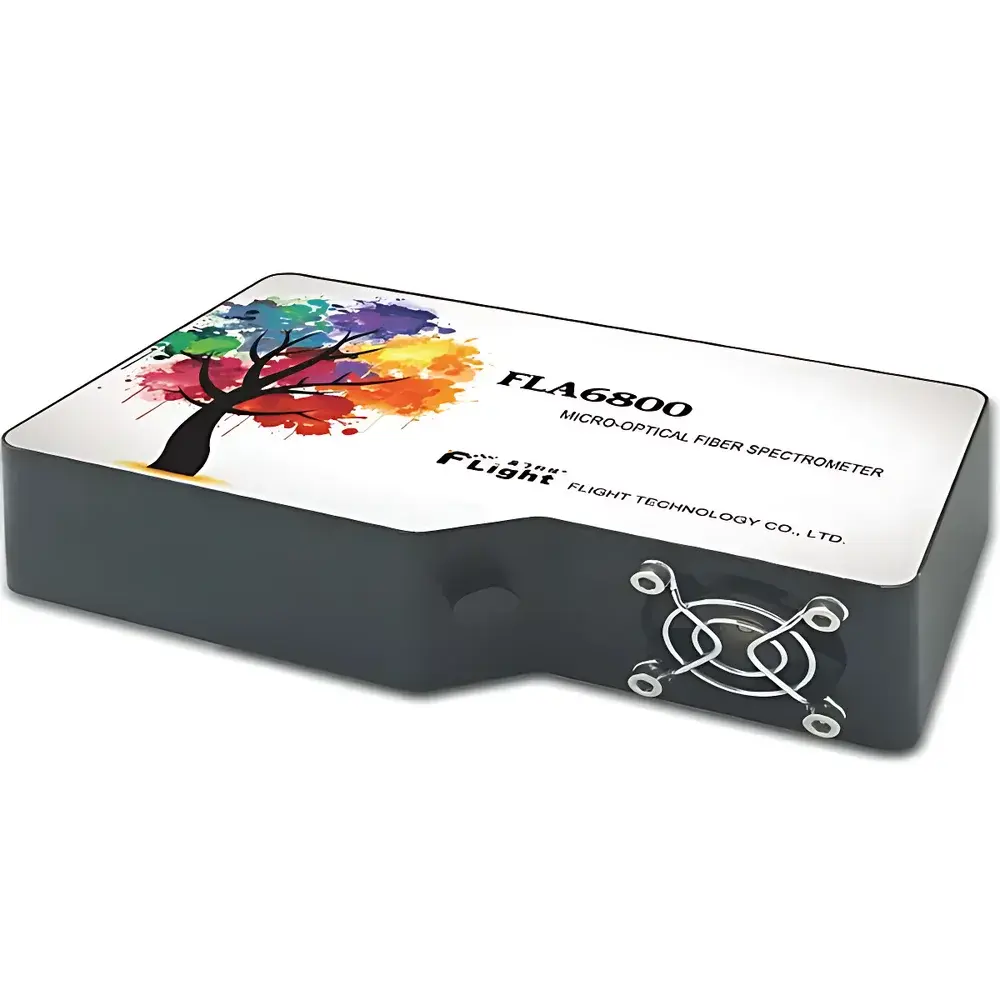
Jingfei FLA6800 Near-Infrared Fiber-Optic Spectrometer (1000–2500 nm)
| Brand | Jingfei Technology |
|---|---|
| Origin | Zhejiang, China |
| Manufacturer Type | Direct Manufacturer |
| Instrument Type | Laboratory-grade |
| Model | FLA6800 |
| Spectral Range | 1000–2500 nm |
| Optical Resolution | ≤3.20 nm (FWHM) |
| Stray Light | <0.1% |
| Detector | InGaAs linear array (512 pixels) |
| Slit Width | 200 µm (standard, optional) |
| SNR | 1200:1 |
| Linearity | >99.8% |
| Dynamic Range | 900,000 |
| Data Acquisition Interval | 12 ms + integration time |
| Sampling Mode | Reflectance / Transmittance |
| A/D Converter | 16-bit |
| FIFO Depth | 4K |
| Interface | USB 2.0 |
| Dimensions | 182 × 110 × 50 mm |
| Weight | 1500 g |
Overview
The Jingfei FLA6800 is a compact, laboratory-grade near-infrared (NIR) fiber-optic spectrometer engineered for high-fidelity spectral acquisition in the 1000–2500 nm wavelength region. It employs a fixed-grating optical design with a non-scanning InGaAs linear photodiode array detector — a configuration optimized for stability, repeatability, and rapid spectral capture without mechanical moving parts. Unlike scanning monochromator-based systems, the FLA6800 delivers full-spectrum acquisition in a single integration cycle, minimizing temporal drift and enabling real-time process monitoring or kinetic studies. Its robust optomechanical architecture ensures consistent alignment under thermal and mechanical stress, making it suitable for both benchtop research environments and field-deployable measurement setups. The instrument operates on USB bus power alone, eliminating external power supplies and enhancing portability — a critical advantage for mobile spectroscopy applications in agriculture, pharmaceutical QA/QC, and materials science.
Key Features
- High-resolution NIR detection across 1000–2500 nm using a thermoelectrically stabilized 512-pixel InGaAs linear array
- Optical resolution of ≤3.20 nm (FWHM) at standard 200 µm slit width — configurable for application-specific trade-offs between throughput and resolution
- 16-bit analog-to-digital conversion with 4K deep hardware FIFO buffer, supporting continuous streaming at up to 83 Hz (12 ms minimum cycle time + user-defined integration)
- USB 2.0 interface with embedded EEPROM storing unique calibration coefficients, wavelength mapping, and dark reference data per unit
- Zero external power requirement — fully powered via USB bus (5 V DC), compliant with USB Battery Charging Specification 1.2 for stable operation on laptops and portable workstations
- Integrated thermal management with passive heat dissipation; no active cooling required for typical lab ambient conditions (15–30 °C)
Sample Compatibility & Compliance
The FLA6800 supports both reflectance and transmittance measurement geometries through interchangeable fiber-optic probes and modular optical accessories (e.g., integrating spheres, cuvette holders, contact probes). Its spectral range covers key overtones and combination bands of C–H, O–H, and N–H bonds — essential for quantitative analysis of moisture, protein, fat, starch, and cellulose in agricultural, food, and pharmaceutical samples. The system complies with ISO/IEC 17025 requirements for measurement traceability when used with NIST-traceable calibration standards. While not certified for GMP or FDA 21 CFR Part 11 out-of-the-box, its firmware and software architecture support audit-ready configurations including electronic signatures, data integrity logging, and secure user access control — prerequisites for GLP-compliant laboratories.
Software & Data Management
The FLA6800 ships with cross-platform SDKs (Windows/Linux/macOS) and a native GUI application supporting real-time spectrum display, baseline correction, peak integration, and multivariate calibration (PLS, PCA). Raw spectral data is exported in ASCII (.csv) or HDF5 format — both compatible with MATLAB, Python (NumPy/Pandas), and commercial chemometric platforms such as Unscrambler® and Pirouette®. All calibration files and instrument metadata are stored internally and auto-loaded upon connection, ensuring reproducibility across instruments and operators. The software implements checksum-verified firmware updates and maintains a local event log (connection/disconnection, integration changes, temperature readings) for troubleshooting and compliance documentation.
Applications
- Non-destructive quality assessment of grains, seeds, and forage in agronomy and feed manufacturing
- In-line monitoring of blend uniformity and moisture content during tablet compression in pharmaceutical solid-dose production
- Identification and quantification of polymer types and additives in recycling sorting workflows
- Soil organic carbon and nitrogen estimation in environmental field surveys
- Research-grade characterization of quantum dot emission, rare-earth doped phosphors, and semiconductor absorption edges
- Method development for ASTM E1655 (standard practices for NIR quantitative analysis) and ISO 12099 (animal feeding stuffs)
FAQ
Is the FLA6800 suitable for regulatory submissions under FDA or EMA guidelines?
It can be validated for use in regulated environments; however, final qualification requires site-specific IQ/OQ/PQ protocols aligned with your organization’s SOPs and applicable standards (e.g., USP <1119>, ICH Q2(R2)).
Can the spectral resolution be improved beyond 3.20 nm?
Resolution is primarily determined by slit width and focal length; selecting a narrower slit (e.g., 50 µm) improves resolution at the expense of signal-to-noise ratio — custom configurations are available upon request.
Does the instrument include NIST-traceable calibration?
Factory calibration uses NIST-traceable tungsten-halogen and rare-earth oxide sources; users receive a calibration certificate with uncertainty budget and wavelength accuracy ±0.5 nm across the range.
What is the maximum recommended integration time?
Up to 65 seconds — limited by dark current accumulation in the InGaAs detector; for long integrations, thermoelectric stabilization is advised to maintain baseline stability.
How is thermal drift managed during extended measurements?
The detector housing incorporates thermal mass buffering and low-thermal-EMF PCB layout; internal temperature is monitored continuously and reported in real time via software API for post-acquisition drift correction.




