
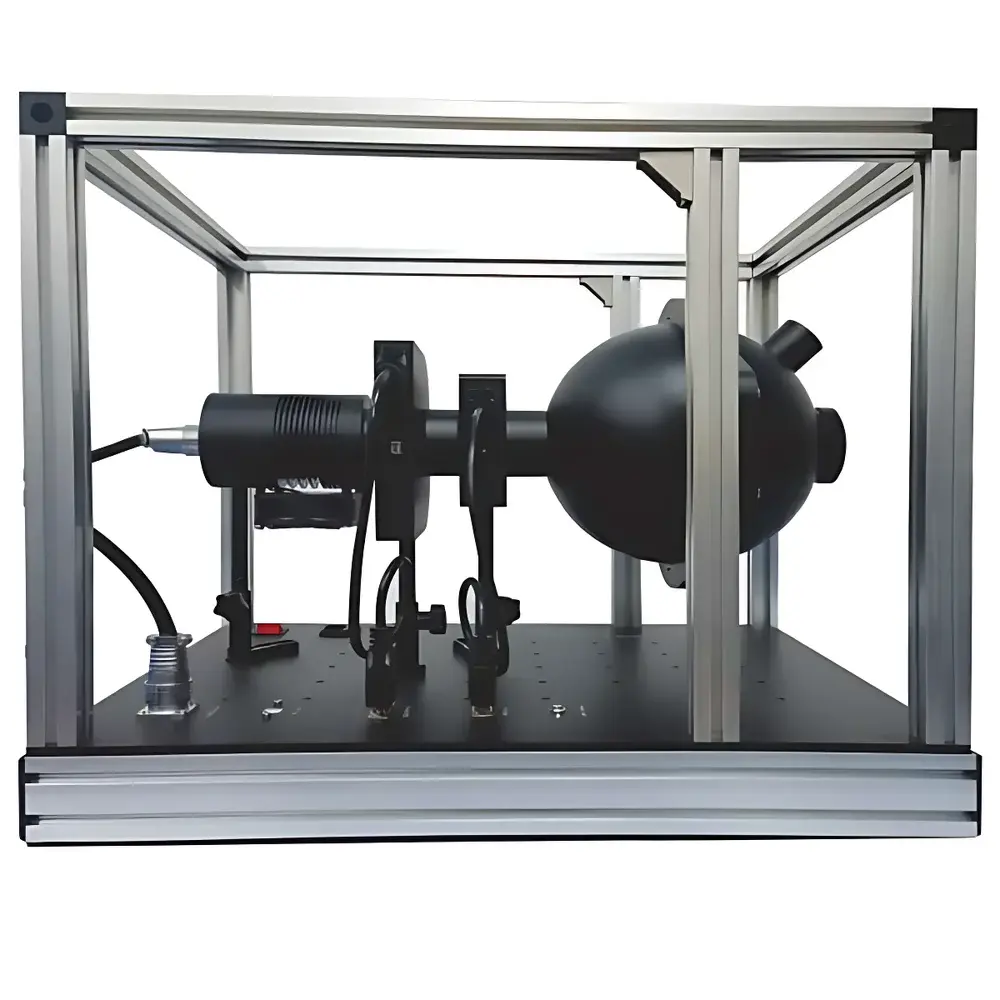
Jingfei FLQ1004 Uniform Light Source Integrating Sphere
| Brand | Jingfei Technology |
|---|---|
| Origin | Zhejiang, China |
| Manufacturer Type | OEM/ODM Producer |
| Product Origin | Domestic (China) |
| Model | FLQ1004 |
| Light Source Type | Broadband Continuous Arc Lamp (Configurable for Xenon or Mercury Short-Arc Lamps) |
| Illumination Mode | External Illumination (Collimated or Diffuse Beam Delivery) |
| Integrating Sphere Diameter Options | 200 mm, 300 mm, 500 mm (Custom Diameters Available) |
| Control Interface | RS-232 / USB / Ethernet (via Integrated Controller) |
| Attenuation Mechanism | Motorized Iris Aperture + Motorized Neutral Density Filter Wheel + Electronic Shutter |
| Software Control | Windows-Based GUI with Real-Time Intensity Calibration & Log Data Export |
Overview
The Jingfei FLQ1004 Uniform Light Source Integrating Sphere is an engineered optical calibration and testing platform designed to deliver spatially uniform, spectrally stable, and radiometrically traceable illumination over a defined exit port. Based on the fundamental principle of multiple diffuse reflections within a highly reflective PTFE-coated spherical cavity, the FLQ1004 achieves Lambertian emission characteristics essential for photometric and radiometric validation. Unlike point-source or collimated systems, this integrating sphere homogenizes angular distribution and eliminates hot spots—enabling reproducible irradiance measurements across imaging sensors, spectroradiometers, camera modules, and remote sensing detectors. The system supports configurable broadband arc-lamp excitation (Xenon or Mercury short-arc lamps), ensuring spectral coverage from 250 nm to 2500 nm depending on lamp selection and optional bandpass filtering.
Key Features
- Motorized optical attenuation architecture comprising a precision iris aperture, a multi-step neutral density (ND) filter wheel, and a high-speed electronic shutter—enabling continuous intensity control from 0.01% to 100% of maximum output with ≤0.5% repeatability per step.
- Modular sphere geometry: Standard diameters include 200 mm, 300 mm, and 500 mm; custom spheres up to 1000 mm are available to meet specific étendue and irradiance requirements.
- High-reflectance (>98% average reflectance from 250–1800 nm) sintered PTFE coating applied uniformly to interior surfaces, certified per ASTM E275 and ISO/CIE 11664-4 for spectral neutrality and long-term stability.
- Integrated controller with embedded microprocessor enables local manual operation and full remote command via ASCII-based serial protocol (RS-232), USB virtual COM, or TCP/IP Ethernet—compatible with LabVIEW, Python (PySerial), MATLAB, and custom SCADA environments.
- Thermally stabilized lamp housing with forced-air cooling and real-time temperature monitoring ensures lamp output drift < ±0.3% over 2-hour continuous operation at rated power.
Sample Compatibility & Compliance
The FLQ1004 accommodates a wide range of optoelectronic devices under test (DUTs), including but not limited to CMOS/CCD image sensors, focal plane arrays (FPAs), photodiode arrays, spectrometers, and optical encoders. Its external illumination configuration allows flexible integration into existing optical benches without requiring internal sample placement. Radiometric calibration is performed using NIST-traceable reference detectors (e.g., Hamamatsu S1337 series or IDT FDS100), with uncertainty budgets documented per ISO/IEC 17025 procedures. The system complies with relevant sections of ISO 9001:2015 (design and manufacturing controls), IEC 61000-4-3 (EMC immunity), and supports audit readiness for GLP/GMP environments when paired with validated software and calibration logs.
Software & Data Management
The included Windows-based control application provides intuitive GUI-driven operation: users define intensity setpoints, ramp profiles, dwell times, and trigger sequences. All hardware state changes—including ND filter position, iris opening angle, shutter status, and lamp power—are timestamped and logged in CSV format. Audit trail functionality records operator ID, session start/stop time, parameter modifications, and error events—meeting minimum requirements for FDA 21 CFR Part 11 compliance when deployed with user authentication and electronic signature modules. API documentation and DLL libraries are provided for seamless integration into automated test systems requiring synchronized light stimulus and data acquisition.
Applications
- Radiometric and photometric calibration of imaging systems (e.g., satellite Earth observation payloads, medical endoscopes, automotive ADAS cameras).
- Non-uniformity correction (NUC) and gain mapping of infrared and visible-band focal plane arrays.
- Linearity verification and dynamic range characterization of photodetectors and optical power meters.
- Validation of stray light rejection performance in monochromators and hyperspectral imagers.
- Development and testing of automatic exposure control (AEC) algorithms in embedded vision platforms.
FAQ
Can the FLQ1004 be calibrated against NIST-traceable standards?
Yes—Jingfei offers optional factory calibration services using primary standard detectors accredited to ISO/IEC 17025, with certificates reporting spectral irradiance (W·m⁻²·nm⁻¹) at specified wavelengths and spatial uniformity (% deviation across exit port).
Is spectral filtering supported?
The system includes standardized M32 threaded filter mounts at the exit port; customers may integrate interference filters, cut-on/cut-off filters, or custom dichroics—subject to transmission loss compensation in software.
What lamp types are compatible with the FLQ1004 housing?
The lamp module accepts standard 75 W to 300 W DC-powered short-arc xenon and mercury lamps (e.g., Ushio XBO, Hamamatsu LAX, or Excelitas GSC series); lamp drivers and safety interlocks must be selected based on electrical and thermal specifications.
Does the system support automated sequencing in production test environments?
Yes—the integrated controller supports programmable intensity ramps, dwell steps, and TTL-triggered shutter events, enabling full integration into ATE platforms via Modbus RTU or custom ASCII command sets.
How is thermal management handled during extended operation?
Active cooling uses dual centrifugal fans with thermistor feedback; internal cavity temperature is maintained below 45 °C during 4-hour continuous operation at 100% output, minimizing PTFE aging and spectral shift.




