
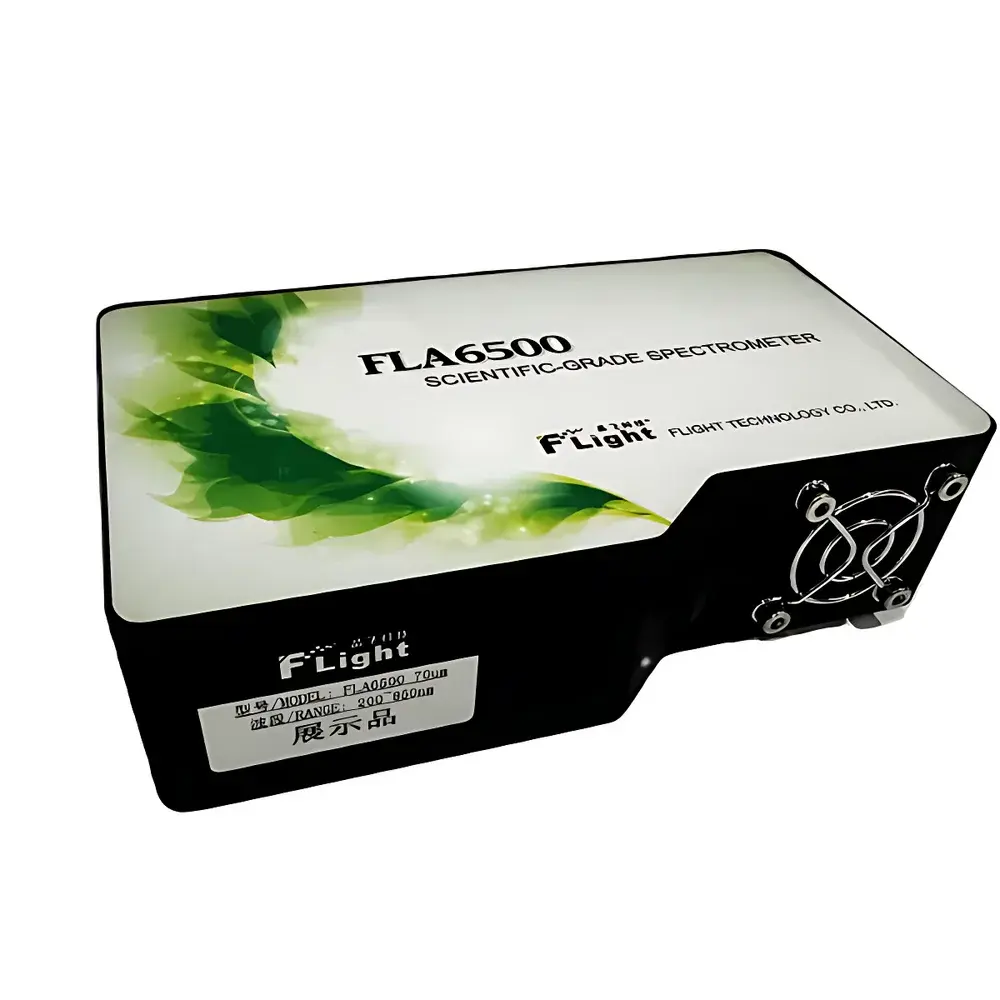
Jingfei FLA6500 High-Performance Cooled Fiber Optic Spectrometer
| Brand | Jingfei Technology |
|---|---|
| Origin | Zhejiang, China |
| Manufacturer Type | OEM Manufacturer |
| Country of Origin | China |
| Model | FLA6500 |
| Spectral Range | 200–1100 nm |
| Detector Type | Hamamatsu CCD Array |
| Optical Resolution | 0.50 nm FWHM |
| Sensitivity | 2.2 µV/e⁻ |
| Signal-to-Noise Ratio | 1000:1 |
| Dynamic Range | 2×10⁶ |
| Stray Light | <0.1% |
| Pixel Count | 1024 pixels |
| Slit Width | 70 µm (standard, optional) |
| Linearity | >99.8% |
| Minimum Integration Time | 3.6 ms |
| ADC | 16-bit with auto-zero dark current correction |
| FIFO Depth | 4K |
| Interface | USB 2.0 |
| Dimensions | 182 × 110 × 50 mm |
| Weight | 1600 g |
Overview
The Jingfei FLA6500 is a scientific-grade, thermoelectrically cooled fiber optic spectrometer engineered for high-sensitivity spectral acquisition in demanding low-light applications. Based on the principle of diffraction grating dispersion and CCD array detection, it delivers stable, reproducible measurements across the broad UV-VIS-NIR range (200–1100 nm). Its integrated Peltier cooling system reduces detector dark current by up to two orders of magnitude compared to uncooled counterparts—enabling a 200× sensitivity gain over standard benchtop spectrometers. This makes the FLA6500 particularly suited for quantitative fluorescence spectroscopy—including weak biological fluorophores (e.g., GFP, NADH), solid-state luminescence, Raman scattering pre-filtered signals, and time-resolved emission studies where photon budget is constrained.
Key Features
- Thermoelectrically cooled Hamamatsu CCD detector operating at stabilized temperatures (typically −10 °C to −15 °C), minimizing thermal noise and enabling long integration times without saturation.
- Optical resolution of ≤0.50 nm FWHM (at 500 nm, with 70 µm slit), achieved via precision-blazed holographic grating and optimized optical path design.
- 16-bit analog-to-digital converter with hardware-based auto-zero dark current correction—eliminating baseline drift and enhancing measurement repeatability across variable ambient conditions.
- 4K-deep FIFO buffer and USB 2.0 high-speed interface support sustained data throughput up to 1.2 MB/s, facilitating real-time spectral monitoring and rapid sequence acquisition.
- Onboard EEPROM stores individual wavelength calibration coefficients, intensity response curves, and pixel-specific nonlinearity corrections—ensuring traceable, instrument-specific metrology without external recalibration.
- Minimum integration time of 3.6 ms enables dynamic process monitoring while preserving signal fidelity; maximum integration extends to 65 seconds for ultra-low-light capture.
Sample Compatibility & Compliance
The FLA6500 interfaces seamlessly with industry-standard SMA 905 fiber connectors and supports modular optical configurations—including integrating spheres (for reflectance/transmittance), cuvette holders, collimating optics, and laser-induced fluorescence (LIF) excitation paths. It complies with essential laboratory instrumentation requirements for analytical traceability: each unit ships with NIST-traceable spectral calibration data, and its firmware architecture supports audit-ready logging per GLP/GMP-aligned workflows. While not FDA 21 CFR Part 11 certified out-of-the-box, the device’s deterministic USB communication protocol and EEPROM-stored calibration metadata enable straightforward validation for regulated environments (e.g., ISO/IEC 17025-accredited labs, USP spectroscopic method verification).
Software & Data Management
The spectrometer is compatible with Jingfei’s cross-platform SDK (Windows/Linux/macOS) and third-party APIs including LabVIEW, MATLAB, Python (via PyUSB or custom ctypes bindings), and .NET. The native SpectraView software provides real-time spectral visualization, multi-curve overlay, peak identification with full-width half-maximum (FWHM) calculation, and export in CSV, TXT, and JCAMP-DX formats. All acquired spectra retain embedded metadata: timestamp, integration time, temperature sensor reading, and detector gain setting—critical for longitudinal data integrity and post-acquisition reprocessing. Hot-swap capability allows live parameter adjustment (e.g., integration time, averaging count) without disconnecting the device.
Applications
- Low-intensity fluorescence quantification in life sciences: single-cell autofluorescence, enzyme-linked fluorometric assays, and quantum dot photostability testing.
- Material characterization: photoluminescence quantum yield (PLQY) estimation of perovskites and OLED emitters, bandgap analysis of nanomaterials.
- Environmental monitoring: dissolved organic matter (DOM) fluorescence EEM profiling, chlorophyll-a detection in turbid waters.
- Industrial QC: LED spectral power distribution (SPD) verification, color consistency grading of phosphor-coated LEDs, and UV-curable resin cure monitoring.
- Academic research: cavity ring-down spectroscopy (CRDS) signal detection, plasma emission line profiling, and portable field-deployable LIBS spectral preprocessing.
FAQ
What cooling method does the FLA6500 use, and how does it impact performance?
The FLA6500 employs a single-stage thermoelectric (Peltier) cooler that stabilizes the CCD sensor at approximately −12 °C. This reduces dark current by >99% relative to room-temperature operation, directly improving signal-to-noise ratio and enabling reliable sub-second integrations in low-photon-flux scenarios.
Is the spectral calibration traceable to NIST standards?
Yes—each unit undergoes factory calibration using NIST-traceable tungsten-halogen and mercury-argon lamp sources. Calibration coefficients are permanently stored in onboard EEPROM and accessible programmatically.
Can the FLA6500 be synchronized with external triggers (e.g., pulsed lasers or shutter systems)?
Yes—the device supports TTL-compatible external trigger input (rising-edge active) for precise timing control in time-gated or pump-probe experiments.
Does the spectrometer support dark reference acquisition during measurement sequences?
Yes—integrated dark scan functionality allows automatic background subtraction using zero-integration-time references, fully synchronized with light scans to compensate for thermal drift.
What is the warranty and service support structure for international customers?
Jingfei offers a 24-month limited warranty covering parts and labor. Technical documentation, firmware updates, and SDK support are provided globally via secure customer portal access; regional service partners are available in EU, North America, and APAC for calibration and repair.
Related Products





