
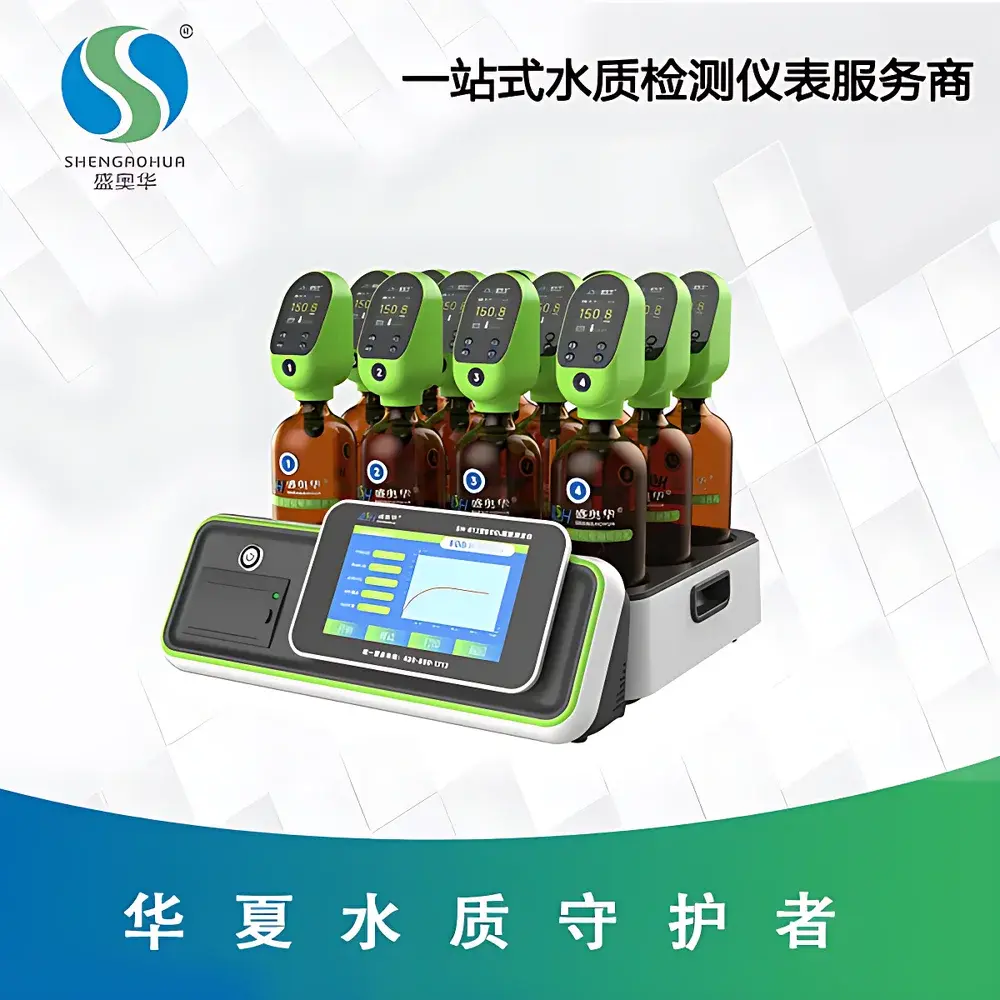
Shengaohua SH-808/SH-812 BOD₅ Intelligent Analyzer
| Brand | Shengaohua |
|---|---|
| Origin | Jiangsu, China |
| Manufacturer Type | Direct Manufacturer |
| Country of Origin | China |
| Model | SH-808 / SH-812 |
| Instrument Type | Laboratory BOD Analyzer |
| Measurement Principle | Manometric (Pressure-Difference) Method |
| Measurement Range | 0–4000 mg/L |
| Detection Limit | 0.1 mg/L |
| Accuracy | ±8% |
| Repeatability | 3% |
| Incubation Duration | 5 Days |
| Sample Capacity | 8 or 12 vials per batch |
| Display | 7-inch color touchscreen + 1.5-inch auxiliary color LCD |
| Stirring Mechanism | Electromagnetic |
| Temperature Control | 20 °C ±1 °C |
| Data Storage | 10,000 records |
| Recording Interval | Every 2 hours |
| Power Rating | 20 W |
| Net Weight | 2.8 kg (SH-808) / 5.8 kg (SH-812) |
| Dimensions | 300×400×150 mm (SH-808) / 400×400×150 mm (SH-812) |
Overview
The Shengaohua SH-808 and SH-812 BOD5 Intelligent Analyzers are laboratory-grade manometric respirometers engineered for precise, mercury-free determination of biochemical oxygen demand over a standard 5-day incubation period. Designed in strict compliance with HJ 505–2009 (“Determination of Biochemical Oxygen Demand (BOD5) in Water—Five-Day Culture Method”), these instruments quantify BOD5 by continuously monitoring pressure differentials within sealed, CO2-scrubbed test vessels. As microorganisms degrade biodegradable organic matter under controlled aerobic conditions at 20 °C ±1 °C, dissolved oxygen is consumed and replenished from the headspace; concurrently, generated CO2 is chemically absorbed by potassium hydroxide (KOH) pellets integrated into the vessel caps. The resulting net pressure drop—proportional to oxygen consumption—is detected by high-stability imported pressure sensors and converted directly into BOD5 concentration (mg/L), eliminating manual calculation or unit conversion.
Key Features
- Mercury-free manometric detection ensures operator safety, regulatory compliance, and environmental responsibility—fully aligned with global phase-out initiatives for mercury-based analytical methods.
- Dual-display architecture: a 7-inch capacitive touchscreen serves as the primary interface for real-time parameter configuration, live trend visualization, and result review; a secondary 1.5-inch color LCD provides at-a-glance status feedback—including temperature, elapsed time, and vial-specific progress—without requiring screen navigation.
- Independent vial operation: each of the 8 (SH-808) or 12 (SH-812) sample positions features dedicated pressure sensing, electromagnetic stirring, and thermal regulation—enabling heterogeneous sample batches with mixed matrices (e.g., industrial effluent, municipal wastewater, surface water) to be processed simultaneously without cross-interference.
- Integrated lithium battery system supports uninterrupted operation during brief power outages and enables portable deployment in field laboratories or mobile environmental testing units; simultaneous charging and active measurement is supported.
- Eight segmented calibration ranges (0–10, 0–50, 0–100, …, up to 0–4000 mg/L) allow optimized signal-to-noise ratio across diverse sample strengths—critical for maintaining resolution at low concentrations (<1 mg/L) while preserving linearity at high-load scenarios.
- Automated data logging at 2-hour intervals stores up to 10,000 complete test records locally, including timestamps, pressure differentials, calculated BOD values, temperature traces, and user-assigned sample IDs—each record cryptographically timestamped and immutable post-acquisition.
Sample Compatibility & Compliance
The SH-808/812 accommodates standard 60-mL BOD bottles with KOH-absorbent caps, compatible with both domestic and international bottle specifications (e.g., ASTM D5210, ISO 5815-1:2019). It supports raw and diluted wastewater, treated effluents, drinking water sources, agricultural runoff, and spiked reference solutions. All firmware and hardware design elements adhere to the metrological requirements outlined in HJ 505–2009, with traceable validation against NIST-traceable pressure standards. While not certified to IEC 61000-6-3 (EMC) or UL 61010-1 out-of-the-box, the instrument’s robust enclosure and shielded sensor circuitry meet typical laboratory electromagnetic compatibility expectations. For regulated environments, audit trails, electronic signatures, and user access control can be enabled via optional GLP/GMP-compliant software modules compliant with FDA 21 CFR Part 11 requirements.
Software & Data Management
Built-in embedded firmware enables full-cycle automation—from vial initialization and temperature stabilization to endpoint validation and report generation. Raw pressure-time datasets are stored in IEEE 754-compliant floating-point format to preserve numerical integrity. Local export options include USB-host CSV dumps and direct thermal printing of final reports (including sample ID, incubation start/end times, measured BOD5, and operator signature field). Optional cloud-connected firmware extends functionality to remote monitoring: authenticated users access real-time dashboards via secure HTTPS endpoints to view live vial status, historical trends, and comparative analytics across multiple instruments. Role-based permissions (admin, technician, viewer) enforce data governance policies. All wireless transmissions use TLS 1.2+ encryption; no data is retained on third-party servers unless explicitly configured in private-deployment mode.
Applications
- Wastewater treatment plant QC/QA: daily influent/effluent BOD5 verification, process optimization, and discharge compliance reporting.
- Environmental consulting labs: multi-client project tracking, regulatory submission packages (e.g., EPA Form 3320-1), and inter-laboratory comparison studies.
- Academic research: kinetic modeling of biodegradation pathways, inhibitor screening, and microbial community activity profiling under controlled DO regimes.
- Industrial EHS departments: routine monitoring of process water, cooling tower blowdown, and pretreatment verification prior to municipal sewer discharge.
- Government monitoring networks: standardized field-deployable BOD assessment in regional water quality surveillance programs where mercury-free methodology is mandated.
FAQ
What is the fundamental difference between manometric BOD measurement and dilution-based Winkler titration?
Manometric detection measures oxygen consumption indirectly via pressure change in a closed system, enabling continuous, non-destructive monitoring without reagent addition or endpoint ambiguity. Titration requires discrete sampling, chemical reagents, and subjective endpoint interpretation—introducing higher variability and labor intensity.
Can the SH-812 accommodate custom bottle geometries or alternative CO2 absorbents?
The instrument is calibrated for standard 60-mL glass BOD bottles with KOH-saturated wicks. Substitution with alternate absorbents (e.g., NaOH, ascarite) invalidates factory calibration and requires full recalibration using certified BOD reference standards.
Is temperature uniformity across all 12 vials validated under load?
Yes—thermal mapping per ICH Q5C guidelines confirms ≤±0.3 °C spatial deviation across the full chamber at 20 °C steady state, verified with NIST-traceable PT100 probes at nine defined locations.
How does the system handle volatile organic compounds (VOCs) that may interfere with pressure readings?
VOC volatilization is mitigated by the KOH cap’s dual function: CO2 absorption and alkaline suppression of weak acid volatility. For highly volatile samples (e.g., ethanol-rich distillery effluent), dilution below 1% v/v or pre-aeration is recommended per HJ 505–2009 Annex C.
What maintenance intervals are recommended for long-term accuracy?
Pressure sensor zero calibration every 90 days; KOH cap replacement before each new batch; annual verification against certified pressure standard (±0.05 kPa tolerance); stirrer coil inspection every 6 months for magnetic coupling integrity.
Related Products







