
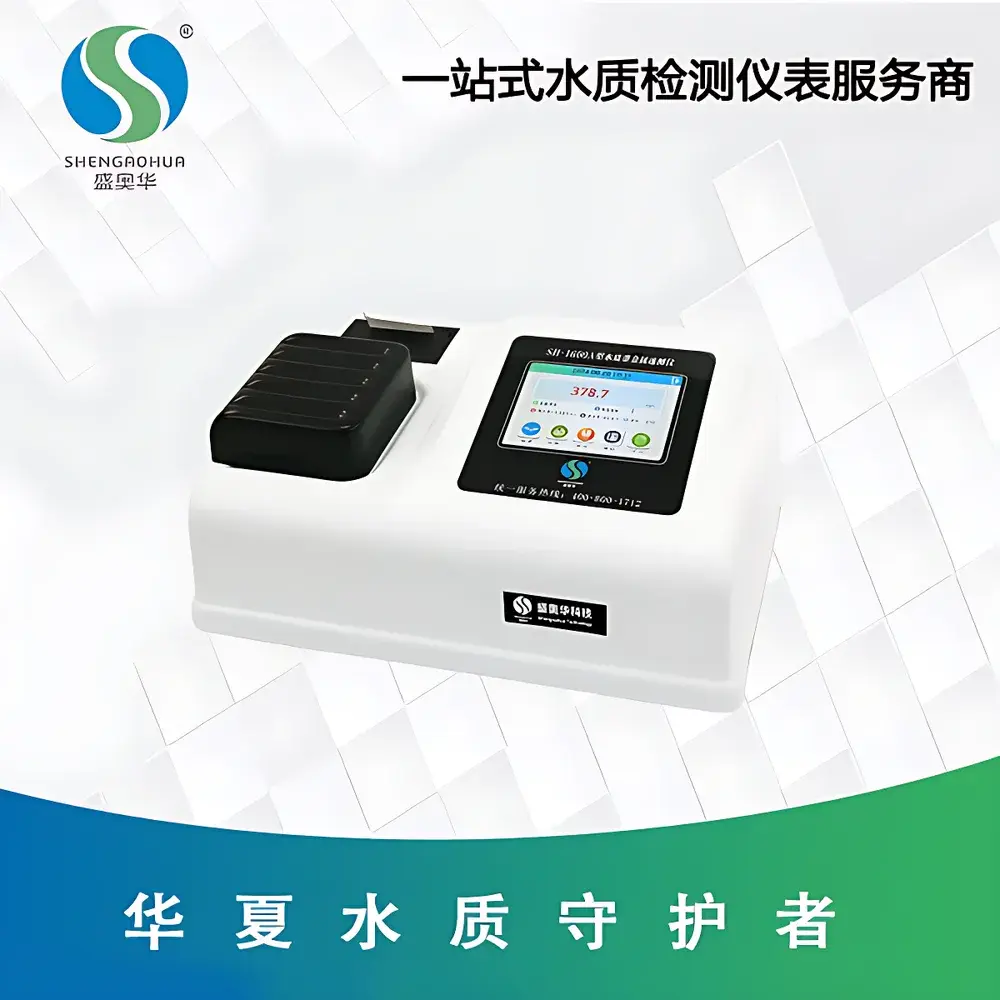
Shengaohua SH-1600A(V10) Benchtop Heavy Metals Analyzer for Water Quality
| Brand | Shengaohua |
|---|---|
| Origin | Jiangsu, China |
| Manufacturer Type | Direct Manufacturer |
| Origin Category | Domestic |
| Model | SH-1600A(V10) |
| Instrument Type | Benchtop Laboratory Analyzer |
| Detection Principle | Photometric Method (Colorimetry) |
| Detectable Metals | Cu, Ni, Total Cr, Cr(VI), Fe, Zn, Ag (Multi-parameter) |
| Measurement Time | 30–40 min per sample |
| Accuracy/Precision | ≤ ±8% |
| Resolution | 0.001 mg/L |
| Display | 5-inch Full-touch Color LCD |
| Cuvette/Tube Compatibility | Dual-mode (Cuvette & Test Tube) |
| Light Source | Cold LED with Narrow-band Interference Filter (Lifespan ≥ 100,000 h) |
| Digestion Temperature Range | Room Temp to 200 °C (Adjustable & Saveable) |
| Curve Storage | 100 total curves (15 standard + 85 expandable) |
| Data Storage Capacity | 5 million records |
| Operating Humidity | ≤85% RH (non-condensing) |
| Power Supply | AC 220 V ±10%, 50 Hz |
| Rated Power | 15 W |
| Net Weight | 2.5 kg |
Overview
The Shengaohua SH-1600A(V10) Benchtop Heavy Metals Analyzer is a dedicated photometric instrument engineered for quantitative determination of trace heavy metal ions in aqueous matrices—including surface water, groundwater, wastewater, and industrial effluents. It operates on the principle of spectrophotometric colorimetry: target analytes (Cu²⁺, Ni²⁺, Fe²⁺/Fe³⁺, Zn²⁺, Ag⁺, Cr³⁺, and Cr⁶⁺) react with specific chromogenic reagents under controlled thermal digestion conditions to form stable colored complexes. Absorbance is measured at defined wavelengths using a cold LED light source coupled with narrow-band interference filters—ensuring minimal spectral drift and high photometric stability (< ±0.005 absorbance units over 20 minutes). The system integrates digestion, reaction, optical measurement, and data processing into a single compact benchtop platform, eliminating external heating blocks or standalone spectrophotometers. Its modular design supports method flexibility across regulatory and research contexts, particularly where multi-parameter screening and field-deployable lab validation are required.
Key Features
- Integrated digestion and photometric measurement in one unit, with programmable temperature control from ambient to 200 °C and adjustable digestion time—enabling compliance with standardized digestion protocols (e.g., EPA Method 200.7, ISO 11969).
- Dual-format sample handling: compatible with both 10-mm square cuvettes and standard 16-mm test tubes, accommodating diverse laboratory workflows and legacy method requirements.
- 5-inch full-touch color LCD interface with intuitive Chinese menu navigation; no external PC required for routine operation.
- Preloaded calibration curve library: 15 factory-validated standard curves plus 85 user-expandable curves—each configurable for matrix-specific compensation (e.g., high-salinity or organic-rich wastewater).
- Intelligent power management: digestion heater output dynamically adjusts based on number of loaded samples; built-in over-temperature and time-delay protection ensures reproducible thermal profiles.
- Optical architecture employs rear-mounted optical path design to eliminate ambient light interference—critical for stable absorbance readings in non-dedicated lab environments.
- Onboard thermal printer enables immediate hardcopy documentation of results, including date/time stamp, sample ID, method name, and raw absorbance values—supporting GLP-compliant record retention.
Sample Compatibility & Compliance
The SH-1600A(V10) is validated for use with drinking water, municipal wastewater, industrial process water, and pretreated leachates. It meets fundamental performance criteria outlined in ISO 7027 (water quality — determination of turbidity) and aligns with photometric accuracy expectations referenced in US EPA Guidance Document QA/G-5. While not certified to ISO/IEC 17025 as a standalone testing service, its measurement uncertainty profile (≤ ±8% RSD at mid-range concentrations) satisfies internal QC requirements for Tier-2 environmental monitoring labs. The instrument’s digestion capability supports oxidation of Cr(III) to Cr(VI) prior to hexavalent chromium analysis—a prerequisite for compliance with ASTM D5257 and ISO 11087. All reagent kits supplied by Shengaohua are traceably calibrated against NIST-traceable CRM standards (e.g., NIST SRM 1643e for multi-element water standards).
Software & Data Management
Data acquisition and reporting are managed via embedded firmware with timestamped storage of up to 5 million discrete measurements. Each entry includes sample ID, selected parameter, measured concentration (mg/L), absorbance value, curve ID used, digestion temperature/duration, and operator tag (if enabled). USB 2.0 interface allows secure export of CSV-formatted datasets to Windows-based PCs for further statistical analysis or LIMS integration. Optional desktop software provides automated graph generation (concentration vs. time series, calibration linearity plots), batch report compilation, and audit trail logging—supporting basic 21 CFR Part 11 readiness through user-access controls and electronic signature prompts. No cloud connectivity or remote access functionality is implemented, preserving data sovereignty in regulated environments.
Applications
- Routine compliance monitoring of discharge permits (e.g., NPDES, EU Urban Wastewater Treatment Directive Annex I limits).
- QC/QA support for electroplating, metal finishing, and battery manufacturing effluent streams.
- Academic and research laboratories conducting speciation studies (e.g., Cr(VI) vs. total Cr differentiation) and method development.
- Environmental consulting firms performing site characterization and remediation verification sampling.
- Water utility labs conducting source water surveillance and treatment efficacy assessment.
FAQ
What digestion methods does the SH-1600A(V10) support for chromium speciation?
It supports open-vessel hot acid digestion (HNO₃/H₂SO₄) for total chromium determination and selective oxidation (e.g., KMnO₄ in acidic medium) for Cr(VI) quantification—protocols aligned with ISO 11087 and EPA Method 7196A.
Can the instrument store custom calibration curves generated with user-prepared standards?
Yes—up to 85 expandable curves can be created, saved, and recalled using the touch interface; each curve retains slope, intercept, correlation coefficient, and validity date.
Is the thermal printer compatible with continuous label stock or only roll paper?
It uses standard 57-mm thermal roll paper; no adhesive label support is provided.
Does the device meet electromagnetic compatibility (EMC) requirements for laboratory deployment?
It complies with GB/T 18268.1–2010 (equivalent to IEC 61326-1), including immunity to electrostatic discharge and radiated RF fields typical of shared analytical lab spaces.
How is measurement traceability maintained across instrument lifetime?
Users may perform periodic verification using NIST-traceable liquid standards; the firmware logs all verification events with pass/fail status and deviation metrics relative to certified values.







