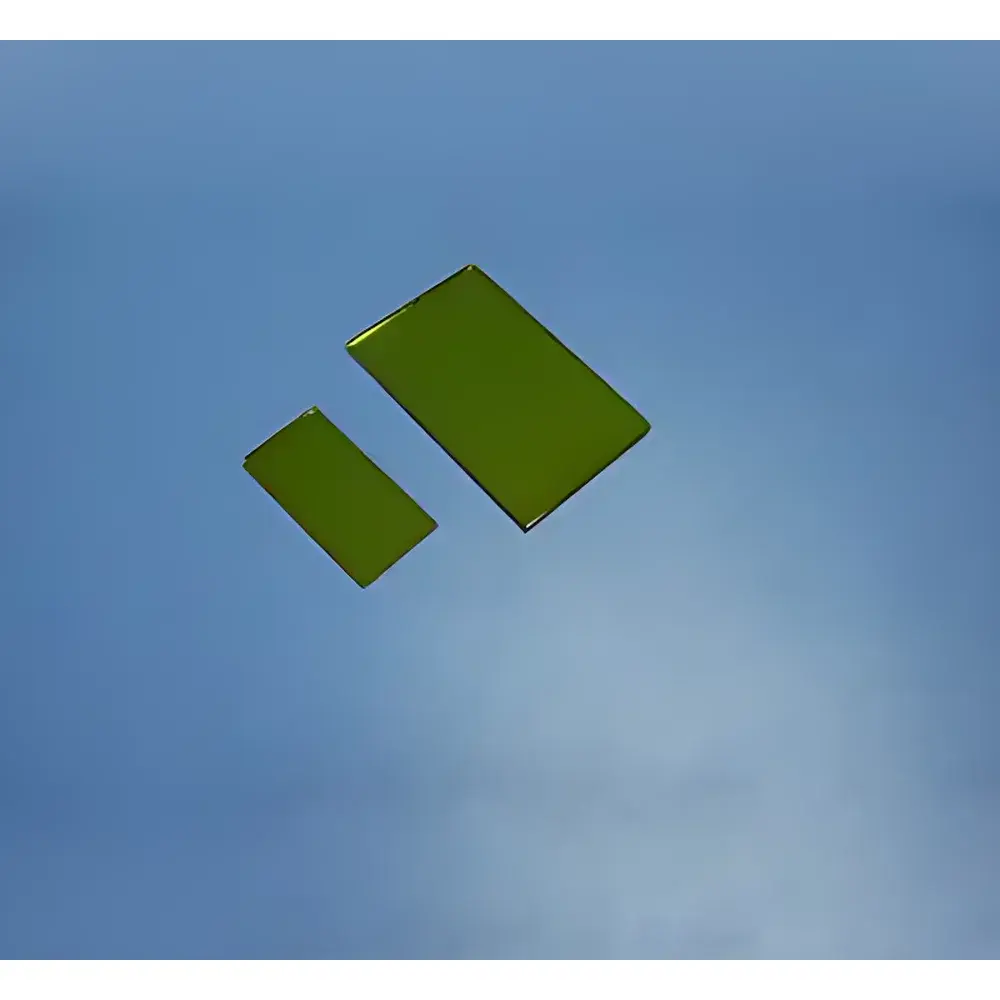
Bi12SiO20 Bismuth Silicon Oxide Crystal Substrate
| Brand | Hefei Kejing |
|---|---|
| Origin | Anhui, China |
| Manufacturer Type | Authorized Distributor |
| Origin Category | Domestic |
| Model | Bi12SiO20 Crystal Substrate |
| Price | Upon Request |
| Crystal Orientation | <100>, <110> |
| Crystal Structure | Cubic |
| Lattice Constant | a = 10.146 Å |
| Growth Method | Czochralski (CZ) |
| Melting Point | 930 °C |
| Density | 9.2 g/cm³ |
| Mohs Hardness | 4.5 |
| Dielectric Constant (εS₁₁/ε₀) | 42.7 |
| Dielectric Constant (εT₁₁/ε₀) | 47.5 |
| Elastic Stiffness Coefficient (×10¹¹ N/m²) | CE₁₁ = 1.33, CE₄₄ = 0.25 |
| Piezoelectric Strain Coefficient (C/m²) | e₁₄ = 1.01 |
| Transmission Range | 470–7500 nm |
| Electro-Optic Coefficient (×10⁻¹² m/V) | r₄₁ = 5 |
| Refractive Index | 2.45 @ 632.8 nm |
| Refractive Index Gradient | ≤5 ×10⁻⁵ /cm @ 632.8 nm |
| Optical Rotation | −20°/mm (left-handed) @ 632.8 nm |
| Transmittance | 69% @ 632.8 nm |
| Standard Orientations | <001>, <100> |
| Orientation Tolerance | ±0.5° |
| Typical Dimensions | 10×10×0.5 mm, 25×25×0.5 mm, 30×30×0.5 mm, 50×50×0.5 mm |
| Surface Finish | Fine-Lapped or Double-Polished |
| Packaging | Class 1000 Cleanroom Assembly, Class 100 Clean Bag or Individual Chip Carrier |
Overview
Bi12SiO20 (Bismuth Silicon Oxide, commonly abbreviated as BSO) is a cubic electro-optic and piezoelectric crystal widely employed in advanced photonic and acoustic device fabrication. Engineered for high reproducibility in optical modulation, acousto-optic deflection, holographic data storage, and surface/bulk acoustic wave (SAW/BAW) transduction, BSO substrates exhibit strong Pockels effect, moderate transparency across the visible to mid-infrared spectrum, and favorable lattice matching with thin-film dielectric and metallic electrodes. Its non-centrosymmetric structure (space group I23) enables linear electro-optic response without applied bias, making it especially suitable for low-voltage, high-speed phase modulators and real-time holography systems. The material’s relatively low hardness and controlled thermal expansion support precision dicing, lithographic patterning, and epitaxial layer integration under standard cleanroom protocols.
Key Features
- Cubic crystal symmetry with lattice constant a = 10.146 Å, enabling isotropic mechanical compliance and predictable anisotropic optical response
- High electro-optic coefficient r41 = 5 × 10⁻¹² m/V at 632.8 nm — among the highest for non-ferroelectric oxides
- Broad optical transmission window (470–7500 nm), optimized for He–Ne laser (632.8 nm), Nd:YAG (1064 nm), and CO2 (10.6 µm) applications
- Controlled orientation tolerance (±0.5°) for and cuts, critical for polarization-sensitive interferometric and modulator designs
- Double-polished surfaces with RMS roughness < 5 Å, certified for thin-film deposition (e.g., Ti/Au, ITO, SiO2) and direct bonding processes
- Class 1000 cleanroom handling and Class 100 packaging ensure particulate contamination < 10 particles ≥0.5 µm per cubic foot
Sample Compatibility & Compliance
BSO substrates are compatible with standard semiconductor processing tools including sputtering, e-beam evaporation, photolithography (i-line, 365 nm), and reactive ion etching (RIE) using CHF3/O2 chemistries. All wafers undergo post-growth annealing to reduce oxygen vacancy concentration, thereby minimizing optical absorption drift and improving long-term refractive index stability. While not classified as a medical device or regulated under FDA 21 CFR Part 11, BSO substrates conform to ISO 14644-1 Class 5 cleanroom packaging standards and meet ASTM F1529-18 requirements for optical substrate dimensional verification. Certificates of Conformance include XRD rocking curve full-width-at-half-maximum (FWHM) < 30 arcsec, surface flatness λ/10 PV (per 25 mm aperture), and spectral transmittance traceability to NIST-traceable reference standards.
Software & Data Management
No embedded firmware or proprietary software is associated with raw BSO crystal substrates; however, they serve as foundational platforms for integration into instrumented testbeds governed by GLP/GMP-compliant data acquisition frameworks. When used in electro-optic modulator characterization, substrates interface with commercial instrumentation (e.g., Keysight B1500A, Thorlabs TSP01) whose software supports automated parameter logging, timestamped spectral scans, and export to CSV/HDF5 formats. Traceability documentation includes lot-specific XRD patterns, interferometric surface maps, and spectrophotometric transmittance curves — all archived with unique serial identifiers aligned to internal quality management system (QMS) revision control per ISO 9001:2015 Clause 8.5.2.
Applications
- Electro-optic phase and amplitude modulators for fiber-optic communications and quantum optics experiments
- Holographic memory cells leveraging real-time dynamic grating formation via two-beam interference
- Surface acoustic wave (SAW) delay lines and resonators operating up to 2 GHz, benefiting from BSO’s high electromechanical coupling factor k² ≈ 0.12
- Acousto-optic tunable filters (AOTFs) requiring broadband diffraction efficiency and sub-millisecond response
- Substrates for van der Waals heterostructure assembly in 2D optoelectronics research
- Reference standards in ellipsometry calibration workflows due to stable, well-characterized complex refractive index
FAQ
What crystal orientations are available as standard?
Standard offerings include and orientations, both with angular tolerance ≤ ±0.5° as verified by high-resolution X-ray diffraction (HRXRD).
Can custom thicknesses or coatings be provided?
Yes — custom thicknesses (0.3–2.0 mm), anti-reflection coatings (MgF₂, Ta₂O₅/SiO₂ multilayer), and metallization (Cr/Au, Ti/Pt/Au) are available under NDA and supported by process qualification reports.
Is thermal annealing recommended prior to device fabrication?
Annealing at 500–600 °C in O2 ambient for 2–4 hours is recommended to stabilize defect-related absorption and improve electro-optic response linearity.
How is surface quality validated?
Each substrate undergoes white-light interferometry (WLI) for flatness (λ/10 PV), atomic force microscopy (AFM) for RMS roughness (<5 Å), and visual inspection under 100× dark-field microscopy for scratches and digs per MIL-PRF-13830B.
Are material certificates traceable to international standards?
Yes — all certificates include metrological traceability to NIST SRM 2034 (for transmittance) and PTB reference crystals (for lattice parameter), documented per ISO/IEC 17025:2017 Annex A.2.