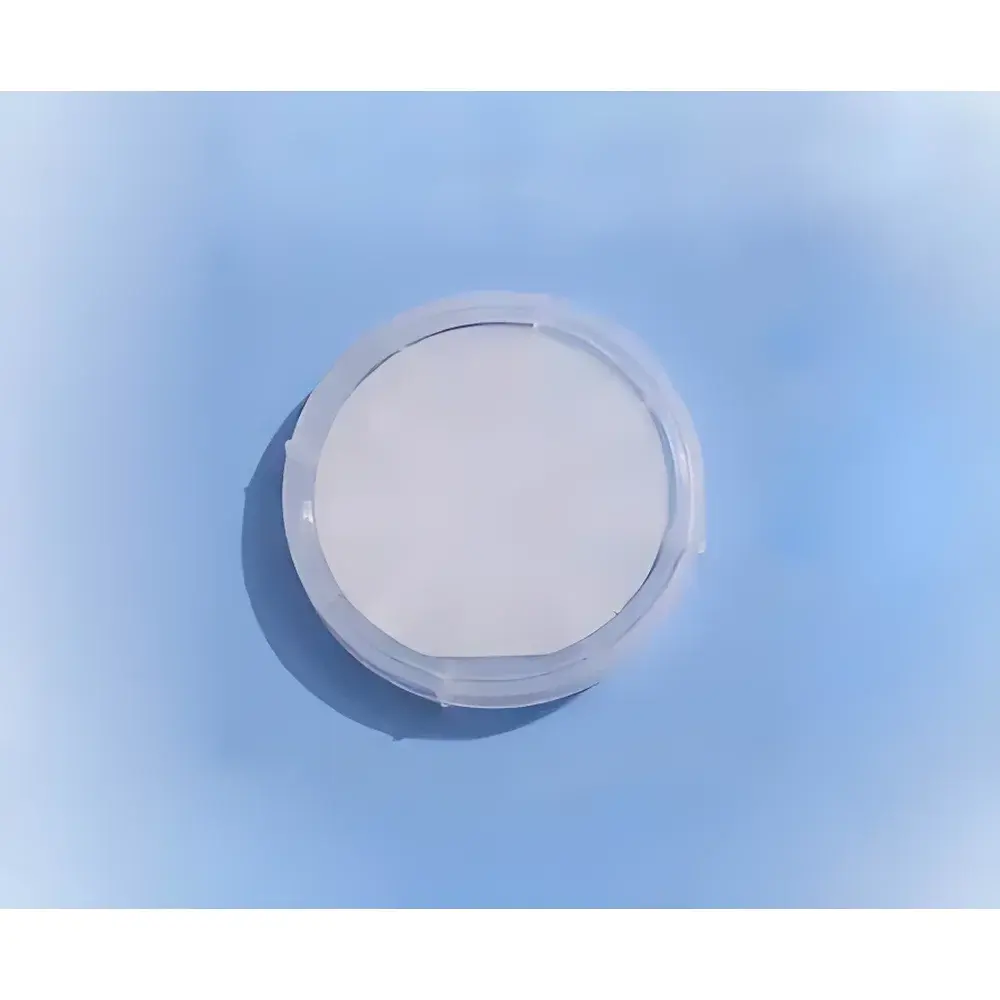
Gallium Nitride (GaN) Epitaxial Thin Films on Sapphire Substrates
| Brand | Hefei Kejing |
|---|---|
| Origin | Anhui, China |
| Manufacturer Type | Authorized Distributor |
| Country of Origin | China |
| Model | GaN Epitaxial Thin Film on Sapphire |
| Standard Dimensions | Ø50.8 ± 1 mm × 4–25 µm |
| Crystal Orientation | c-plane <0001> ±1° |
| Conductivity Type | N-type (ρ < 0.05 Ω·cm), Semi-insulating (ρ > 10⁶ Ω·cm), or P-type |
| Dislocation Density | <1 × 10⁸ cm⁻² |
| Surface Finish | As-grown Ga-face |
| RMS Roughness | <1 nm |
| Usable Area | >90% |
| Packaging | Class 1000 Cleanroom, Class 100 clean bag or individual cassette |
Overview
Gallium Nitride (GaN) epitaxial thin films on sapphire substrates are engineered for high-performance optoelectronic and power electronic device fabrication. These films are grown via hydride vapor phase epitaxy (HVPE), a scalable and industrially validated technique that enables high growth rates and excellent crystalline quality. In the HVPE process, gaseous gallium chloride (GaCl) — generated by reacting metallic gallium with hydrogen chloride — reacts with ammonia (NH₃) to deposit stoichiometric GaN on thermally stable, lattice-mismatched sapphire (Al₂O₃) templates. The resulting heteroepitaxial structure leverages sapphire’s thermal stability and optical transparency while mitigating the cost and scalability limitations associated with bulk GaN single-crystal substrates. The films exhibit strict c-axis orientation ( ±1°), low threading dislocation density (<1 × 10⁸ cm⁻²), and sub-nanometer surface roughness (RMS <1 nm), making them suitable for demanding applications including blue/UV LEDs, laser diodes, high-electron-mobility transistors (HEMTs), and RF power amplifiers.
Key Features
- High-quality heteroepitaxial GaN layers grown on c-plane sapphire (0001) with angular tolerance ≤ ±1°
- Controlled conductivity types: N-type (resistivity 10⁶ Ω·cm), and P-type options available
- Thickness range: 4 µm to 25 µm — selectable per application requirements (e.g., thicker films for high-voltage devices; thinner for UV photodetectors)
- Low defect density: threading dislocation density consistently below 1 × 10⁸ cm⁻², verified by high-resolution X-ray diffraction (HR-XRD) and cathodoluminescence mapping
- As-grown Ga-polar surface with RMS roughness <1 nm — eliminating post-growth polishing and preserving interface integrity
- High usable area (>90%) with minimal edge exclusion, supporting high-yield wafer-level processing
- Customizable specifications: alternative orientations (e.g., m-plane, r-plane), non-standard diameters (Ø25 mm to Ø150 mm), and tailored doping profiles upon request
Sample Compatibility & Compliance
These GaN/sapphire wafers are compatible with standard semiconductor fabrication toolsets, including metal-organic chemical vapor deposition (MOCVD), molecular beam epitaxy (MBE), reactive ion etching (RIE), electron-beam lithography, and lift-off metallization processes. All wafers undergo rigorous pre-shipment inspection in ISO Class 5 (Class 100) cleanroom environments and are packaged in certified Class 1000 cleanrooms using static-dissipative, particle-free containers. While not certified to specific regulatory standards (e.g., ISO 9001 or IATF 16949), the manufacturing and handling protocols align with industry best practices for compound semiconductor materials used in R&D and pilot-line production. Documentation includes material certificates of conformance (CoC), HR-XRD rocking curve full-width-at-half-maximum (FWHM) data, and surface profilometry reports — supporting traceability and GLP-compliant lab workflows.
Software & Data Management
As a passive substrate material, these GaN thin films do not incorporate embedded firmware or require proprietary software. However, they are fully compatible with industry-standard metrology platforms — including Veeco Dimension XR AFMs, Bruker D8 Discover XRD systems, and KLA-Tencor P-17 profilometers — which generate structured data files (e.g., .csv, .txt, .tiff) compliant with ASTM E1318 and ISO/IEC 17025 reporting frameworks. For laboratories operating under FDA 21 CFR Part 11 or EU Annex 11 requirements, raw measurement logs from third-party characterization tools can be archived with audit trails, electronic signatures, and version-controlled metadata — ensuring full data integrity throughout the device development lifecycle.
Applications
- Development and prototyping of visible and ultraviolet light-emitting diodes (LEDs) and laser diodes (LDs)
- Fabrication of AlGaN/GaN high-electron-mobility transistors (HEMTs) for 5G RF front-end modules and power converters
- Research into deep-UV photodetectors and solar-blind sensors
- Substrate engineering for subsequent heterostructure growth (e.g., InGaN quantum wells, AlN buffer layers)
- Calibration reference materials for Raman spectroscopy, photoluminescence (PL), and Hall-effect measurements
- Testing of novel dielectric passivation schemes and ohmic contact metallizations
FAQ
What is the typical threading dislocation density for these GaN films?
Typical values are confirmed to be below 1 × 10⁸ cm⁻², measured by high-resolution X-ray diffraction (ω-scan FWHM) and cross-sectional TEM validation.
Can you supply GaN films with non-standard orientations such as m-plane or a-plane?
Yes — custom orientations including m-plane (1-100) and r-plane (10-12) sapphire templates with GaN overgrowth are available upon technical review and minimum order quantity agreement.
Do you provide electrical characterization data (e.g., Hall mobility, carrier concentration)?
Standard shipments include resistivity classification (N-type/semi-insulating/P-type); full Hall-effect data can be provided optionally at additional cost and lead time.
Is the Ga-face surface suitable for direct metal deposition without cleaning?
While the as-grown surface meets RMS <1 nm specification, standard solvent-based pre-deposition cleaning (e.g., acetone/isopropanol ultrasonication followed by O₂ plasma treatment) is recommended prior to metallization to ensure optimal adhesion and contact resistance.
What packaging options are available for sensitive R&D environments?
All wafers ship in individually sealed Class 100 clean bags inside rigid, static-dissipative cassettes; nitrogen-purged vacuum-sealed options are available for extended shelf life and moisture-sensitive applications.