
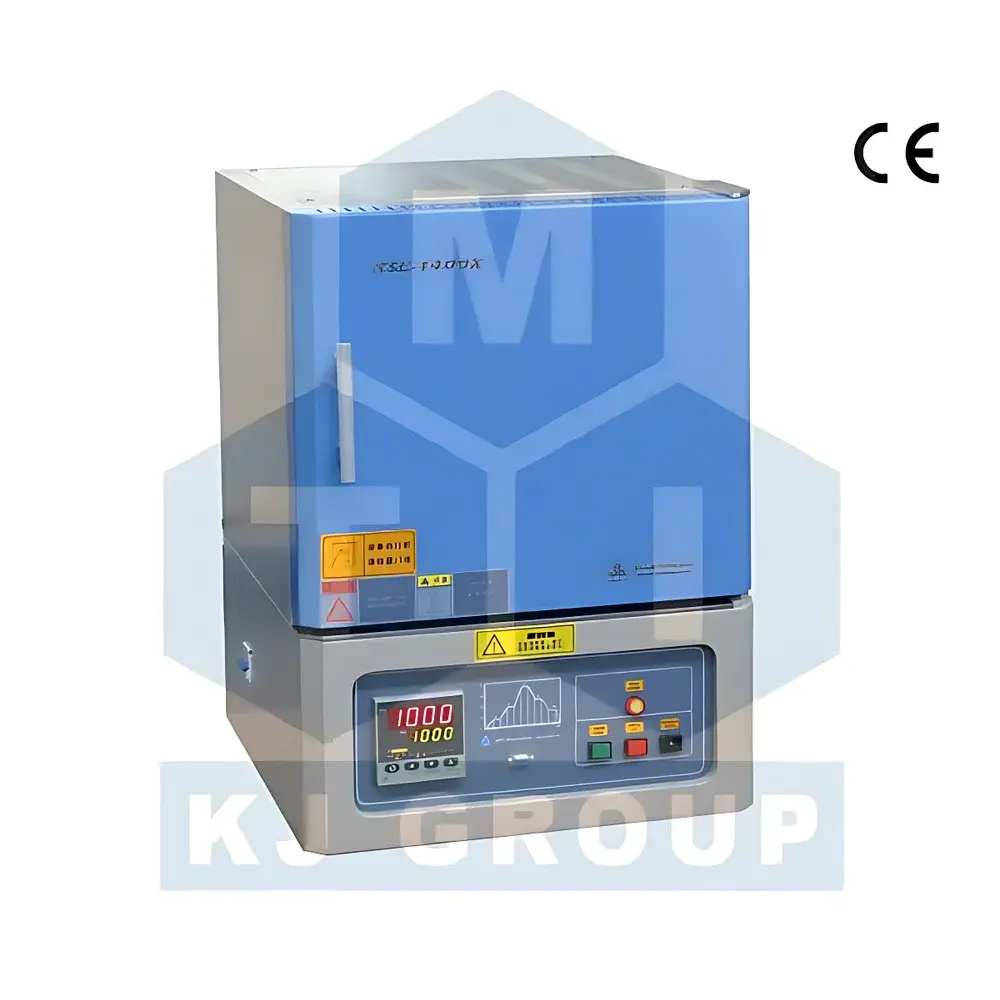
KSL-1400X-A2 1400°C Benchtop Box Furnace with 8L Chamber (150 × 150 × 150 mm Internal Dimensions)
| Brand | Hefei Kejing |
|---|---|
| Origin | Anhui, China |
| Model | KSL-1400X-A2 |
| Max Temperature | 1400°C |
| Temperature Uniformity | ±1°C |
| Max Power | 5.2 kW |
| Heating Rate (to max temp) | 10°C/min |
| Heating Element | Silicon Carbide Rods |
| Internal Chamber Dimensions | 150 × 150 × 150 mm |
| External Dimensions | 550 × 660 × 820 mm |
| Net Weight | 120 kg |
| Control System | 30-Stage Programmable PID Controller with S-Type Platinum-Rhodium Thermocouple |
| Insulation | Dual-Layer Alumina Fiber + US-Imported 1750°C Al₂O₃ Reflective Coating |
| Safety Certification | CE |
Overview
The KSL-1400X-A2 is a laboratory-grade benchtop box furnace engineered for precise high-temperature thermal processing in materials science, ceramics, metallurgy, and advanced battery research. Operating on the principle of resistive heating via silicon carbide (SiC) rods, it delivers stable, repeatable temperature profiles up to 1400°C within an 8-liter working chamber (150 × 150 × 150 mm internal volume). Its dual-layer stainless steel housing—filled with high-purity alumina fiber insulation and finished with a proprietary 1750°C-rated aluminum oxide reflective coating—ensures surface temperatures below 60°C during operation while maximizing thermal efficiency and minimizing energy loss. The furnace employs an S-type platinum-rhodium thermocouple (Pt–10%Rh / Pt) for accurate, drift-resistant temperature sensing and integrates a 30-segment programmable PID controller (model 518P) for flexible ramp-hold-cool cycling. Designed for non-vacuum, ambient-atmosphere applications, it complies with CE safety directives and supports GLP-aligned documentation workflows through deterministic thermal logging.
Key Features
- High-stability SiC heating elements with redundant design—two spare rods included standard
- Dual-shell construction with vacuum-formed alumina fiber insulation (≥1400°C rated) and US-sourced high-emissivity Al₂O₃ reflective coating for enhanced thermal uniformity and extended service life
- ±1°C temperature control accuracy across the full operating range (room temperature to 1400°C), validated per ASTM E220 calibration protocol
- Programmable thermal profile capability: 30 independent time-temperature segments with user-defined ramp rates (0.1–10°C/min), soak durations, and cooling protocols
- Side-opening door with ceramic fiber gasket seal and mechanical latch ensures safe access and minimizes thermal leakage during loading/unloading
- Integrated over-temperature protection (independent limit controller), ground-fault circuit interrupter (GFCI), and automatic power cutoff upon door opening
Sample Compatibility & Compliance
The KSL-1400X-A2 is intended for use in inert, oxidizing, or mildly reducing atmospheres (e.g., air, N₂, Ar). It is not equipped with vacuum sealing or gas-tight ports; therefore, it must not be operated with flammable, explosive, or highly reactive gases (e.g., H₂, CH₄, CO). Strongly corrosive gases—including Cl₂, NH₃, HF, SO₂, and sulfur-containing vapors—are incompatible with the standard alumina fiber lining and S-type thermocouple unless pre-approved modifications are implemented. Optional corrosion-resistant upgrades (e.g., fused quartz liner, Hastelloy C-276 thermocouple sheathing, and custom-coated SiC elements) are available upon technical consultation. The furnace meets CE marking requirements under Directive 2014/35/EU (Low Voltage Directive) and 2014/30/EU (EMC Directive). While not intrinsically compliant with FDA 21 CFR Part 11, its digital controller supports manual audit trail generation suitable for ISO/IEC 17025-accredited labs performing method validation per ASTM C865 or ISO 11358.
Software & Data Management
The 518P intelligent temperature controller provides local front-panel programming and real-time display of setpoint, measured temperature, output power (%), and segment status. RS485 serial interface (Modbus RTU protocol) enables integration with LabVIEW, MATLAB, or SCADA systems for remote monitoring and automated data acquisition. Time-stamped temperature logs (sample interval: 1–60 s, configurable) can be exported via USB memory stick in CSV format. All operational parameters—including program ID, start time, total cycle duration, and deviation alerts—are retained in non-volatile memory for post-run review. For regulated environments, users may implement supplementary electronic record-keeping using third-party LIMS platforms with 21 CFR Part 11-compliant signature modules.
Applications
- Sintering of oxide ceramics (Al₂O₃, ZrO₂), nitrides (Si₃N₄), and carbides (SiC, WC)
- Heat treatment of metal alloys (annealing, stress relieving, homogenization up to 1300°C)
- Thermal gravimetric analysis (TGA) sample pre-conditioning and ashing (per ASTM D3174)
- Electrode calcination for lithium-ion and solid-state battery R&D
- Crucible-based melting trials and flux-assisted synthesis of intermetallic compounds
- Calibration reference source for secondary thermocouples and infrared pyrometers (traceable to NIST standards)
FAQ
What is the recommended maximum heating and cooling rate to ensure longevity?
For optimal element life and thermal shock mitigation, we recommend limiting ramp rates to ≤10°C/min for both heating and controlled cooling. Rapid thermal cycling accelerates SiC rod degradation and microcracking in the alumina fiber insulation.
Can this furnace be used under vacuum or with flowing gas?
No—the KSL-1400X-A2 lacks vacuum flanges, gas inlet/outlet ports, or pressure-rated seals. It is strictly rated for ambient-pressure, open-atmosphere operation only.
Why do fine cracks appear in the furnace chamber after repeated use?
Microfissures in the alumina fiber lining are intrinsic to thermal cycling of refractory ceramics and do not compromise performance or safety. They may be sealed with the supplied high-temperature Al₂O₃ coating during routine maintenance.
Is the S-type thermocouple calibrated and traceable?
The installed S-type thermocouple conforms to IEC 60584-1 and is factory-calibrated against NIST-traceable standards. Users should perform periodic verification per ASTM E220 using a certified reference thermocouple before critical experiments.
What consumables require scheduled replacement?
Silicon carbide heating rods (typical service life: 1,500–2,500 hours at ≤1300°C), the S-type thermocouple (recommended replacement every 12–18 months under continuous use), and the ceramic fiber door gasket (inspect annually for compression set) constitute the primary scheduled maintenance items.



