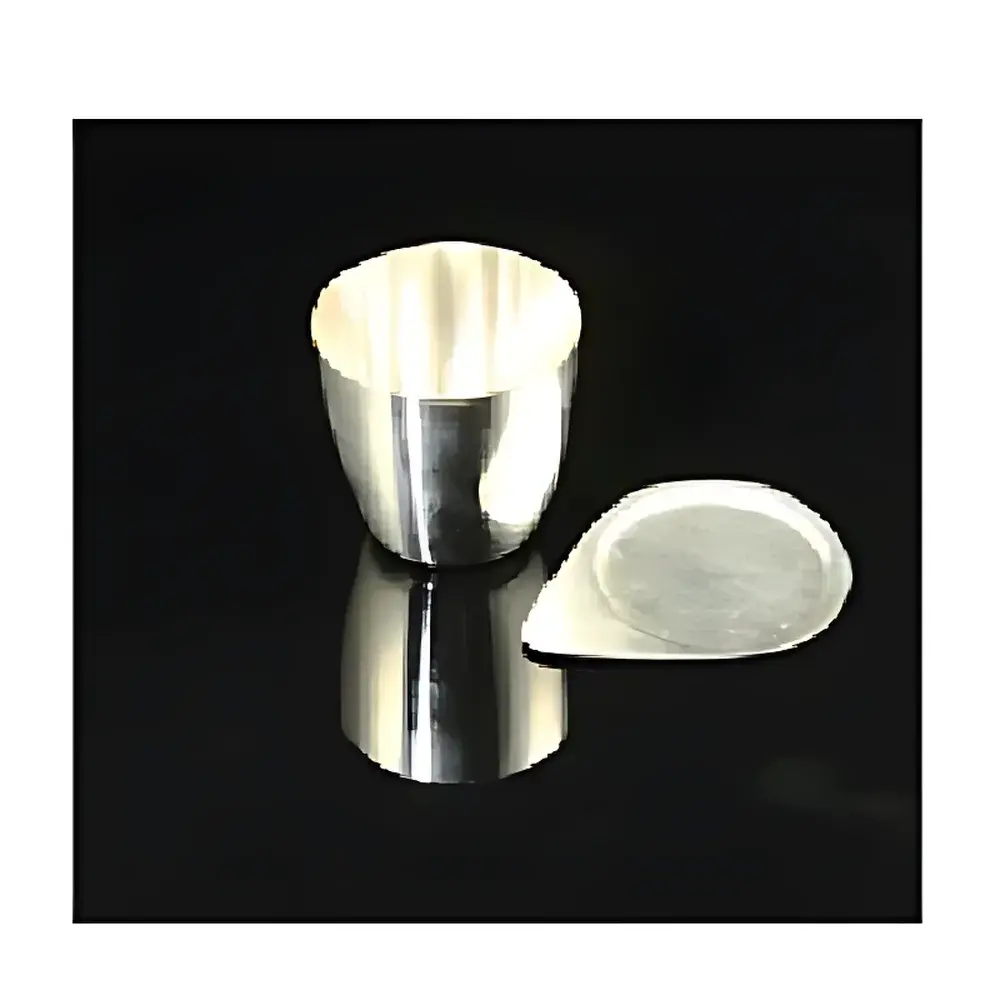
Platinum Crucible (with Lid)
| Brand | Hefei KEJING |
|---|---|
| Origin | Anhui, China |
| Manufacturer Type | Authorized Distributor |
| Origin Category | Domestic (China) |
| Model | Platinum Crucible |
| Pricing | Available Upon Request |
| Standard Capacity | 50 mL (50 g) |
| Customization | Dimensional customization available per client specifications |
Overview
The Platinum Crucible (with Lid) is a high-purity laboratory component engineered for extreme thermal stability, chemical inertness, and long-term dimensional integrity under aggressive high-temperature environments. Constructed from 99.95% pure platinum (Pt), this crucible operates reliably across a continuous temperature range of up to 1773 K (1500 °C) in air and maintains structural stability even during prolonged exposure to molten alkalis, oxidizing fluxes (e.g., Na₂O₂, Li₂B₄O₇), and halogen-containing reagents—conditions where quartz, alumina, or nickel-based vessels would rapidly degrade. Its design adheres to fundamental metallurgical principles governing noble metal behavior under thermal cycling: minimal grain growth, negligible creep deformation, and absence of catalytic surface reactions that could compromise sample purity. This makes it indispensable for gravimetric analysis, fusion sample preparation prior to XRF or ICP-OES, and high-temperature thermogravimetric studies requiring trace-metal-clean containment.
Key Features
- Material purity: ≥99.95% Pt (certified per ASTM B580–22, with full mill test report available upon request)
- Sealed lid design ensures controlled atmosphere retention and prevents sample volatilization or contamination during heating
- Smooth, polished interior surface minimizes sample adhesion and facilitates quantitative recovery (>99.8% rinse efficiency for aqueous and acidic matrices)
- Thermal shock resistance validated per ISO 7888:2018—capable of direct transfer from furnace at 1400 °C to ambient air without microcracking
- Dimensionally stable after repeated use: coefficient of linear expansion 8.8 × 10⁻⁶ K⁻¹ ensures consistent volume calibration over >200 thermal cycles
- Electropolished finish reduces surface area for adsorption and eliminates embedded polishing residues
Sample Compatibility & Compliance
This crucible is compatible with a broad spectrum of inorganic and geochemical samples, including silicates, oxides, carbonates, phosphates, and sulfides. It is routinely employed in ASTM C659 (fusion of refractory materials), ISO 12677 (XRF sample preparation), and USP heavy metals testing protocols. The platinum grade meets the material requirements specified in ISO/IEC 17025-accredited laboratories for certified reference material (CRM) handling. While not classified as a “measuring instrument” per se, its dimensional consistency and mass stability support GLP-compliant weighing workflows when used with Class A analytical balances (e.g., METTLER TOLEDO XP series). No regulatory certification (e.g., FDA, CE) applies, as it functions solely as a passive containment component—not an active measurement device.
Software & Data Management
As a passive laboratory consumable, the Platinum Crucible does not incorporate embedded electronics, firmware, or software interfaces. Its usage is fully integrated into standard laboratory information management systems (LIMS) via manual entry of lot-specific traceability data—including heat number, purity certificate ID, and pre-use mass calibration records. For audit readiness, users are advised to log crucible lifecycle events (initial tare weight, cumulative heating cycles, post-cycle visual inspection notes) in accordance with ISO/IEC 17025 clause 7.11 (equipment records) and 21 CFR Part 11 Annex A (if operating in regulated pharmaceutical or clinical diagnostics environments). Digital record templates compliant with these standards are available upon request.
Applications
- Alkali fusion for total digestion of refractory minerals prior to multi-element ICP-MS analysis
- High-temperature ashing of organic-rich environmental samples (soils, sediments, biological tissues) without platinum-catalyzed charring artifacts
- Preparation of homogeneous glass discs for wavelength-dispersive X-ray fluorescence (WD-XRF) quantification
- Thermogravimetric analysis (TGA) of catalysts and battery cathode materials under oxidizing atmospheres
- Calibration verification of high-temperature furnaces using Pt–Pt/Rh thermocouple reference points
- Trace-level borate fusion for rare earth element (REE) partitioning studies in petrology
FAQ
Can this crucible be used with hydrofluoric acid (HF)?
No. Platinum is susceptible to corrosion by HF and fluoride melts above 500 °C; use PTFE or gold crucibles instead.
Is cleaning required between uses—and if so, what method is recommended?
Yes. Rinse with ultra-pure water, followed by immersion in 1:1 nitric acid (≥65%) at 80 °C for 30 min, then triple-rinse with 18.2 MΩ·cm water and dry in Class 100 clean air.
Does the crucible come with a certificate of conformance?
Yes—each unit ships with a manufacturer-issued CoC referencing ASTM B580 and batch-specific purity assay data.
What is the maximum recommended heating rate to avoid thermal stress?
≤10 K/min below 800 °C; ≤5 K/min above 800 °C, particularly during first use or after extended storage.
Can custom dimensions be manufactured with tighter tolerances than ±0.2 mm?
Yes—dimensional tolerances down to ±0.05 mm are achievable for orders ≥10 units, subject to engineering review and lead-time extension.