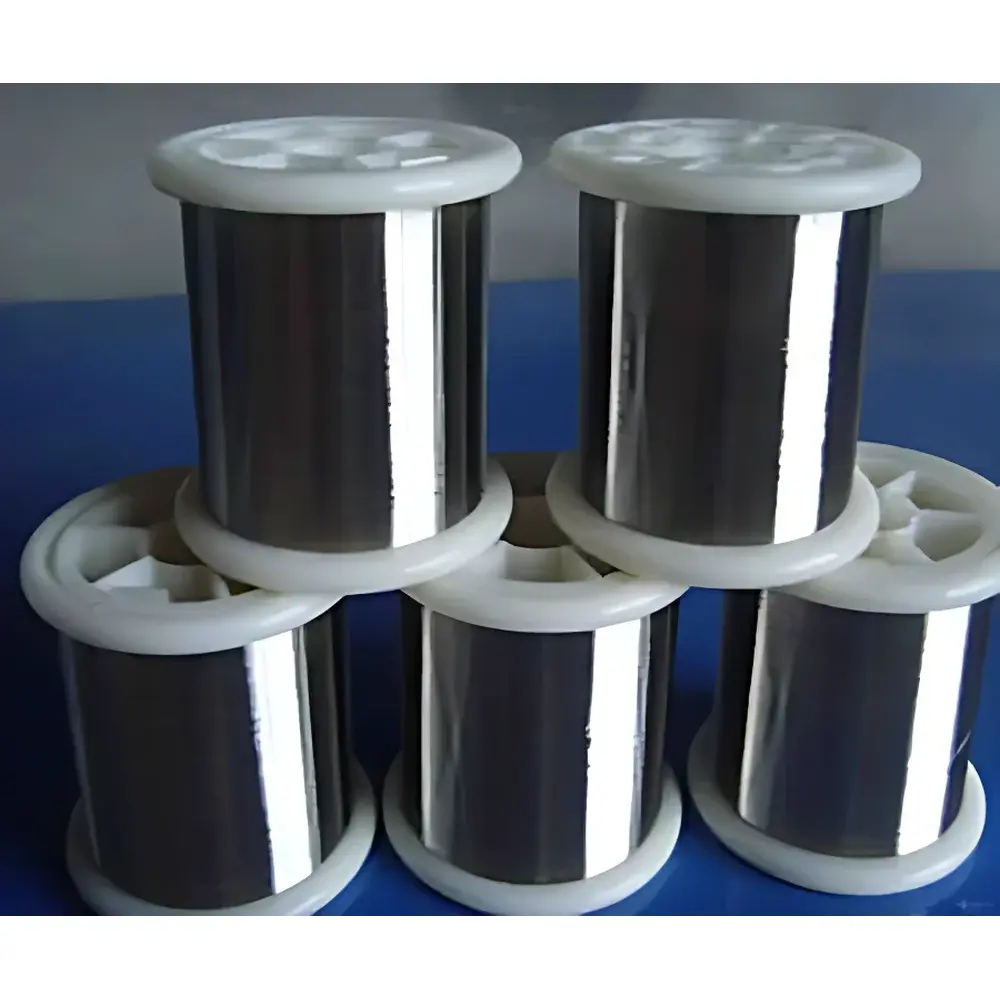
Ni Wire (99.99% Pure, 0.01–2 mm Diameter) – Hefei Kejing Instrument Component
| Brand | Hefei Kejing |
|---|---|
| Origin | Anhui, China |
| Manufacturer Type | Authorized Distributor |
| Country of Origin | China |
| Model | Ni Wire |
| Packaging | Class 1000 Cleanroom / Class 100 Clean Bag with Aluminum Foil Wrap |
| Purity | 99.99% (4N) |
| Diameter Range | 0.01–2 mm |
Overview
Ni wire (nickel wire) is a high-purity metallic conductor widely employed in scientific instrumentation, vacuum systems, thermal processing fixtures, resistance heating elements, thermocouple assemblies, and as a substrate or precursor material in thin-film deposition and sputtering applications. This product—supplied by Hefei Kejing as a certified instrument component—is manufactured to stringent metallurgical specifications, ensuring consistent grain structure, low interstitial impurity content (C, O, N, S), and excellent ductility for precision winding, drawing, and microfabrication tasks. The wire conforms to ASTM B160-21 (Standard Specification for Nickel Wire) and is traceable to certified reference materials. Its intrinsic properties—including high electrical resistivity (~6.9 × 10⁻⁷ Ω·m at 20 °C), Curie temperature of 358 °C, and stable oxidation behavior up to 800 °C in air—make it suitable for controlled-atmosphere furnaces, calibration standards, and sensor fabrication where reproducible thermal and electrical response is critical.
Key Features
- Ultra-high purity: 99.99% (4N) nickel, verified by GDMS (Glow Discharge Mass Spectrometry) and ICP-MS analysis; total metallic impurities ≤ 10 ppm
- Precise dimensional control: Diameter tolerance ±0.5 µm for wires ≤ 0.1 mm; ±1% for diameters > 0.1 mm
- Controlled surface finish: Electrolytically polished and annealed in ultra-high vacuum (<10−6 Pa) to minimize oxide layer thickness and surface contamination
- Class 100 cleanroom handling and double-layer packaging: First wrapped in oxygen-barrier aluminum foil, then sealed in ISO Class 5 (Class 100) laminar flow clean bags
- Full lot traceability: Each spool includes certificate of conformance (CoC) with batch number, melt ID, tensile strength (≥350 MPa), elongation (>30%), and residual stress data
Sample Compatibility & Compliance
This Ni wire is compatible with standard wire-drawing dies, ultrasonic wedge bonders, electron-beam evaporation sources, and RF sputtering targets. It exhibits no outgassing anomalies under UHV conditions (<10−9 mbar) after 24-hour bakeout at 250 °C, meeting requirements for ultra-high-vacuum chamber components per ISO 14644-1 Class 5 environmental classification. The material complies with RoHS Directive 2011/65/EU and REACH Annex XVII restrictions on nickel release (≤ 0.5 µg/cm²/week). For biomedical or implant-related use, additional passivation per ASTM F86-22 (Standard Practice for Surface Preparation and Marking of Metallic Surgical Implants) is recommended prior to deployment.
Software & Data Management
As a passive physical component, this Ni wire does not incorporate embedded electronics or firmware. However, its certified metrological attributes are fully integrated into Hefei Kejing’s digital quality management system (QMS), compliant with ISO 9001:2015 and aligned with FDA 21 CFR Part 11 audit-trail requirements for electronic records. Batch-specific analytical reports—including GDMS spectra, tensile test curves, and SEM/EDS surface morphology maps—are available upon request in PDF/A-2b format with digital signature and SHA-256 hash verification.
Applications
- Resistance-heated furnace windings for crystal growth (e.g., Czochralski, Bridgman) and annealing furnaces operating up to 1100 °C in inert or reducing atmospheres
- Thermocouple extension wire (Type E, K, and N configurations) requiring low thermal EMF drift and long-term stability
- Target material for magnetron sputtering of Ni and Ni-alloy thin films (e.g., NiFe, NiCr, NiTi) used in spintronics, MEMS, and corrosion-resistant coatings
- Substrate for electrochemical deposition of nanostructured catalysts (e.g., Ni-Mo, Ni-Co) in fuel cell and electrolyzer R&D
- Reference electrode wire and current collector in in situ XRD/XAS cells and battery half-cell testing fixtures
FAQ
Is this Ni wire suitable for ultra-high-vacuum (UHV) applications?
Yes—each lot undergoes vacuum degassing validation and is certified for use in systems operating below 10−9 mbar.
Can I request custom diameters outside the 0.01–2 mm range?
Custom diameters down to 5 µm (with minimum order quantity ≥ 50 m) and up to 5 mm (with annealing and straightness certification) are available upon technical review.
What documentation accompanies each shipment?
Certificate of Conformance (CoC), GDMS impurity report, tensile test summary, and cleanroom handling log—all digitally signed and archived for 10 years.
Does the wire exhibit magnetic hysteresis that could interfere with sensitive measurements?
Below its Curie temperature (358 °C), Ni is ferromagnetic; users conducting magnetic susceptibility or SQUID measurements should apply field-cooling protocols or select non-magnetic alternatives (e.g., Cu or Pt) where appropriate.
How is traceability maintained across spools from the same melt?
Each spool carries a unique laser-etched identifier linked to the master melt log, including furnace charge composition, casting parameters, and hot/cold rolling reduction ratios.