
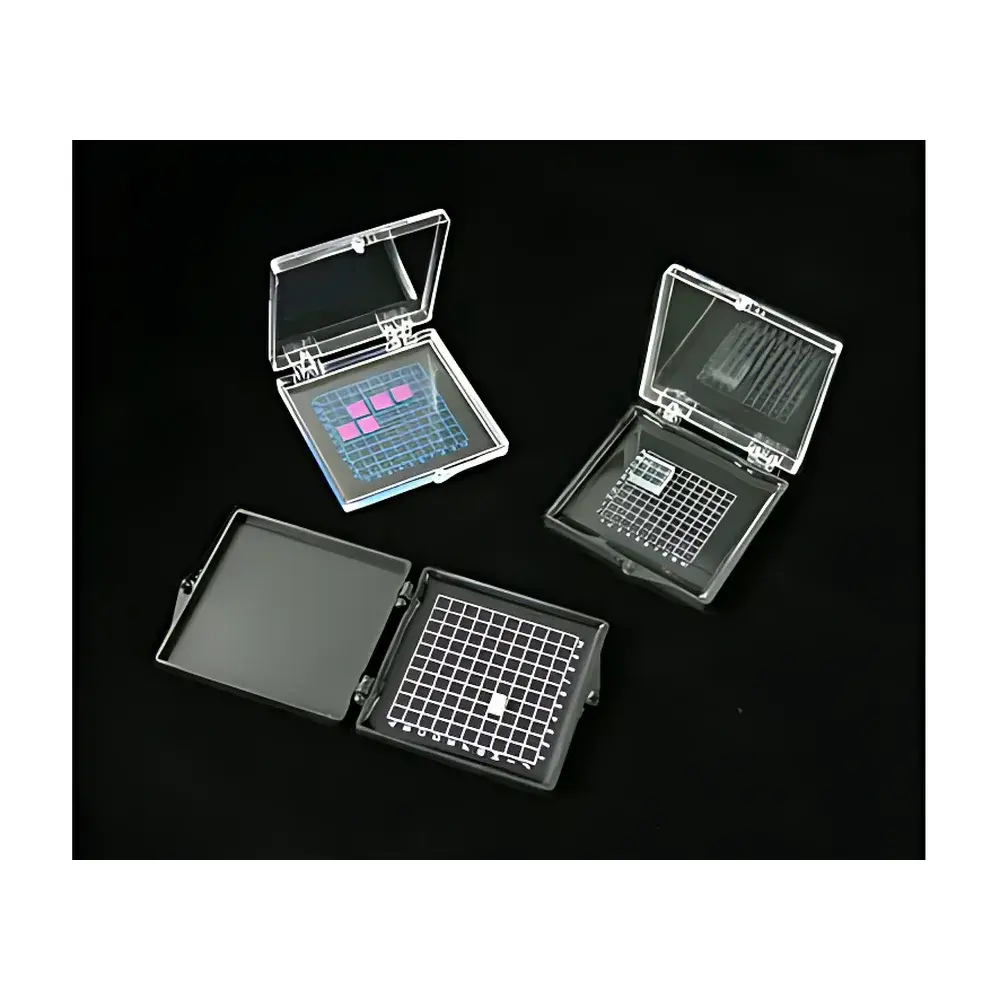
Kojin SP1-5510 Self-Adhesive QCM Crystal Carrier Box
| Brand | Kojin |
|---|---|
| Origin | Anhui, China |
| Manufacturer Type | Authorized Distributor |
| Origin Category | Domestic (China) |
| Model | SP1-5510 Self-Adhesive QCM Crystal Carrier Box |
| Dimensions (L×W×H) | 55 mm × 55 mm × 10 mm |
| Internal Cavity | 51 mm × 51 mm × 7 mm |
| Lid/Bottom Height | 5 mm each |
| Adhesion Strength | Low or High (configurable) |
| Color Options | Transparent or Black |
| Material | Ultra-Low-Particulate Pressure-Sensitive Acrylic Gel |
| Compliance | ISO Class 5 (Class 100) Cleanroom-Compatible Surface |
Overview
The Kojin SP1-5510 Self-Adhesive QCM Crystal Carrier Box is a precision-engineered handling and storage solution designed specifically for quartz crystal microbalance (QCM) sensors, AT-cut resonators, and other thin-film piezoelectric substrates used in electrochemical and surface science applications. Unlike conventional foam-based or mechanical clamping carriers, the SP1-5510 utilizes a controlled-tack, solvent-free acrylic gel layer applied uniformly to the internal cavity floor. This gel exhibits non-migrating, low-outgassing adhesion—sufficient to immobilize delicate crystals during transport and process handling, yet fully reversible without residue or surface shear stress. The carrier operates on passive physical adsorption rather than chemical bonding or vacuum fixation, preserving native surface chemistry and electrode integrity critical for QCM-D (dissipation monitoring), impedance spectroscopy, and real-time mass-sensitivity calibration. Its geometry aligns with standard 14 mm and 25 mm diameter QCM crystals, supporting both bare quartz blanks and metallized (Au, Pt, Cr/Au) sensor chips used in biosensing, corrosion studies, and thin-film deposition monitoring.
Key Features
- Ultra-clean, low-particulate gel surface compliant with ISO 14644-1 Class 5 cleanroom requirements—validated for ≤100 particles ≥0.5 µm per cubic foot
- Reversible, non-damaging adhesion: no solvent leaching, no static charge buildup, and no residual tack after crystal removal
- Optically transparent polycarbonate housing enables visual inspection without opening—critical for pre-installation QC of electrode uniformity and contamination status
- Modular cavity depth (7 mm internal height) accommodates standard QCM crystals with backside wiring leads or integrated temperature sensors
- Configurable adhesion strength: low-tack variant for ultra-thin (<100 nm) coated crystals; high-tack variant for heavier multi-layer stacks or roughened electrodes
- Compatible with automated pick-and-place systems via standardized edge grip zones—designed for integration into semiconductor-grade QCM module assembly lines
Sample Compatibility & Compliance
The SP1-5510 supports QCM crystals ranging from 10 mm to 25 mm in diameter and up to 1.0 mm thickness, including those with sputtered, evaporated, or ALD-deposited electrode layers. It is validated for use with gold-, platinum-, and chromium-gold-coated AT-cut quartz (5–10 MHz fundamental frequency), as well as harmonic-mode crystals (3rd, 5th, 7th overtones). The gel formulation meets USP extractables profile limits and shows no detectable interference in cyclic voltammetry baseline stability (tested in 0.1 M KCl + 1 mM Fe(CN)63−/4−). All materials comply with RoHS Directive 2011/65/EU and REACH Annex XVII restrictions. Each batch undergoes particulate shedding testing per SEMI F22-0201 and is certified for use in GLP-compliant electrochemical method validation workflows.
Software & Data Management
While the SP1-5510 is a passive hardware component, it integrates seamlessly into traceable QCM workflow ecosystems. When used with Kojin’s A-Z series crystal cleaning stations and QCM control software (e.g., QCM-Studio v4.x), the carrier ID (laser-etched on base) can be scanned and logged alongside crystal lot number, cleaning cycle history, and post-cleaning contact angle data. Audit trails support FDA 21 CFR Part 11 compliance when paired with electronic lab notebooks (ELNs) such as LabArchives or Benchling. No embedded firmware or Bluetooth connectivity is present—ensuring electromagnetic compatibility in shielded Faraday cage environments typical of high-sensitivity QCM measurements.
Applications
- Safe inter-facility transport of calibrated QCM sensors between metrology labs and production cleanrooms
- Temporary storage of functionalized crystals prior to flow cell mounting in QCM-D biosensor assays
- In-line buffering between spin-coating, plasma treatment, and electrodeposition steps in thin-film R&D
- Standardized packaging for reference crystal sets used in ASTM E2982-22 (Standard Practice for QCM Sensor Calibration)
- Protection of fragile quartz resonators during ultrasonic cleaning cycles in A-Z series cleaning machines
FAQ
Can the SP1-5510 be autoclaved or exposed to IPA/acetone?
No—gel layer integrity is compromised above 60 °C or upon prolonged exposure to polar aprotic solvents. Sterilization must be performed via dry heat (120 °C, 2 h) or UV-C (254 nm, 30 min) only.
Does the gel leave residue on gold electrodes after repeated use?
Independent XPS analysis confirms no carbonaceous residue or Au signal attenuation after 50+ placement/removal cycles under controlled humidity (40–50% RH).
Is the box compatible with vacuum desiccators?
Yes—the polycarbonate body maintains dimensional stability under 10−2 mbar; however, gel adhesion strength decreases by ~15% below 10−1 mbar due to reduced ambient pressure-assisted contact.
How is lot-to-lot consistency verified?
Each production lot undergoes peel adhesion testing (ASTM D3330), outgassing TGA-FTIR screening, and particle shedding quantification per ISO 14644-1 Annex B.




