
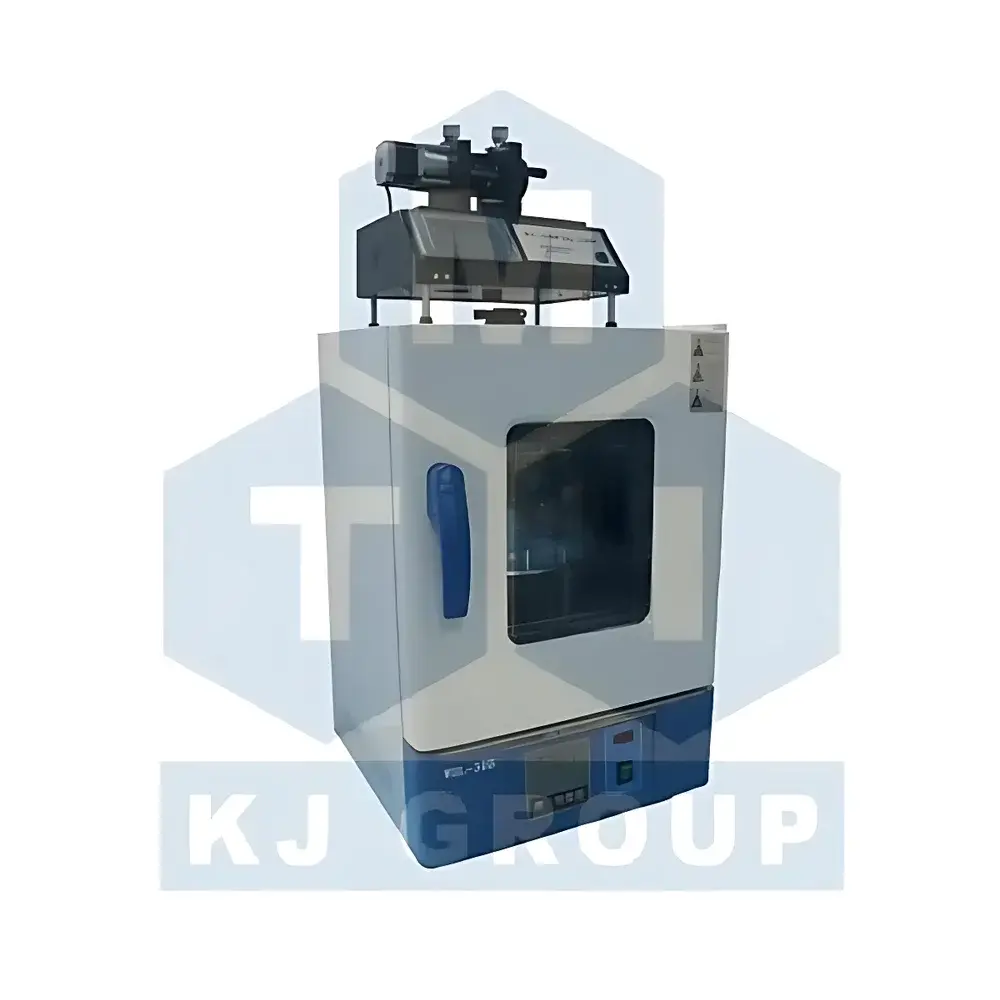
PTL-OV6P 6-Station Programmable Dip-Coating System with Integrated Temperature-Controlled Chamber
| Origin | Anhui, China |
|---|---|
| Manufacturer Type | Authorized Distributor |
| Origin Category | Domestic (China) |
| Model | PTL-OV6P |
| Price Range | USD 700 – 1,400 |
| Instrument Type | Dip Coater |
| Power Supply | 220 V AC, <800 W |
| Temperature Control Range | Ambient to 100 °C |
| Chamber Interior Dimensions | 280 mm × 280 mm × 280 mm (stainless steel lining) |
| Glass Beaker Capacity | 150 mL (Ø60 mm) |
| Withdrawal Speed | 1–40 mm/min (digital setpoint, ±0.2 mm/min repeatability) |
| Sample Size Limit | ≤80 mm × 40 mm × 2 mm |
| Net Weight | 40 kg |
| Certification | CE compliant |
| Warranty | 12 months parts & labor, lifetime technical support |
Overview
The PTL-OV6P is a precision-engineered 6-station programmable dip-coating system designed for reproducible, temperature-controlled thin-film deposition via vertical withdrawal (also known as “dip coating” or “withdrawal coating”). It operates on the principle of controlled meniscus formation and capillary-driven film thinning during substrate withdrawal from liquid precursors—governed by the Landau–Levich–Derjaguin (LLD) model under laminar flow conditions. Unlike thermal processing equipment such as muffle furnaces or tube furnaces, the PTL-OV6P does not generate heat for material synthesis; instead, it integrates a thermostatically regulated chamber to stabilize ambient and solution temperature during coating—critical for minimizing solvent evaporation gradients, suppressing Marangoni instabilities, and ensuring uniform film thickness across multiple samples. Its architecture supports comparative studies in sol-gel processing, colloidal nanomaterial assembly, functional surface modification, and optical interference layer fabrication where batch consistency and parametric control are essential.
Key Features
- Six independent, synchronized coating stations enabling parallel processing of up to six substrates under identical thermal and kinematic conditions.
- Digital speed controller with adjustable withdrawal rate (1–40 mm/min) and programmable dwell time at immersion depth and post-withdrawal drying phase.
- Integrated stainless-steel temperature-controlled chamber (280 mm × 280 mm × 280 mm internal volume) maintaining uniform ambient-to-100 °C stability (±0.5 °C at setpoint, verified per IEC 60068-3-5).
- Modular sample holder design accommodating substrates up to 80 mm × 40 mm × 2 mm; includes six standardized glass beakers (Ø60 mm, 150 mL capacity) with precision alignment fixtures.
- Micro-stepper motor drive system delivering high positional resolution (10,000 cycles without drift.
- Front-panel LCD interface with real-time display of speed, immersion time, dwell duration, and chamber temperature; supports manual override and parameter recall.
Sample Compatibility & Compliance
The PTL-OV6P accommodates rigid planar substrates including silicon wafers, glass slides, ITO-coated PET, quartz crystals, and ceramic plates. It is compatible with aqueous, alcoholic, and low-viscosity organic precursor solutions (e.g., titanium isopropoxide in ethanol, silica sols, polymer dispersions). All wetted components—including beakers, clamps, and chamber lining—are constructed from 316 stainless steel and borosilicate glass to ensure chemical resistance and minimize leaching. The system complies with CE marking requirements under Directive 2014/30/EU (EMC) and 2014/35/EU (LVD), and conforms to ISO 14644-1 Class 8 cleanroom handling protocols when operated in controlled environments. No modifications are required for GLP-compliant operation; full audit trails can be implemented via optional external logging interfaces.
Software & Data Management
While the base unit features standalone digital control, optional RS-232 or USB-to-serial connectivity enables integration with custom LabVIEW, Python, or MATLAB scripts for automated protocol sequencing and data capture. Users may log timestamped parameters—including actual withdrawal velocity, chamber temperature deviation, and cycle count—for traceability in regulatory submissions. Though not natively 21 CFR Part 11 compliant, the system supports third-party electronic lab notebook (ELN) synchronization when paired with validated middleware. Firmware updates are delivered via secure HTTPS download and require physical confirmation to prevent unauthorized configuration changes.
Applications
- Preparation of antireflective, hydrophobic, or photocatalytic TiO₂/SiO₂ multilayers via sol-gel dip coating.
- Controlled assembly of graphene oxide or MXene films for flexible electronics research.
- Deposition of perovskite precursor layers in photovoltaic device prototyping.
- Surface functionalization of biosensors using silane-based self-assembled monolayers (SAMs).
- High-throughput screening of coating formulations under constant thermal history—enabling DoE (Design of Experiments) workflows.
FAQ
Is the PTL-OV6P suitable for use with volatile solvents such as chloroform or acetone?
Yes—provided the chamber is operated in a ventilated fume hood and the solvent flash point exceeds the maximum chamber setpoint (100 °C). Recommended vapor pressure limit: <10 kPa at operating temperature.
Can the withdrawal speed profile be ramped or segmented within a single cycle?
No—the standard firmware supports only constant-speed withdrawal per cycle. Multi-stage profiles require external PLC integration via analog/digital I/O expansion modules (available as OEM option).
What maintenance is required to ensure long-term accuracy?
Monthly calibration of chamber temperature sensor against NIST-traceable RTD reference; biannual inspection of stepper motor coupling and guide rail lubrication using food-grade silicone grease.
Does the system include validation documentation for IQ/OQ protocols?
A basic Factory Acceptance Test (FAT) report is included. Full Installation Qualification (IQ) and Operational Qualification (OQ) templates are available upon request for GMP-regulated laboratories.
Related Products



