
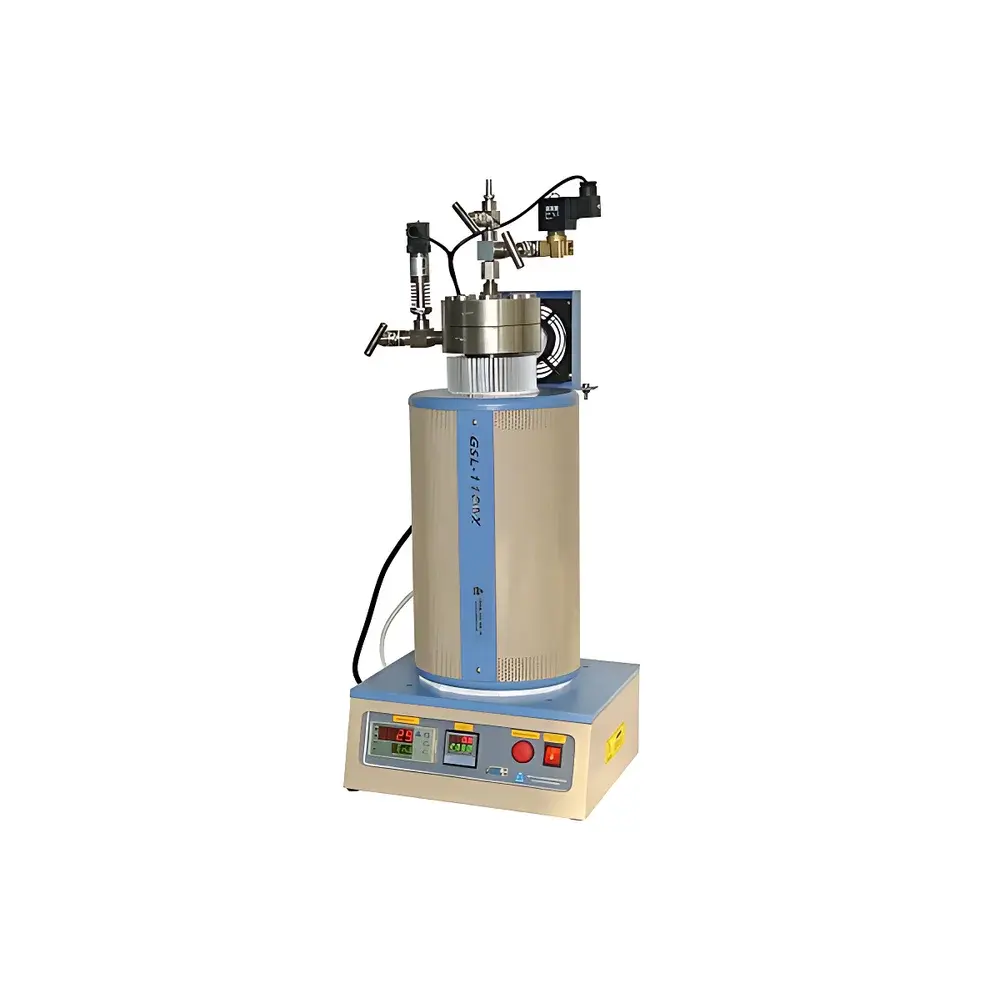
Hefei Kejing RC-Ni-300 Nickel-Based Superalloy High-Temperature High-Pressure Autoclave
| Brand | Hefei Kejing |
|---|---|
| Origin | Anhui, China |
| Model | RC-Ni-300 |
| Volume | 300 mL |
| Material | Nickel-based superalloy (Inconel-type) |
| Max Operating Temperature | 1100 °C |
| Max Pressure | 18 MPa @ ≤800 °C |
| Temperature Control | 30-segment programmable ramp/soak, ±1 °C accuracy |
| Pressure Sensing | Integrated high-precision piezoresistive sensor with digital MPa display and user-set overpressure alarm threshold |
| Cooling | Aluminum finned heat sink + axial cooling fan on flange assembly |
| Seal | Oxygen-free copper gasket (63 mm OD) |
| Compliance | Designed for laboratory-scale synthesis under ISO/IEC 17025-aligned safety practices |
| Warranty | 12 months parts and labor, lifetime technical support |
Overview
The Hefei Kejing RC-Ni-300 is a benchtop high-temperature, high-pressure autoclave engineered for controlled solid-state synthesis, oxidative thermal treatment, hydrothermal crystallization, and catalytic reaction studies under extreme process conditions. Constructed entirely from nickel-based superalloy—selected for exceptional creep resistance, phase stability, and oxidation resistance up to 1100 °C—the reactor enables reproducible operation in aggressive atmospheres including pure O₂, CO₂, H₂, or inert gas environments. Its design follows fundamental principles of thick-walled pressure vessel mechanics per ASME BPVC Section VIII Division 1 guidelines, with geometry optimized to minimize thermal stress gradients across the cylindrical body and flanged closure. The unit operates as a closed-system batch reactor, where temperature and pressure are independently monitored and constrained via integrated feedback loops, ensuring strict adherence to experimental protocols required in materials science R&D, battery cathode development, and ceramic precursor synthesis.
Key Features
- Nickel-based superalloy construction (equivalent to Inconel 600/625 grade) provides long-term structural integrity at sustained temperatures up to 1100 °C and pressures up to 18 MPa.
- 30-segment programmable temperature controller supports complex thermal profiles—including multi-step ramps, holds, and cooling cycles—with ±1 °C setpoint accuracy and real-time thermocouple (Type K) monitoring.
- Integrated piezoresistive pressure transducer mounted directly on the flange enables continuous in-situ pressure measurement (0–20 MPa range), displayed digitally in MPa on the front-panel instrument.
- User-configurable overpressure safety protocol: when internal pressure reaches a pre-defined alarm threshold, a fail-safe solenoid relief valve activates automatically to vent excess gas through a dedicated exhaust line.
- Active flange cooling system comprising an aluminum finned heat sink and forced-air axial fan prevents thermal degradation of the oxygen-free copper gasket and maintains seal integrity during repeated thermal cycling.
- Compact cylindrical geometry (70 mm OD × 35 mm ID × 326 mm height) accommodates standard 300 mL working volume while enabling uniform radial heat distribution and minimal dead volume.
Sample Compatibility & Compliance
The RC-Ni-300 supports heterogeneous reactions involving powders, pellets, thin films, and precursor solutions. It is routinely deployed in oxygen-rich environments for high-temperature oxidation of transition metal oxides, in CO₂ atmospheres for carbonate formation studies, and under inert gas for nitridation or carburization. All wetted surfaces are passivated and non-catalytic, minimizing unintended surface reactions. While not certified to PED 2014/68/EU or ASME U-stamp requirements, the reactor is intended for use within institutional safety frameworks compliant with ANSI Z9.5 (Laboratory Ventilation) and OSHA 1910.119 (Process Safety Management). Users must operate the unit inside a certified explosion-resistant containment cabinet meeting NFPA 45 standards; direct line-of-sight exposure to the flange during pressurized operation is strictly prohibited.
Software & Data Management
The RC-Ni-300 operates via standalone front-panel interface with no proprietary software dependency. Temperature and pressure data are logged locally on the embedded controller’s non-volatile memory (up to 10,000 data points) and exportable via RS-485 serial interface to third-party SCADA or LabVIEW environments. Audit trails—including setpoint changes, alarm events, and valve actuation timestamps—are retained with time/date stamping. For GLP/GMP-aligned workflows, optional analog output (4–20 mA) enables integration into centralized process historians. The system complies with FDA 21 CFR Part 11 data integrity principles when paired with validated external acquisition software supporting electronic signatures and change control.
Applications
- Synthesis of layered oxide cathodes (e.g., NMC, NCA) under controlled O₂ partial pressure and elevated temperature.
- Hydrothermal growth of metal–organic frameworks (MOFs) and zeolitic imidazolate frameworks (ZIFs).
- Oxidative annealing of perovskite precursors for photovoltaic absorber layer optimization.
- High-pressure sintering of nanoceramic powders without external pressure application.
- Thermal stability testing of battery electrolytes and solid-state electrolyte interphases (SEI).
- Catalyst activation and regeneration studies under redox-cycling conditions.
FAQ
Is the RC-Ni-300 suitable for corrosive halogen-containing atmospheres?
Nickel-based superalloys exhibit moderate resistance to dry Cl₂ or HCl up to 600 °C; however, prolonged exposure above this temperature or in condensed-phase halide environments may accelerate intergranular attack. Consult material compatibility charts prior to use.
Can the reactor be operated under vacuum prior to pressurization?
The unit is not rated for deep vacuum service; its sealing system is optimized for positive internal pressure. Pre-purge with inert gas is recommended to remove ambient air before heating.
What maintenance is required for long-term reliability?
Oxygen-free copper gaskets must be replaced after each thermal cycle above 800 °C. Flange faces should be inspected for scoring prior to reassembly; torque sequence must follow manufacturer-specified values using calibrated tools.
Does the system include pressure calibration documentation?
A factory-assembled pressure sensor is supplied with traceable calibration certificate (NIST-traceable reference standard), valid for 12 months from date of shipment.



