
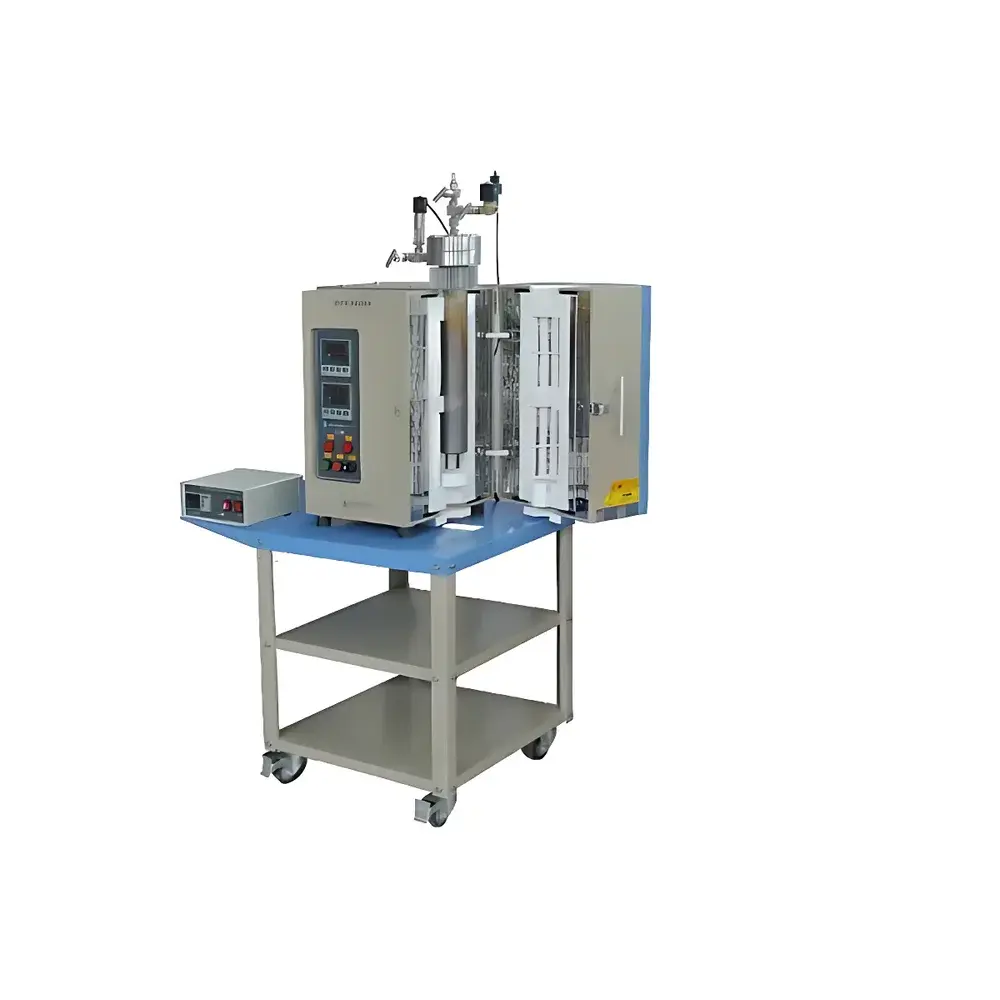
OTF-1200X-VTHP Dual-Zone Vertical High-Temperature High-Pressure Tube Furnace
| Brand | Hefei Kejing |
|---|---|
| Origin | Anhui, China |
| Model | OTF-1200X-VTHP |
| Type | Horizontal/Vertical Tube Furnace |
| Max. Operating Temperature | 1100 °C (tube), 1200 °C (furnace body) |
| Max. Pressure Rating | 20 MPa @ ≤800 °C, 15 MPa @ ≤900 °C, 10 MPa @ ≤1000 °C, 5 MPa @ ≤1100 °C |
| Control Accuracy | ±1 °C |
| Heating Rate | ≤10 °C/min (RT–600 °C), ≤5 °C/min (600–1100 °C) |
| Power Supply | AC 208–240 V, 1Φ, 2.5 kW |
| Heating Element | Mo-doped Fe-Cr-Al alloy with ZrO₂ coating |
| Thermocouple | Omega K-type |
| Temperature Zones | 2 independent PID-controlled zones |
| Uniformity Zone | 170 mm (±2 °C at isothermal setting) |
| Tube Dimensions | Ø70 mm (OD) × Ø35 mm (ID) × 526 mm (L) |
| Cooling | Air-cooled flange with aluminum heat sink |
| Pressure Monitoring | Integrated pressure transducer + digital display |
| Safety Relief | Solenoid valve (max. 15 MPa rating) + manual needle valve bypass |
| Sealing | Oxygen-free copper gasket |
| Compliance | CE-certified |
| Software Option | MTS-03 PC-based control interface (optional) |
Overview
The OTF-1200X-VTHP Dual-Zone Vertical High-Temperature High-Pressure Tube Furnace is an engineered solution for controlled thermal processing under elevated pressure conditions—specifically designed for materials synthesis, oxidation studies, hydrothermal reaction kinetics, and high-pressure annealing in research laboratories and advanced R&D facilities. Unlike conventional muffle or box furnaces, this system integrates two independently programmable heating zones along a vertical orientation, enabling precise axial thermal gradient control across the reaction zone. The furnace core employs a seamless nickel-based superalloy tube (Inconel 600 or equivalent), selected for its exceptional creep resistance, long-term structural stability above 1000 °C, and compatibility with oxidizing, inert, and mildly corrosive atmospheres. Its pressure-rated design conforms to ASME B31.3 process piping guidelines for laboratory-scale applications, with validated mechanical integrity up to 20 MPa at temperatures ≤800 °C. The dual-zone architecture supports complex thermal protocols—including ramp-hold-cool sequences with differential setpoints—making it suitable for crystal growth, phase transformation mapping, and solid-state reaction profiling under non-equilibrium pressure-temperature conditions.
Key Features
- Dual independent PID temperature controllers (30-segment programmable ramp/soak profiles) with Omega K-type thermocouples embedded in each heating zone
- Nickel-based alloy reaction tube (Ø35 mm ID × 526 mm L) rated for continuous operation at 1100 °C and up to 5 MPa; certified creep-limited deformation behavior ensures fail-safe pressure release via controlled ductile yielding—not brittle fracture
- Integrated pressure monitoring system: calibrated transducer linked to digital display with user-configurable upper-limit alarm and automatic solenoid valve actuation (rated to 15 MPa)
- Air-cooled flange assembly with extruded aluminum heat sink prevents thermal migration to sealing surfaces, extending oxygen-free copper gasket service life and maintaining leak-tight integrity over repeated thermal cycles
- Mo-doped Fe-Cr-Al heating elements coated with stabilized zirconia (ZrO₂) for enhanced oxidation resistance and extended operational lifetime beyond 1000 h at 1100 °C
- Vertical configuration optimizes gravitational sedimentation control during hydrothermal synthesis and enables direct integration with gas feed lines, condensate traps, and online pressure regulators
Sample Compatibility & Compliance
The OTF-1200X-VTHP accommodates cylindrical samples up to Ø30 mm × 400 mm in length, compatible with quartz, alumina, and graphite crucibles as well as direct placement of powders, pellets, or thin films on ceramic setters. It supports reactive atmospheres including O₂, Ar, N₂, H₂, CO, and mixed gases—provided external gas delivery systems comply with ISO 8573-1 Class 2 purity standards. All pressure-bearing components meet CE Machinery Directive 2006/42/EC requirements and are documented per EN 13445-3 for unfired pressure vessels. The furnace’s safety architecture aligns with GLP-compliant lab practices: pressure and temperature logs are timestamped and exportable when paired with optional MTS-03 software, satisfying audit-trail requirements under FDA 21 CFR Part 11 for regulated environments.
Software & Data Management
An optional MTS-03 PC-based control module enables full remote supervision via USB or RS485 interface. Users can define synchronized temperature-pressure ramps, monitor real-time deviations from setpoints, and generate CSV-formatted reports containing time-stamped T/P/Power data at user-selectable intervals (1–60 s). The software includes password-protected operator levels, electronic signature support, and configurable alarm escalation (email/SNMP). All data files are SHA-256 hashed to ensure immutability, meeting ALCOA+ principles for data integrity in quality-critical workflows.
Applications
- High-pressure oxide growth and defect engineering in transition metal oxides (e.g., LiCoO₂, Ni-rich NMC cathodes)
- Hydrothermal synthesis of MOFs, perovskites, and layered double hydroxides (LDHs) under controlled p–T trajectories
- In situ oxidation kinetics studies of refractory alloys and ceramic matrix composites
- Thermal stability assessment of battery electrode materials under simulated abuse conditions (elevated T + pO₂)
- Phase diagram validation for multicomponent systems where volatile species require containment (e.g., Sn–Bi–Ag solder alloys)
- Calibration reference source for high-temperature pyrometry and pressure sensor validation labs
FAQ
What is the maximum allowable pressure at 1100 °C?
At 1100 °C, the nickel alloy tube is rated for continuous operation at 5 MPa. Exceeding this value may accelerate creep deformation and reduce service life.
Can the solenoid valve be used above 15 MPa?
No. The integrated solenoid valve is rated to 15 MPa maximum. For experiments requiring >15 MPa, the valve must be isolated using the manual needle valve, and pressure relief must be managed externally via a certified rupture disk or back-pressure regulator.
Is the furnace suitable for reducing atmospheres like H₂?
Yes—provided hydrogen concentration remains below 4% vol in air (LEL compliance) and flow rates are controlled to prevent thermal shock. A dedicated H₂-compatible version with explosion-proof wiring and flame arrestors is available upon request.
How is temperature uniformity verified across the dual zones?
Uniformity is characterized using a 5-point axial thermocouple mapping procedure per ASTM E220-19. At matched setpoints, the central 170 mm region maintains ±2 °C tolerance; deviation increases to ±5 °C within 50 mm of zone boundaries.
Does the system include documentation for IQ/OQ qualification?
Yes. Factory calibration certificates (traceable to NIST standards), as-built P&IDs, and FAT test reports are supplied. Optional IQ/OQ protocol templates compliant with ISO/IEC 17025 are available for GxP environments.



