
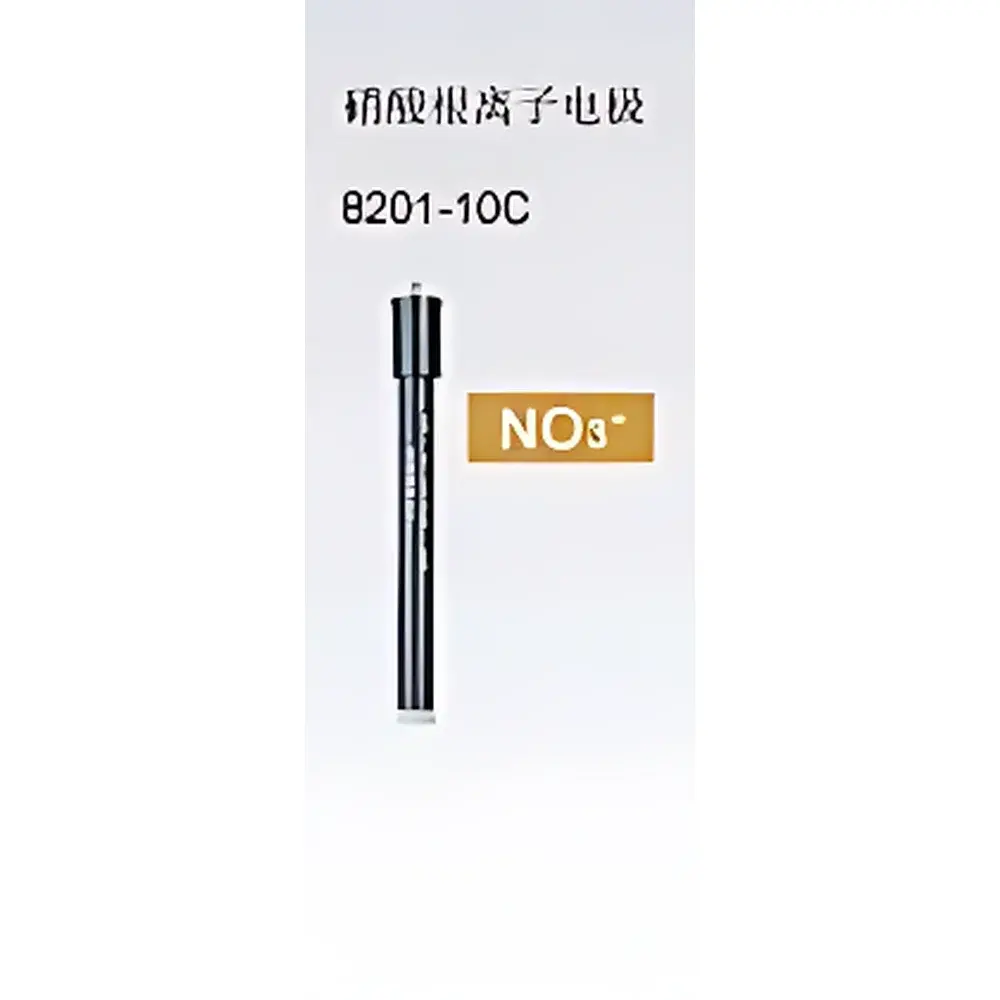
HORIBA 8201-10C Nitrate Ion-Selective Electrode
| Brand | HORIBA |
|---|---|
| Origin | Japan |
| Model | 8201-10C |
| Measuring Range | 0.62–62,000 ppm NO₃⁻ |
| Reference Electrode | 2565A |
| Part Number | 3014094403 (9003016800) |
| Compatible Meters | F-72, F-73, F-74, F-74BW, D-53 |
Overview
The HORIBA 8201-10C is a high-stability, liquid-membrane-type nitrate ion-selective electrode (ISE) engineered for precise, direct potentiometric measurement of nitrate concentration in aqueous environmental and industrial samples. Based on the principle of selective ion exchange across a polymeric membrane doped with a lipophilic quaternary ammonium ionophore, the electrode generates a Nernstian response (−59.2 mV/decade at 25 °C) to nitrate activity in solution. Its design conforms to ISO 10523 and ASTM D3370 standards for ion-selective electrode methodology, ensuring traceable, reproducible quantification across diverse water matrices—including surface water, groundwater, wastewater effluents, agricultural runoff, and drinking water distribution systems. The electrode operates within a pH range of 2.5–10.5; outside this range, hydrogen or hydroxide interference may affect potential stability and requires buffering or pH adjustment per ISO 10304-1 guidelines.
Key Features
- Optimized for long-term stability and low drift: <1 mV/h typical baseline drift after 30 min equilibration
- Robust PVC-based sensing membrane with optimized plasticizer and ionophore composition for enhanced selectivity against common interferents (e.g., chloride, sulfate, bicarbonate)
- Integrated double-junction reference system compatible with HORIBA’s 2565A Ag/AgCl reference electrode—minimizes liquid junction potential and prevents clogging in turbid or particulate-laden samples
- Reusable design with replaceable membrane module (part no. 7681) and standardized BNC connector for seamless integration into HORIBA benchtop (F-72/F-73/F-74/F-74BW) and portable (D-53) meters
- Calibration flexibility: supports two-point (10 ppm and 1000 ppm NO₃⁻) or multi-point calibration protocols aligned with EPA Method 300.0 and ISO 10304-1
- No internal filling solution required—eliminates maintenance downtime and contamination risk associated with refilling
Sample Compatibility & Compliance
The 8201-10C demonstrates reliable performance in freshwater, brackish water, and moderately conductive industrial process streams (conductivity 35 g/L TDS) without matrix-matched calibration due to ionic strength effects on activity coefficients. For regulatory compliance, the electrode supports GLP-compliant workflows when used with HORIBA meters equipped with audit-trail-enabled firmware (e.g., F-74BW v3.2+), satisfying data integrity requirements under FDA 21 CFR Part 11. All measurements comply with ISO/IEC 17025:2017 analytical validity criteria when validated per laboratory SOPs—including detection limit verification (<0.5 ppm NO₃⁻), repeatability (RSD < 2.5% at 100 ppm), and interferences assessment per IUPAC recommendation on ISE selectivity coefficients (log KNO₃−,X− ≤ −2.8 for Cl⁻, SO₄²⁻, HCO₃⁻).
Software & Data Management
When paired with HORIBA’s LAQUA Smart software (v2.1+), the 8201-10C enables automated calibration curve generation, real-time slope monitoring, and automatic temperature compensation (ATC) via integrated Pt1000 sensor input. Data export supports CSV, PDF, and XML formats compliant with LIMS integration (ASTM E1468-18). All measurement sessions include embedded metadata: timestamp, operator ID, electrode serial number, calibration history, and environmental conditions (temperature, pH if co-measured). Firmware updates maintain alignment with evolving ISO/IEC 17025 documentation requirements, including electronic signature support and version-controlled method templates.
Applications
- Regulatory monitoring of nitrate in drinking water per WHO Guideline Value (50 mg/L NO₃⁻) and EU Directive 98/83/EC
- Wastewater treatment plant effluent compliance reporting (e.g., US EPA NPDES permits)
- Agricultural runoff assessment for nutrient loading studies and watershed management
- Groundwater vulnerability mapping in nitrate-prone aquifers (e.g., alluvial deposits with intensive fertilizer use)
- Process control in food & beverage production (e.g., vegetable washing water, dairy effluent)
- Educational laboratories for teaching ion-selective potentiometry and environmental electrochemistry principles
FAQ
What reference electrode is required for the 8201-10C?
The HORIBA 2565A double-junction Ag/AgCl reference electrode is mandatory for optimal performance and stable liquid junction potential.
Can the 8201-10C be used with non-HORIBA meters?
Yes—any pH/mV meter with BNC input and millivolt resolution ≤ 0.1 mV is compatible, though full calibration automation and ATC require HORIBA LAQUA-series instruments.
How often should the membrane be replaced?
Under routine use (≤5 measurements/day), membrane replacement is recommended every 6–12 months; more frequent replacement is advised for high-turbidity or high-organic-content samples.
Is the electrode suitable for field deployment?
Yes—when used with the D-53 portable meter and protective carrying case, it meets IP67 ingress protection for temporary immersion and dust resistance.
Does the electrode require conditioning before first use?
Yes—soak in 100 ppm NO₃⁻ standard for ≥2 hours prior to calibration to stabilize membrane potential and ensure Nernstian response.







