
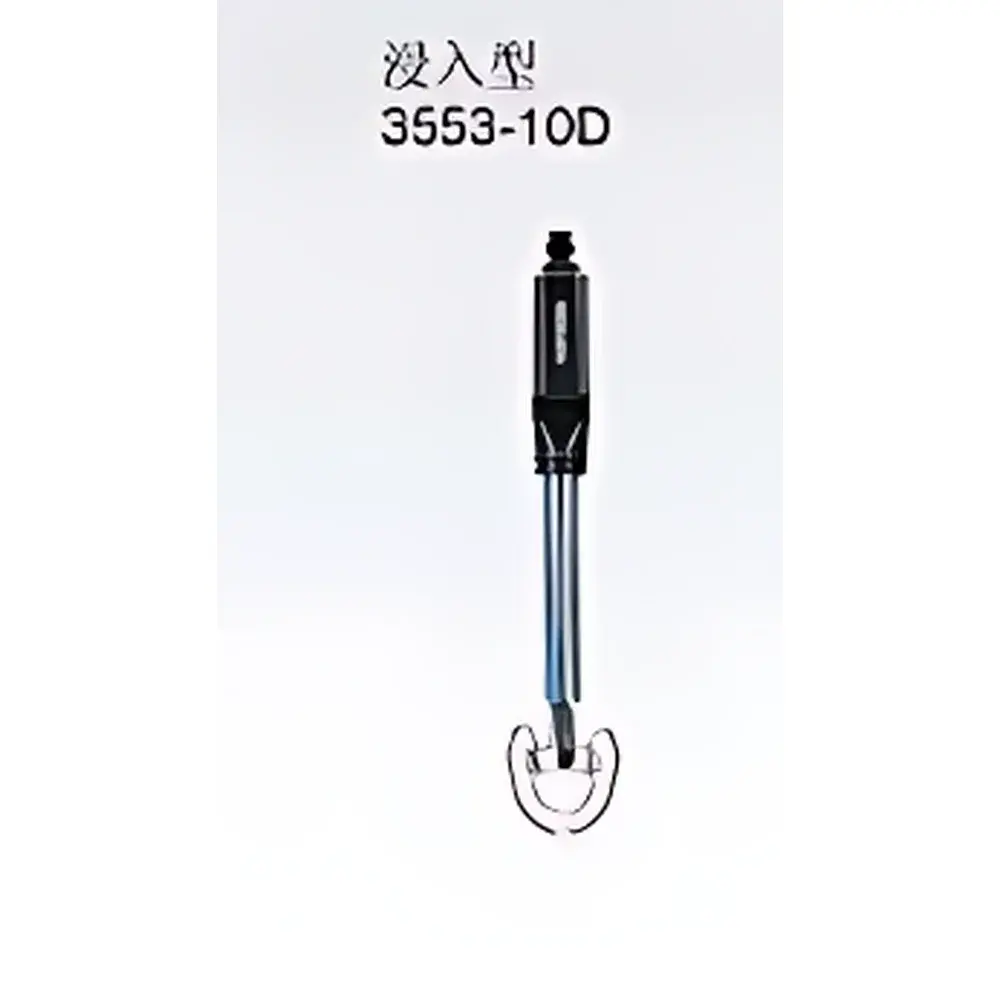
HORIBA Model 3553-10D Immersion-Type Conductivity Electrode
| Brand | HORIBA |
|---|---|
| Origin | Japan |
| Model | 3553-10D |
| Cell Constant | 1000 m⁻¹ (10 cm⁻¹) |
| Conductivity Range | 1 mS/cm to 100 S/cm (10 μS/cm to 1 S/cm) |
| Minimum Sample Volume | 50 mL |
| Operating Temperature Range | 0–60 °C |
| Part Number | 3014081714 (9056001000) |
Overview
The HORIBA Model 3553-10D is a high-precision immersion-type conductivity electrode engineered for reliable, stable measurements in high-conductivity aqueous and industrial process solutions. Designed according to the fundamental principle of two-electrode AC conductometry—where a known alternating current is applied across platinum electrodes and the resulting voltage drop is used to calculate solution conductivity—the 3553-10D employs a robust 1000 m⁻¹ (10 cm⁻¹) cell constant optimized for applications ranging from concentrated brines and electroplating baths to boiler feedwater and chemical synthesis streams. Its fixed-cell geometry ensures consistent calibration traceability and minimizes polarization errors at elevated ionic strengths. Unlike low-cell-constant electrodes intended for ultrapure water or dilute electrolytes, the 3553-10D’s high geometric factor delivers enhanced signal-to-noise ratio and measurement reproducibility in conductive media where traditional 1 cm⁻¹ or 0.1 cm⁻¹ cells saturate or exhibit nonlinearity.
Key Features
- Platinum black-coated electrodes for extended stability and reduced polarization effects in high-conductivity regimes
- Rigid PEEK (polyether ether ketone) body with integrated temperature sensor (NTC thermistor) for simultaneous real-time temperature compensation (0–60 °C)
- IP67-rated housing ensuring resistance to splashing, condensation, and incidental submersion during routine lab or pilot-plant use
- Fixed 1000 m⁻¹ cell constant calibrated per ISO 7888 and ASTM D1125 standards; certificate of calibration traceable to NIST reference materials available upon request
- Threaded M12 × 0.5 connection compatible with HORIBA LAQUA twin series meters (e.g., LAQUA Twin Cond, LAQUA DO-300), as well as third-party analyzers supporting analog 0–5 V or 4–20 mA output interfaces
- No internal electrolyte filling required—maintenance-free operation with no risk of leakage or refilling error
Sample Compatibility & Compliance
The 3553-10D is validated for use with aggressive, high-ionic-strength samples including sodium hydroxide (up to 50% w/w), sulfuric acid (up to 20% v/v), seawater, desalination reject streams, and spent etchants. It is not recommended for highly viscous, suspended, or particulate-laden media without pre-filtration (≥5 µm). The electrode complies with IEC 61000-6-2 (electromagnetic immunity) and IEC 61000-6-4 (emission) for industrial environments. When deployed within a validated analytical system, it supports data integrity requirements under FDA 21 CFR Part 11 when paired with HORIBA’s LAQUA software suite featuring electronic signatures, audit trails, and user access controls. Routine verification against standard KCl solutions (e.g., 0.1 mol/kg, 1.0 mol/kg) aligns with ISO/IEC 17025 quality management expectations for accredited laboratories.
Software & Data Management
When connected to HORIBA LAQUA twin-series instruments or PC-based LAQUA Smart Software (v4.2+), the 3553-10D enables automated temperature-compensated conductivity reporting using linear or non-linear (e.g., natural logarithm) compensation models. Raw sensor outputs—including raw conductance, temperature, and calculated conductivity—are timestamped and stored in .csv or .xlsx formats with full metadata (operator ID, calibration date, electrode ID). Data export supports LIMS integration via OPC UA or Modbus TCP protocols. Calibration history, drift monitoring, and pass/fail thresholds for QC checks are configurable per SOP, facilitating GLP/GMP-aligned documentation workflows without manual transcription.
Applications
- Monitoring conductivity in electrochemical plating baths (e.g., copper sulfate, nickel sulfamate) to maintain bath composition and prevent dendritic growth
- Real-time control of reverse osmosis concentrate streams and multi-effect evaporator blowdown in water reuse facilities
- Quality assurance testing of industrial cleaning agents, caustic soda solutions, and acid pickling liquors
- Research-scale characterization of ionic liquid conductivity and molten salt behavior (within thermal limits)
- Validation of deionized water polishing stages in pharmaceutical purified water (PW) and water-for-injection (WFI) systems—when used downstream of final filtration and prior to storage
FAQ
What is the recommended calibration frequency for the 3553-10D in continuous process monitoring?
Calibration should be performed before each analytical batch or at least once per 24-hour operational cycle. For critical GMP applications, daily verification using a mid-range KCl standard (e.g., 1413 µS/cm or 12.88 mS/cm) is advised.
Can the 3553-10D be sterilized using autoclaving or chemical disinfectants?
No. Autoclaving exceeds its maximum temperature rating (60 °C). Ethanol (70%) or isopropanol wipe-down is permissible; avoid chlorine-based or strong oxidizing agents that may degrade the PEEK housing or platinum coating.
Is this electrode compatible with non-aqueous solvents such as methanol or acetone?
Not recommended. The electrode is designed and calibrated for aqueous electrolyte systems. Non-aqueous media yield unpredictable cell constant deviations and may damage the temperature sensor.
How does the 1000 m⁻¹ cell constant affect measurement uncertainty compared to lower-constant electrodes?
At high conductivity (>10 mS/cm), the 1000 m⁻¹ geometry reduces relative current measurement error by increasing absolute conductance signal magnitude—improving precision to ±0.5% of reading (k = 2) under optimal conditions, per HORIBA technical validation reports.
Does the electrode require periodic re-platinization or refurbishment?
Under normal use in non-abrasive, non-particulate media, the platinum black layer remains stable for ≥2 years. Visual inspection for coating loss or physical damage is recommended quarterly; HORIBA offers certified refurbishment services including re-coating and recalibration.





