
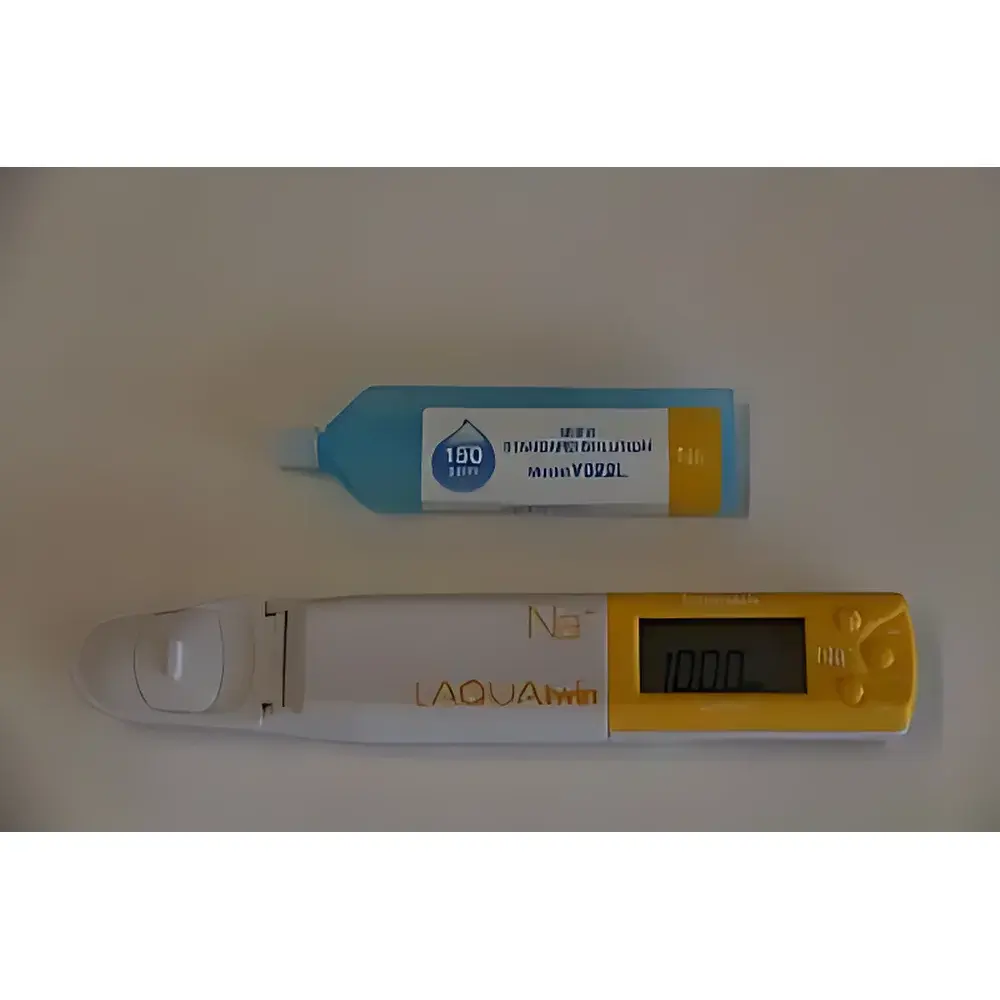
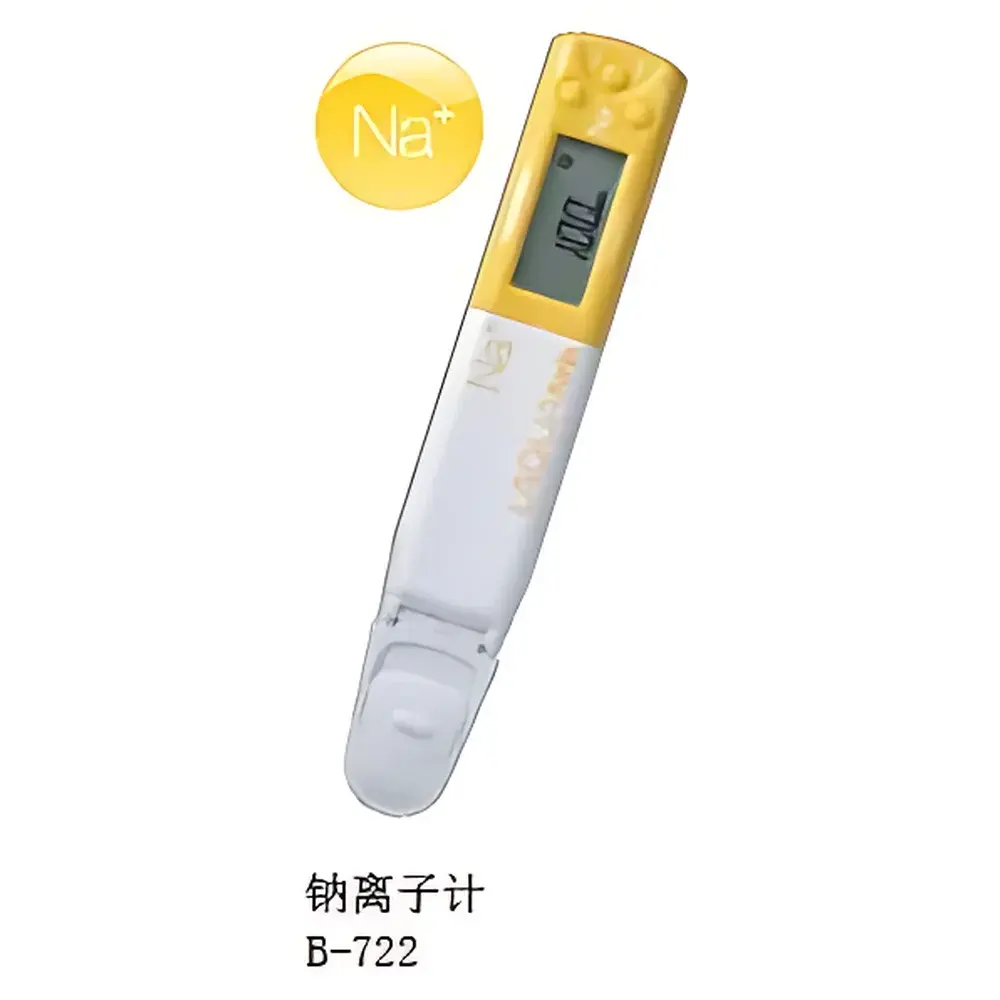
HORIBA B-722 Portable Pen-Type Sodium Ion Meter
| Brand | HORIBA |
|---|---|
| Origin | Japan |
| Model | B-722 |
| Measurement Principle | Ion-Selective Electrode (ISE) Method |
| Measurement Range | 23–2300 ppm (mg/L) [10⁻³–10⁻¹ mol/L] |
| Accuracy | ±10% of reading |
| Calibration | Two-point calibration |
| Temperature Compensation | Automatic (2%/°C fixed coefficient) |
| Sample Volume | 0.05 mL × 2 or ≥0.3 mL |
| IP Rating | IP67 |
| Operating Environment | 5–40 °C, RH <85% (non-condensing) |
| Power Supply | Two CR2032 batteries |
| Dimensions | 164 × 29 × 20 mm (excl. protrusions) |
| Weight | Approx. 50 g (instrument only) |
Overview
The HORIBA B-722 is a compact, handheld pen-type sodium ion meter engineered for rapid, on-site quantification of Na⁺ concentration in aqueous samples using solid-state ion-selective electrode (ISE) technology. Unlike traditional benchtop ion analyzers requiring extensive sample preparation and laboratory infrastructure, the B-722 integrates a miniature sodium-selective membrane electrode with low-power electronics into an ergonomic, pocket-sized form factor. Its measurement principle relies on the Nernstian response of a selective sensing membrane to sodium activity, generating a millivolt potential proportional to log[Na⁺], which is then linearized and displayed in ppm (mg/L) or mol/L units. Designed specifically for field-deployable water quality verification—such as boiler feedwater monitoring, desalination plant effluent screening, or environmental surface water surveys—the instrument delivers reliable semi-quantitative data without external power sources or calibration stations. Its operational range spans 23–2300 ppm Na⁺ (equivalent to 10⁻³–10⁻¹ mol/L), covering critical thresholds for industrial process control, regulatory compliance checks, and preliminary site assessment.
Key Features
- True portable architecture: 164 mm × 29 mm × 20 mm footprint and 50 g mass enable single-hand operation and belt-clip deployment in confined or remote locations.
- IP67-rated enclosure ensures full protection against dust ingress and immersion in water up to 1 m for 30 minutes—validated for use in humid laboratories, wastewater treatment plants, and outdoor sampling campaigns.
- Low-sample-volume capability: Accurate readings achievable with as little as 0.05 mL per measurement (dual-point sampling protocol), minimizing reagent consumption and enabling analysis of limited or precious samples.
- Integrated temperature compensation: Fixed 2%/°C coefficient applied automatically across the 5–40 °C operating range, eliminating manual correction and improving inter-laboratory reproducibility.
- Auto-hold function freezes stable readings after signal stabilization, reducing operator dependency and supporting documentation under GLP-aligned workflows.
- Two-point calibration routine supports traceable adjustment using certified Na⁺ standard solutions (e.g., 100 ppm and 1000 ppm), ensuring measurement integrity across the full dynamic range.
Sample Compatibility & Compliance
The B-722 is optimized for direct immersion measurement in clean to moderately turbid aqueous matrices—including freshwater, treated effluent, cooling tower water, and low-TDS groundwater. It is not recommended for highly viscous, suspended-solid-laden, or strongly acidic/alkaline samples (pH 12) without prior filtration or dilution, as these may affect membrane response kinetics or cause fouling. While not certified to ISO/IEC 17025 or ASTM D1129, its design aligns with common field-testing protocols referenced in EPA Method 300.1 (Ion Chromatography) and ASTM D6919 (Standard Test Method for Determination of Dissolved Alkali and Alkaline Earth Cations). The device meets IEC 60529 for IP67 classification and complies with RoHS Directive 2011/65/EU regarding hazardous substance restrictions.
Software & Data Management
The B-722 operates as a standalone, battery-powered instrument with no onboard data logging, Bluetooth, or USB interface. All measurements are displayed in real time on a high-contrast LCD screen; values are not stored internally. For audit-trail requirements under FDA 21 CFR Part 11 or ISO 17025, users must manually record results in bound lab notebooks or validated electronic systems. Calibration history and date stamps are not retained—operators are advised to maintain external calibration logs per GMP/GLP best practices. Firmware is non-upgradable; functional consistency is ensured through factory calibration traceable to NIST-traceable sodium standards.
Applications
- Boiler feedwater and steam condensate monitoring to detect sodium breakthrough indicating cation exchange resin exhaustion.
- Rapid verification of reverse osmosis (RO) system performance by comparing inlet and permeate Na⁺ concentrations.
- Field screening of drinking water sources for sodium contamination exceeding WHO guideline values (200 mg/L).
- Quality assurance checks during pharmaceutical water-for-injection (WFI) distribution loop validation.
- Educational demonstrations of ion-selective potentiometry principles in undergraduate analytical chemistry laboratories.
- Pre-screening prior to submission of samples for accredited ICP-MS or ion chromatography analysis.
FAQ
What sample volume is required for a valid measurement?
A minimum of 0.05 mL per measurement point is specified, though optimal stability and repeatability are achieved with ≥0.3 mL total volume in static mode.
Does the B-722 require pH adjustment before sodium measurement?
Yes—samples with pH outside 5–11 should be buffered to pH 7–9 using non-sodium-containing buffers (e.g., phosphate or TRIS) to prevent interference from H⁺ and OH⁻ ions.
Can the electrode be cleaned if performance degrades?
The integrated sodium ISE tip may be gently rinsed with deionized water and lightly polished with 0.5 µm alumina slurry; avoid abrasive pads or organic solvents.
Is the B-722 compliant with FDA 21 CFR Part 11 for electronic records?
No—it lacks electronic signature capability, audit trail generation, or secure data storage; manual transcription into validated systems is required for regulated environments.
How often should calibration be performed?
Calibrate before each use session or at least every 2 hours during continuous operation; recalibrate immediately after measuring samples with extreme Na⁺ concentrations (>2000 ppm).
Related Products







