
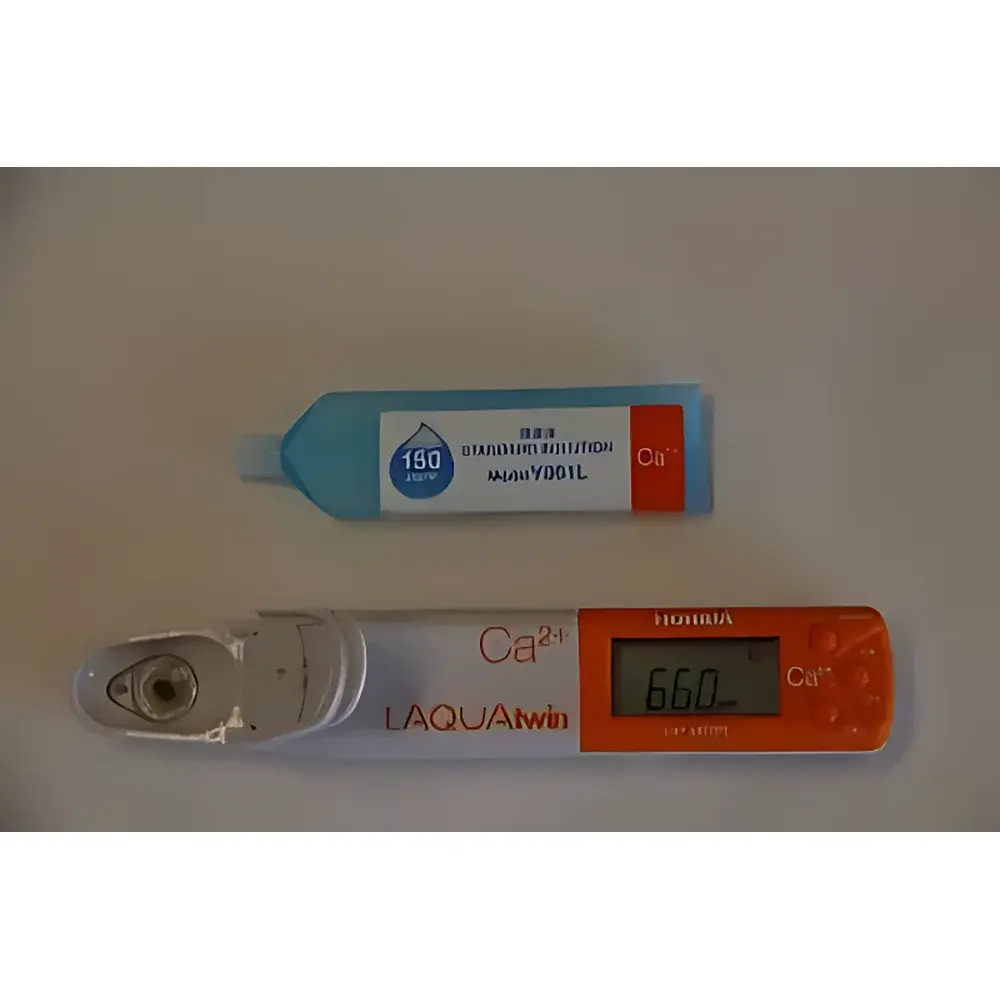
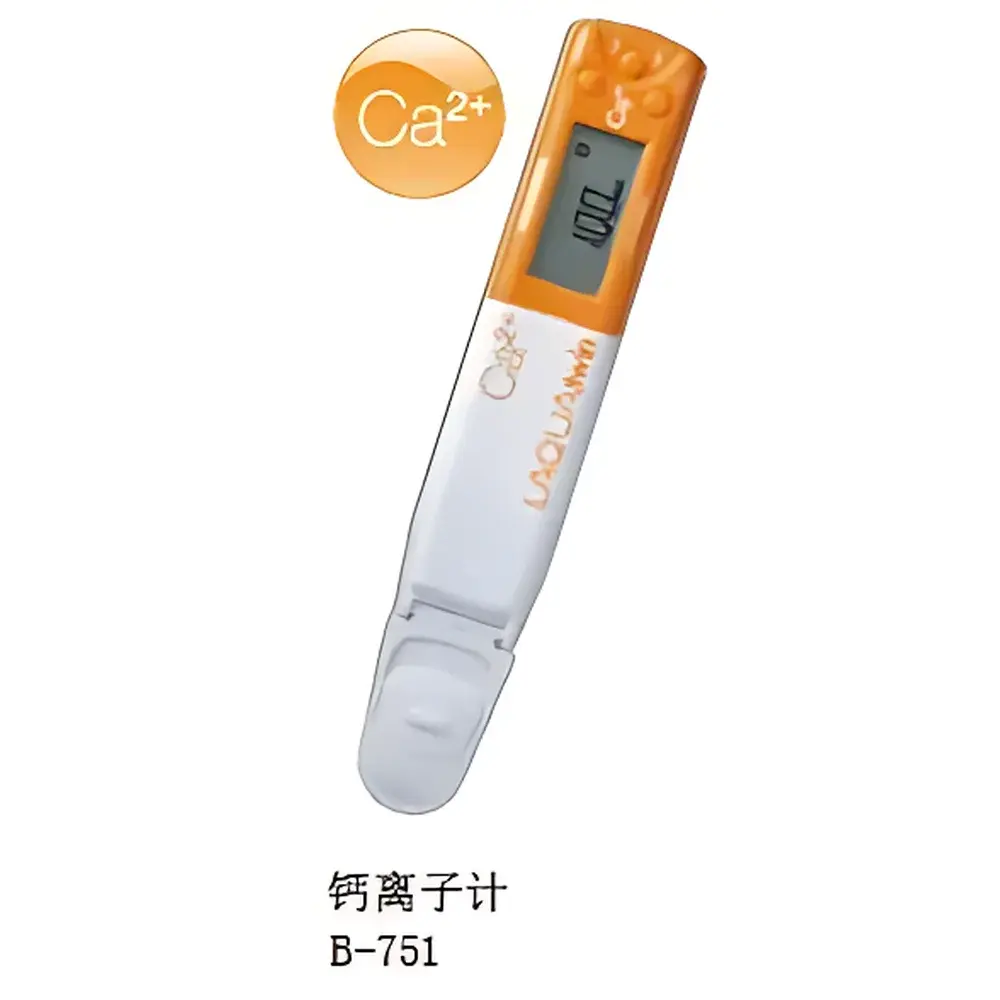
HORIBA B-751 Portable Calcium Ion Meter (Pen-Type Water Quality Analyzer)
| Brand | HORIBA |
|---|---|
| Origin | Japan |
| Model | B-751 |
| Measurement Principle | Ion-Selective Electrode (ISE) Method |
| Measuring Range | 40–4000 ppm (mg/L) Ca²⁺ [1.0 × 10⁻³ – 1.0 × 10⁻¹ mol/L] |
| Minimum Sample Volume | 0.05 mL × 2 or ≥0.3 mL |
| Calibration | Two-Point Calibration |
| Accuracy | ±20% of reading |
| Temperature Compensation | Yes (automatic, 2%/°C fixed coefficient) |
| Auto-Hold | Yes |
| Ingress Protection | IP67 |
| Operating Environment | 5–40 °C, ≤85% RH (non-condensing) |
| Power Supply | Two CR2032 batteries |
| Dimensions (L×W×H) | 164 × 29 × 20 mm (excl. protrusions) |
| Weight | ~50 g (instrument only, excl. batteries) |
Overview
The HORIBA B-751 is a compact, pen-style portable calcium ion meter engineered for rapid, on-site quantification of free Ca²⁺ concentration in aqueous samples using solid-state ion-selective electrode (ISE) technology. Unlike optical or colorimetric methods, the B-751 employs a potentiometric measurement principle based on the Nernst equation, where the electrode potential shifts logarithmically with the activity of calcium ions in solution. This enables direct, real-time measurement without reagents or sample digestion—ideal for field deployment in drinking water distribution networks, aquaculture systems, hydroponic nutrient monitoring, boiler feedwater control, and wastewater effluent screening. Its miniaturized architecture integrates a dedicated Ca²⁺-selective membrane electrode, temperature sensor, and microprocessor-based signal conditioning circuitry into a single handheld unit measuring just 164 mm in length and weighing under 50 g. Designed for operational robustness, the instrument meets IP67 ingress protection standards, ensuring reliable performance in humid, dusty, or splash-prone environments typical of municipal utility vaults, agricultural runoff sites, or industrial process trenches.
Key Features
- Ion-selective electrode (ISE) sensor optimized for Ca²⁺ detection in freshwater, brackish water, and low-TDS process streams
- Two-point calibration protocol supporting standard solutions traceable to NIST-certified reference materials (e.g., 100 ppm and 1000 ppm Ca²⁺)
- Automatic temperature compensation with fixed 2%/°C coefficient—no manual slope adjustment required
- Auto-hold function freezes stable readings after signal stabilization (±0.5 mV for ≥2 sec), minimizing operator variability
- IP67-rated housing certified to IEC 60529:2013—fully dust-tight and submersible up to 1 m for 30 min
- Low-power operation via two replaceable CR2032 coin-cell batteries (typical life: >2000 measurements at 25 °C)
- Compact form factor (164 × 29 × 20 mm) with ergonomic grip and recessed display for glove-compatible operation
Sample Compatibility & Compliance
The B-751 is validated for use with clear, non-viscous aqueous matrices having pH 4–10 and total dissolved solids (TDS) < 5000 ppm. It exhibits minimal interference from Na⁺, K⁺, Mg²⁺, and Cl⁻ at typical environmental concentrations (per HORIBA Application Note AN-B751-01). For regulatory contexts, the device supports documentation practices aligned with ISO/IEC 17025:2017 clause 7.7 (sampling and handling) and ASTM D511-20 (Standard Test Methods for Calcium in Water). While not FDA 21 CFR Part 11-compliant as a standalone instrument, its output data may be recorded manually into GLP/GMP-compliant logbooks or integrated into validated LIMS workflows when paired with certified data transfer protocols. The instrument complies with RoHS Directive 2011/65/EU and REACH Regulation (EC) No. 1907/2006.
Software & Data Management
The B-751 operates as a stand-alone analog-digital hybrid instrument with no onboard memory or Bluetooth/Wi-Fi connectivity. All measurements are displayed in real time on a high-contrast LCD screen with dual-unit readout (ppm and mol/L). Users are expected to record results manually or interface the device with external data loggers via optional analog output adapters (sold separately). HORIBA provides calibration verification checklists and uncertainty estimation templates compliant with EURACHEM/CITAC Guide CG4 (Quantifying Uncertainty in Analytical Measurement), enabling laboratories to establish measurement traceability per ISO/IEC 17025 requirements. Firmware updates are not supported; hardware revision control is maintained through serial-number-based manufacturing logs.
Applications
- Drinking water quality verification at point-of-use locations (e.g., school fountains, hospital dialysis units)
- Calcium hardness monitoring in cooling tower recirculation loops to prevent scale formation
- Process control in dairy wastewater treatment where Ca²⁺ influences coagulant dosing efficiency
- Rapid assessment of irrigation water suitability for calcium-sensitive crops (e.g., tomatoes, lettuce)
- Field validation of laboratory ICP-OES or AAS calcium results during method transfer studies
- Educational demonstrations of ion activity vs. concentration relationships in undergraduate chemistry labs
FAQ
What sample volume is required for accurate measurement?
A minimum of 0.05 mL applied twice (total 0.1 mL) is sufficient for stable electrode response; however, ≥0.3 mL is recommended for improved reproducibility in low-conductivity samples.
Can the B-751 measure calcium in seawater or high-salinity brines?
No—the instrument is calibrated for freshwater and low-ionic-strength matrices (TDS < 5000 ppm). High chloride and sodium concentrations cause significant ISE interference and deviation from Nernstian response.
Is temperature compensation adjustable or fixed?
Temperature compensation uses a fixed 2%/°C coefficient per the Horiba B-Series design specification; no user-adjustable slope or coefficient entry is available.
How often should calibration be performed?
Calibrate before each measurement session and whenever ambient temperature changes by >5 °C or after exposure to extreme humidity; daily calibration is recommended for routine QC applications.
Does the B-751 comply with EPA or ISO drinking water standards?
While the B-751 itself is not EPA-approved as a primary method, it serves as a qualified screening tool per EPA Method 200.7 guidance for preliminary calcium assessment prior to confirmatory ICP analysis.







