
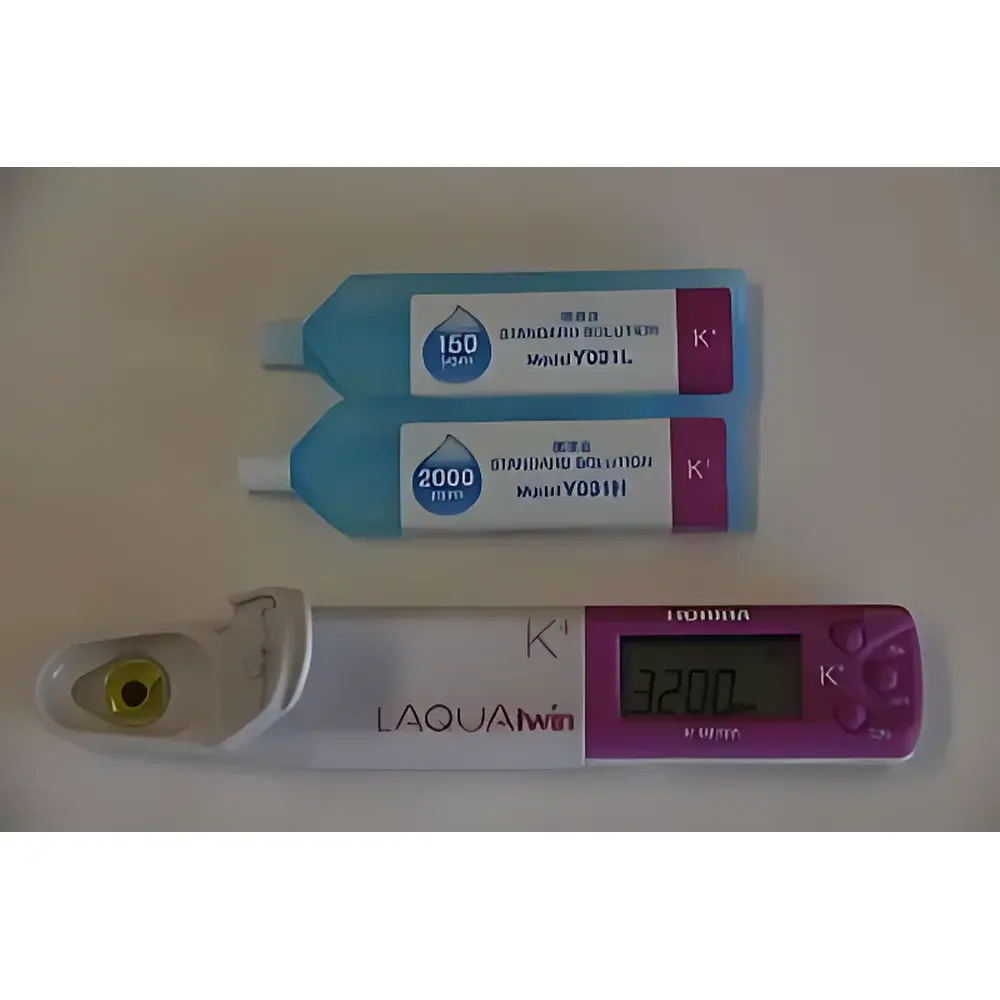
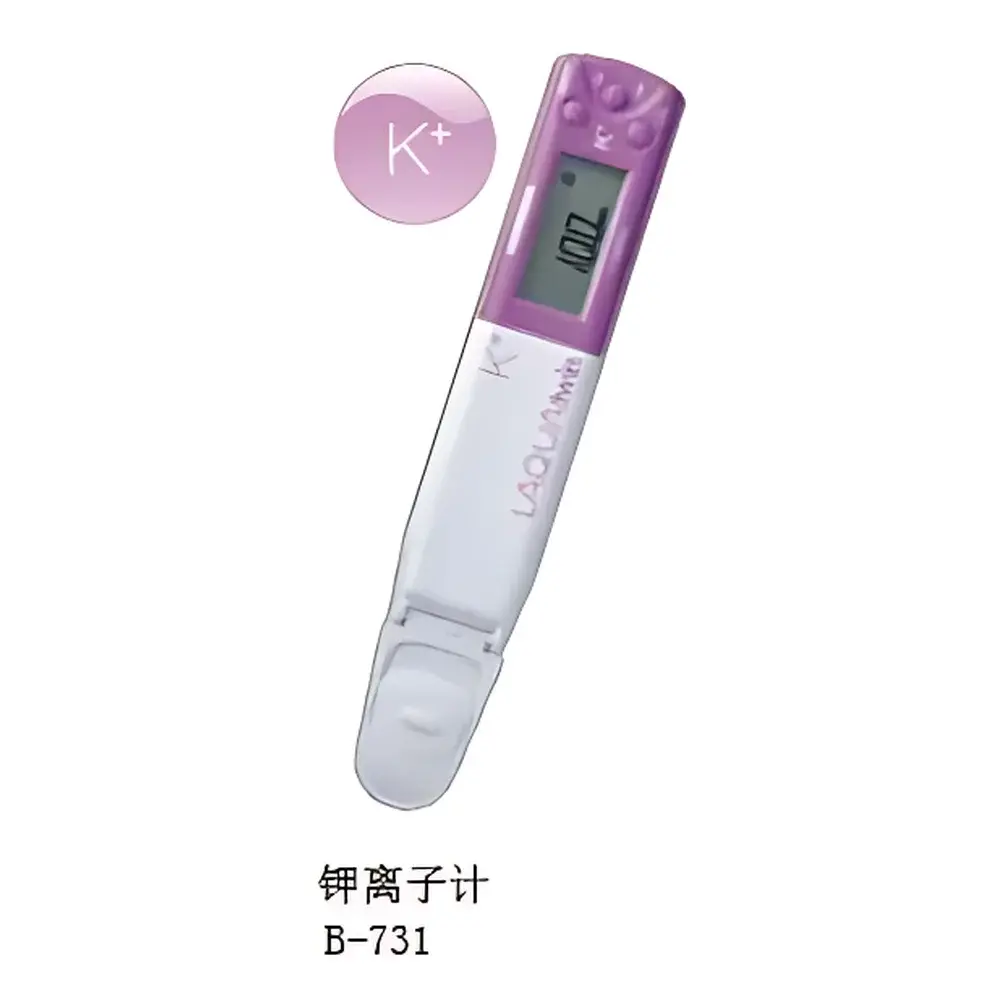
HORIBA B-731 Portable Potassium Ion Meter
| Brand | HORIBA |
|---|---|
| Origin | Japan |
| Model | B-731 |
| Measurement Principle | Solid-State Ion-Selective Electrode (ISE) Method |
| Measuring Range | 39–3900 ppm K⁺ (10⁻³–10⁻¹ mol/L) |
| Minimum Sample Volume | 0.05 mL × 2 or ≥0.3 mL |
| Calibration | Two-Point Calibration |
| Accuracy | ±10% of reading |
| Temperature Compensation | Automatic (NTC thermistor, 2%/°C fixed coefficient) |
| Protection Rating | IP67 |
| Operating Environment | 5–40 °C, ≤85% RH (non-condensing) |
| Power Supply | Two CR2032 lithium batteries |
| Dimensions | 164 × 29 × 20 mm (excl. probe protrusion) |
| Weight | Approx. 50 g (instrument only, excluding batteries) |
Overview
The HORIBA B-731 is a compact, handheld potassium ion meter engineered for rapid, field-deployable quantification of aqueous K⁺ concentration using solid-state ion-selective electrode (ISE) technology. Unlike traditional glass-membrane electrodes, the B-731 employs a robust, maintenance-free polymer-based ISE sensor optimized for stability in variable water matrices—including freshwater, wastewater effluents, hydroponic nutrient solutions, and soil leachates. Its measurement principle relies on the Nernstian response of the potassium-selective membrane, generating a millivolt potential proportional to the logarithm of K⁺ activity in solution. The instrument incorporates built-in temperature compensation via an integrated NTC thermistor, ensuring consistent calibration across ambient conditions without manual correction. Designed as part of HORIBA’s B-700 series of multi-parameter pocket meters, the B-731 delivers trace-level sensitivity (detection limit ~39 ppm) while maintaining operational simplicity—making it suitable for routine monitoring by environmental technicians, agricultural extension staff, and laboratory support personnel requiring immediate, on-site data without benchtop infrastructure.
Key Features
- True portable form factor: 164 mm × 29 mm × 20 mm; weight ≈ 50 g (instrument body only), enabling one-handed operation and extended field use.
- IP67-rated enclosure: Fully dust-tight and submersible up to 1 m for 30 minutes—validated per IEC 60529—ensuring reliability in humid, outdoor, or splash-prone environments.
- Low-volume sampling capability: Supports measurements with as little as 0.05 mL × 2 (dual-point verification) or ≥0.3 mL single-sample mode—ideal for micro-sampling applications such as porewater extraction or small-volume bioreactor monitoring.
- Two-point calibration protocol: Uses standardized K⁺ reference solutions (e.g., 100 ppm and 1000 ppm) to establish slope and offset, complying with ISO 15197:2013 guidance for electrochemical ion measurement reproducibility.
- Auto-hold function: Freezes stable readings after signal stabilization (±0.5 mV/3 sec), reducing operator dependency and minimizing parallax error during field recording.
- Integrated temperature compensation: Fixed 2%/°C coefficient applied automatically—aligned with typical aqueous K⁺ activity temperature dependence per ASTM D1129-22 Annex A1.
Sample Compatibility & Compliance
The B-731 is validated for direct immersion or dip-and-read analysis of liquid samples with pH 2–12 and total dissolved solids (TDS) < 5000 ppm. It exhibits minimal interference from Na⁺ (selectivity coefficient log KK,Na ≈ −2.3), Ca²⁺, and Mg²⁺ under standard environmental concentrations. Cross-sensitivity to NH₄⁺ is present above 500 ppm but remains within ±5% influence at typical agricultural water levels (<100 ppm NH₄⁺). The device complies with RoHS Directive 2011/65/EU and meets CE marking requirements for electromagnetic compatibility (EN 61326-1:2013) and safety (EN 61010-1:2010). While not certified for GLP-regulated reporting, its two-point calibration traceability supports internal QA/QC documentation per ISO/IEC 17025:2017 Clause 7.7 for non-accredited field screening.
Software & Data Management
The B-731 operates as a standalone instrument with no onboard memory or USB/Bluetooth connectivity. All measurements are displayed in real time on a high-contrast LCD and must be manually recorded. This architecture intentionally eliminates firmware dependencies, data encryption overhead, or audit-trail requirements—aligning with low-infrastructure deployment scenarios where regulatory validation of digital records is not mandated. For laboratories requiring traceable electronic logs, users may pair the B-731 with external mobile logging apps or LIMS-integrated tablets using standardized CSV export protocols. Calibration history is retained solely via user-maintained paper logs or spreadsheet entries referencing date, standard lot numbers, and measured mV values.
Applications
- Environmental field surveys: Monitoring potassium leaching in watershed runoff, riverine baseflow, and groundwater monitoring wells.
- Agricultural water management: Verifying K⁺ concentration in irrigation reservoirs, fertigation tanks, and hydroponic recirculation systems.
- Soil testing support: Quantifying extractable K⁺ in 1:5 soil-water extracts (ASTM D512-21 compliant preparation).
- Educational labs: Demonstrating ion-selective electrode fundamentals, Nernst equation derivation, and calibration curve linearity.
- Wastewater pretreatment verification: Confirming K⁺ removal efficiency in ion-exchange or electrodialysis units prior to discharge compliance checks.
FAQ
What sample volume is required for accurate measurement?
Minimum recommended volume is 0.3 mL for single-point analysis; dual-point verification (to assess electrode drift) requires two separate 0.05 mL aliquots.
Does the B-731 require electrode conditioning before first use?
No conditioning is necessary—the solid-state ISE sensor is factory-activated and ready for immediate use after initial two-point calibration.
Can the B-731 measure potassium in seawater or high-salinity brines?
Not recommended: Ionic strength > 1000 mM (e.g., seawater ≈ 600 mM Na⁺ alone) induces significant activity coefficient deviation and violates the linear Nernst range; use dedicated high-ionic-strength ISEs instead.
How often should calibration be performed?
Calibrate before each measurement session and recheck mid-session if ambient temperature shifts >5 °C or after >10 consecutive readings.
Is battery replacement user-serviceable?
Yes—two standard CR2032 coin cells are accessible via a screwless sliding cover; battery life exceeds 2000 measurements per set under typical usage.







