
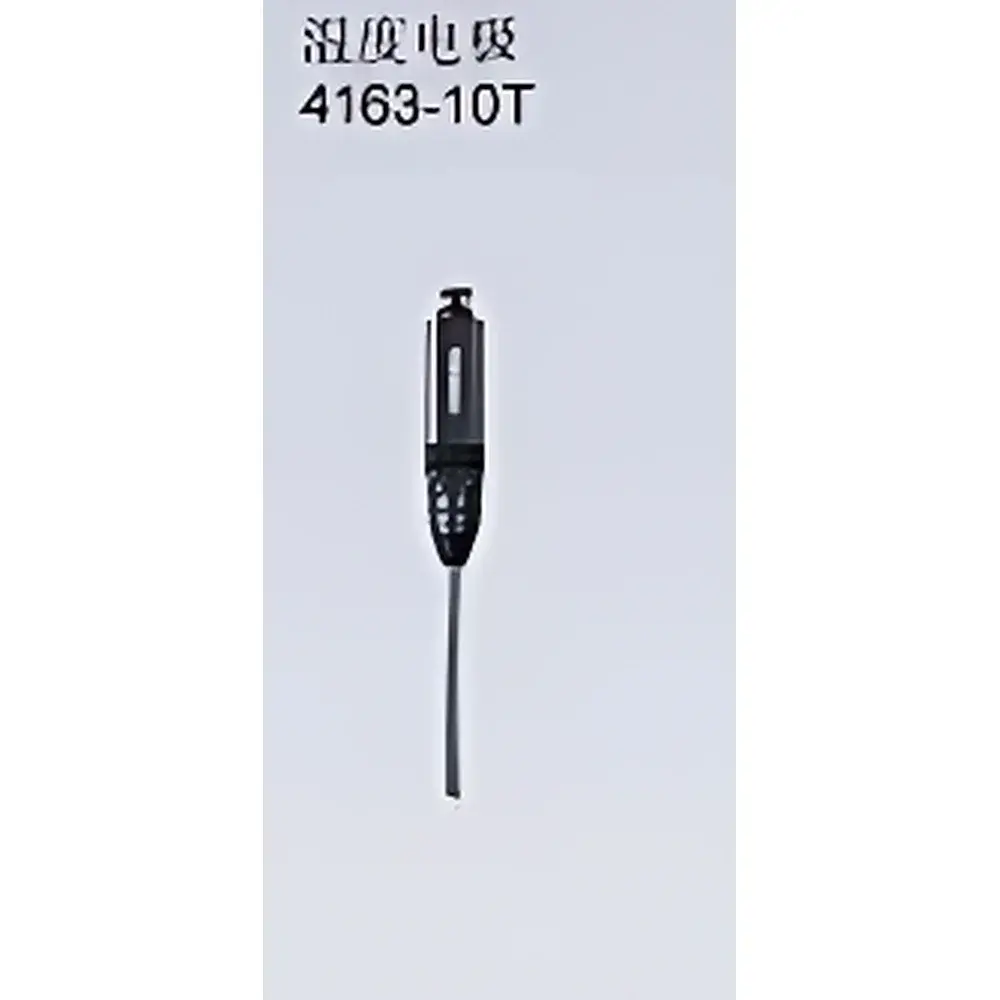
HORIBA 4163-10T Temperature Electrode for pH and ORP Systems
| Brand | HORIBA |
|---|---|
| Origin | Japan |
| Model | 4163-10T |
| Temperature Range | 0–100 °C |
| Compatibility | Designed for use with HORIBA pH/ORP meters (e.g., LAQUA series) and compatible third-party analyzers requiring Pt1000 or analog temperature input |
| Output Signal | Analog (2-wire RTD, Pt1000 class B per IEC 60751) |
| Enclosure Material | Chemically resistant PPS (polyphenylene sulfide) body with stainless steel tip |
| Cable Length | 1 m standard (custom lengths available) |
| IP Rating | IP67 |
| Calibration Traceability | NIST-traceable reference data provided upon request |
Overview
The HORIBA 4163-10T is a high-stability, industrial-grade temperature electrode engineered specifically for integration into electrochemical measurement systems requiring precise, real-time temperature compensation. Unlike generic thermistors or basic RTDs, the 4163-10T employs a platinum resistance thermometer (Pt1000) sensor conforming to IEC 60751 Class B tolerance (±0.3 °C at 0 °C, ±0.58 °C at 100 °C), ensuring metrological integrity across its full operational range of 0–100 °C. Its design supports automatic temperature compensation (ATC) in pH and ORP measurements per ISO 3696, ASTM D1293, and USP , where accurate thermal input directly impacts Nernst equation-based potential correction. The electrode features a compact, chemically inert PPS housing and a corrosion-resistant stainless steel sensing tip—optimized for immersion in aqueous solutions, buffer standards, process streams, and low-conductivity samples. It is not a standalone measuring device but a dedicated auxiliary sensor intended for seamless pairing with HORIBA LAQUA twin-sensor probes (e.g., 96xx-10D series) or benchtop/potable meters supporting external temperature input via analog 2-wire RTD interface.
Key Features
- Pt1000 platinum RTD sensor with IEC 60751 Class B accuracy—validated for reproducible thermal response in laboratory and industrial environments.
- Robust PPS (polyphenylene sulfide) body offering exceptional resistance to acids, alkalis, and organic solvents—tested per JIS K 6911 for chemical exposure stability.
- Stainless steel 316L sensing tip ensures mechanical durability and minimizes thermal lag during rapid temperature transitions.
- IP67-rated cable junction and strain relief enable reliable operation in humid, splash-prone, or semi-submerged conditions without seal degradation.
- 1-meter PVC-insulated shielded cable with color-coded leads (red/white) facilitates straightforward termination to HORIBA’s proprietary connectors or standard 2-wire RTD inputs.
- No internal electrolyte or liquid junction—eliminates drift from evaporation, crystallization, or clogging, unlike combination pH/temperature electrodes.
Sample Compatibility & Compliance
The 4163-10T is compatible with a broad spectrum of sample matrices, including purified water (Type I–III per ISO 3696), pharmaceutical buffers (USP ), wastewater effluents, food extracts, and non-aqueous solvents with minimal water content (<5% v/v). Its solid-state construction avoids contamination risks associated with liquid-filled temperature elements. For regulatory compliance, the electrode supports GLP/GMP workflows by enabling audit-ready temperature logging when paired with HORIBA’s LAQUA software (v2.5+), which records timestamped ATC values alongside pH/ORP data—fully traceable to instrument calibration logs. While the sensor itself does not require periodic recalibration under stable conditions, annual verification against a NIST-traceable reference thermometer (e.g., Fluke 1523) is recommended per ISO/IEC 17025 clause 6.5.2.
Software & Data Management
When connected to HORIBA LAQUA Twin or LAQUAtouch instruments, the 4163-10T delivers continuous temperature data synchronized with pH/ORP readings at up to 10 Hz sampling rate. LAQUA PC Software (v3.1+) stores raw temperature values with 0.1 °C resolution, applies linear or polynomial ATC algorithms per IUPAC recommendations, and exports CSV files containing dual-channel time-series datasets. All temperature metadata—including sensor ID, calibration date, and firmware version—is embedded in exported reports to satisfy FDA 21 CFR Part 11 requirements for electronic records. No firmware update is required for the 4163-10T itself, as it operates passively; however, host instrument firmware must be ≥v2.40 to recognize the Pt1000 characteristic curve correctly.
Applications
- Calibration verification of pH electrodes using standardized buffer solutions at defined temperatures (e.g., 25 °C, 40 °C).
- In-line temperature monitoring during titration assays where thermal expansion affects volume delivery precision.
- Environmental testing of surface water and groundwater per EPA Method 150.1 and ISO 10523.
- Biopharmaceutical process control—monitoring bioreactor broth temperature during pH-stat fermentation runs.
- Quality control of cleaning-in-place (CIP) rinse cycles where residual heat influences conductivity-based end-point detection.
- Educational laboratories requiring rugged, maintenance-free temperature input for electrochemistry experiments.
FAQ
Can the 4163-10T be used independently as a standalone thermometer?
No—it lacks signal conditioning circuitry and requires connection to a compatible meter or data acquisition system with Pt1000 input capability.
Is the electrode suitable for steam-sterilizable applications?
No—maximum continuous operating temperature is 100 °C; autoclaving (≥121 °C) exceeds its thermal rating and may compromise sensor integrity.
Does it require periodic refilling or electrolyte replacement?
No—the 4163-10T contains no liquid components; it is a solid-state RTD and requires only periodic physical inspection and electrical continuity verification.
Can it be submerged continuously in aggressive media such as 6M HCl or 50% NaOH?
Yes—the PPS body and 316L tip are validated for continuous immersion in these concentrations at ≤60 °C; extended exposure above 60 °C in strong alkalis may accelerate surface oxidation.
What is the recommended recalibration interval?
Annual verification against a certified reference thermometer is advised for GLP-compliant operations; more frequent checks are required if used in high-thermal-cycling environments (>5 cycles/day).





