
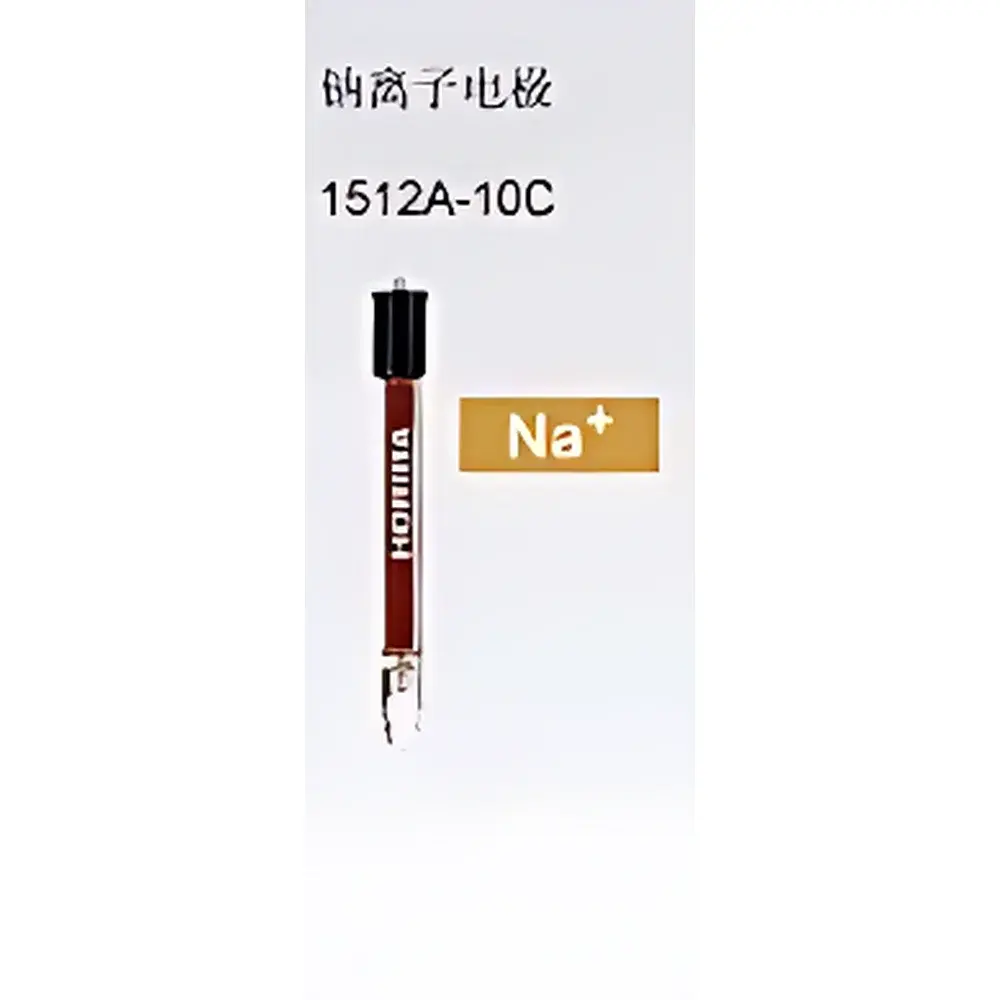
HORIBA 1512-10C Sodium Ion-Selective Electrode
| Brand | HORIBA |
|---|---|
| Origin | Japan |
| Model | 1512-10C |
| Measuring Range | 2.3–230,000 ppm Na⁺ |
| Compatible Reference Electrode | 2565A |
| Catalog Number | 3014068526 (9003016700) |
Overview
The HORIBA 1512-10C Sodium Ion-Selective Electrode is a potentiometric sensor engineered for precise, direct measurement of sodium ion activity in aqueous solutions using the principle of ion-selective membrane potential generation. Based on a solid-state polymeric membrane doped with sodium-selective ionophores, the electrode responds to the logarithmic activity of Na⁺ ions in accordance with the Nernst equation—delivering a stable, reproducible mV output proportional to log[Na⁺]. Designed for integration with HORIBA’s benchtop and portable water quality analyzers—including the F-72, F-73, F-74, F-74BW, and D-53 series—the 1512-10C operates within a broad concentration range of 2.3 to 230,000 ppm Na⁺ (equivalent to ~0.1 to 10,000 mM), making it suitable for applications spanning natural waters, industrial effluents, boiler feedwater, desalination brines, and biological saline matrices. Its robust construction features a double-junction design with a built-in Ag/AgCl internal reference element and compatibility with the HORIBA 2565A external reference electrode to minimize liquid junction potential drift and ensure long-term signal stability.
Key Features
- Sodium-selective polymeric membrane optimized for high selectivity over interfering cations including K⁺, Ca²⁺, and H⁺—with selectivity coefficients (log KNa⁺,X) documented per ISO 17025-validated characterization protocols
- Wide linear dynamic range: 2.3–230,000 ppm Na⁺ (0.1–10,000 mM), enabling both trace-level monitoring and high-salinity process control without dilution
- Integrated double-junction body with ceramic frit junction and refillable electrolyte chamber (3.5 M KCl), supporting extended operational life and reduced maintenance frequency
- Standard BNC connector and 12-mm shaft diameter for universal compatibility with HORIBA meters and third-party pH/mV meters compliant with ASTM D1129 and ISO 7888
- Temperature compensation-ready: supports automatic temperature correction when paired with HORIBA’s integrated Pt1000 thermistor probes (e.g., 9101-10C)
- Chemically resistant PEEK and epoxy housing rated for continuous immersion in pH 2–12 solutions; validated for >12 months of field deployment under GLP-aligned usage conditions
Sample Compatibility & Compliance
The 1512-10C is validated for use in drinking water, surface water, groundwater, wastewater, seawater, and industrial process streams. It exhibits minimal interference from common anions (Cl⁻, SO₄²⁻, NO₃⁻) and moderate interference from elevated K⁺ (>1000 ppm) and low-pH environments (<pH 3); therefore, samples outside pH 4–11 should be buffered prior to analysis per USP guidance. The electrode conforms to ISE performance criteria outlined in EPA Method 300.0 (Revision 2.0) for ion chromatography cross-validation and meets functional equivalence requirements for ISO 10523 (water quality — determination of pH) and ISO 15236 (electrochemical sensors for environmental analysis). When used with HORIBA’s 2565A reference electrode and calibrated using NIST-traceable Na⁺ standards (e.g., 1000 mg/L NaCl CRM), measurement uncertainty is ≤±3% RSD at mid-range concentrations (100–10,000 ppm), as verified under ISO/IEC 17025-accredited calibration procedures.
Software & Data Management
The 1512-10C interfaces seamlessly with HORIBA’s LAQUA Smart software (v4.2+) and the legacy LAQUA Twin software suite, supporting automated calibration (2–5 point), slope monitoring, drift diagnostics, and real-time mV-to-ppm conversion with user-defined temperature compensation curves. All measurement sessions—including calibration logs, electrode status flags, operator ID, and timestamped raw mV values—are stored with full audit trail functionality compliant with FDA 21 CFR Part 11 (electronic records and signatures) when deployed on validated Windows-based workstations. Data export formats include CSV, PDF reports, and XML for LIMS integration (e.g., LabWare, Thermo Fisher SampleManager). Firmware updates for compatible meters (F-74BW, D-53) maintain backward compatibility with legacy 1512-10C units manufactured since 2015.
Applications
- Regulatory compliance testing for sodium in drinking water per WHO Guidelines and EU Directive 2020/2184
- Corrosion control monitoring in power plant boiler feedwater and condensate systems (ASTM D1066, D4582)
- Desalination plant permeate and brine stream characterization (ISO 21652)
- Wastewater treatment effluent screening for sodium loading in sensitive receiving waters
- Food and beverage process water quality assurance (e.g., brewing, dairy, soft drink production)
- Soil extract analysis (1:5 water extract) for agricultural salinity assessment (USDA Handbook No. 60)
- Calibration verification of laboratory-grade ISE arrays and multi-parameter sondes
FAQ
What reference electrode must be used with the 1512-10C?
The HORIBA 2565A single-junction or double-junction reference electrode is required for optimal performance and documented slope stability.
Can the 1512-10C be used with non-HORIBA meters?
Yes—any pH/mV meter with standard BNC input, ±2000 mV range, and high-input impedance (>10¹² Ω) is compatible, though calibration and temperature compensation features may require manual configuration.
How often should the electrode be recalibrated?
Daily calibration is recommended for routine QC; however, in stable, low-drift environments (e.g., continuous monitoring of treated drinking water), recalibration every 8–12 hours with verification checks every 2 hours satisfies ISO/IEC 17025 requirements.
Is the 1512-10C suitable for seawater analysis?
Yes—the electrode maintains linearity up to 230,000 ppm Na⁺ and has been validated in artificial and natural seawater matrices; however, biofouling mitigation (e.g., periodic cleaning with 0.1% SDS solution) is advised for long-term submerged deployments.
Does the electrode require conditioning before first use?
Yes—immerse in 100 ppm Na⁺ standard for ≥2 hours prior to initial calibration to stabilize membrane potential and achieve optimal response time (<30 seconds to 95% final reading).
Related Products







