
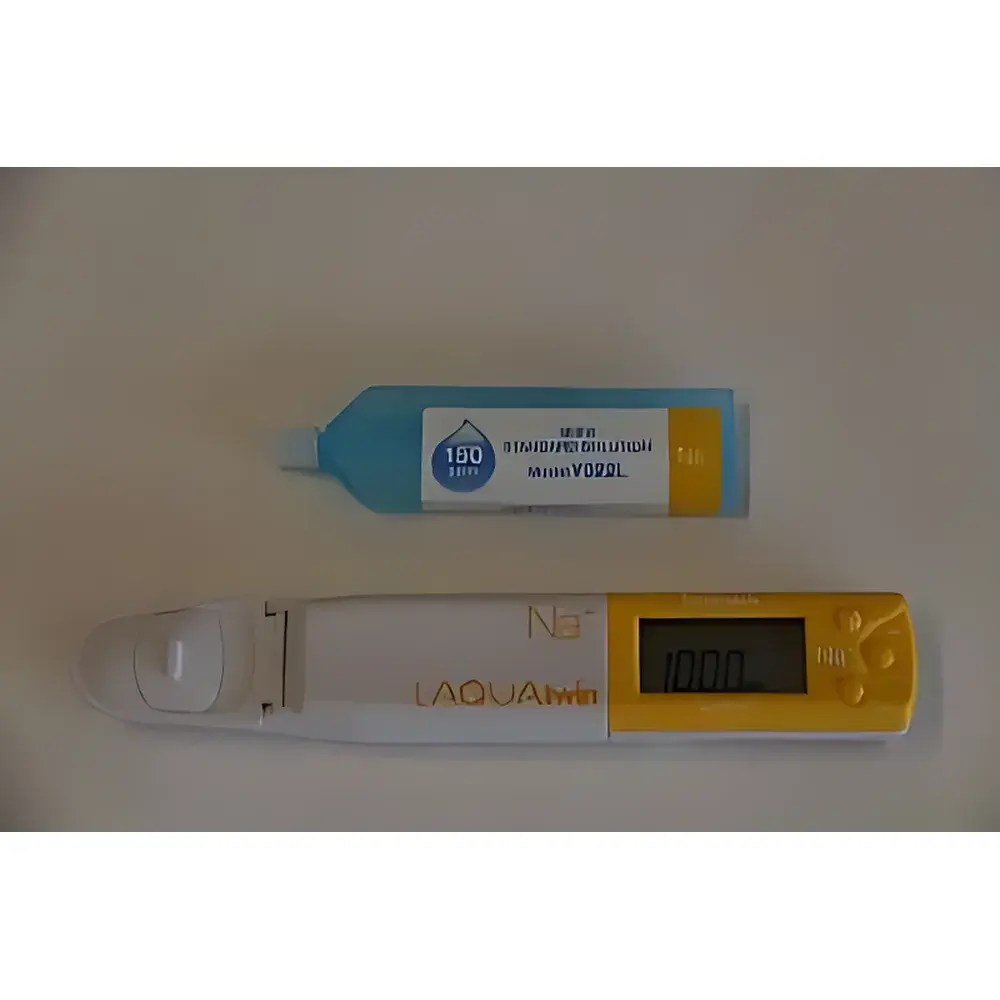
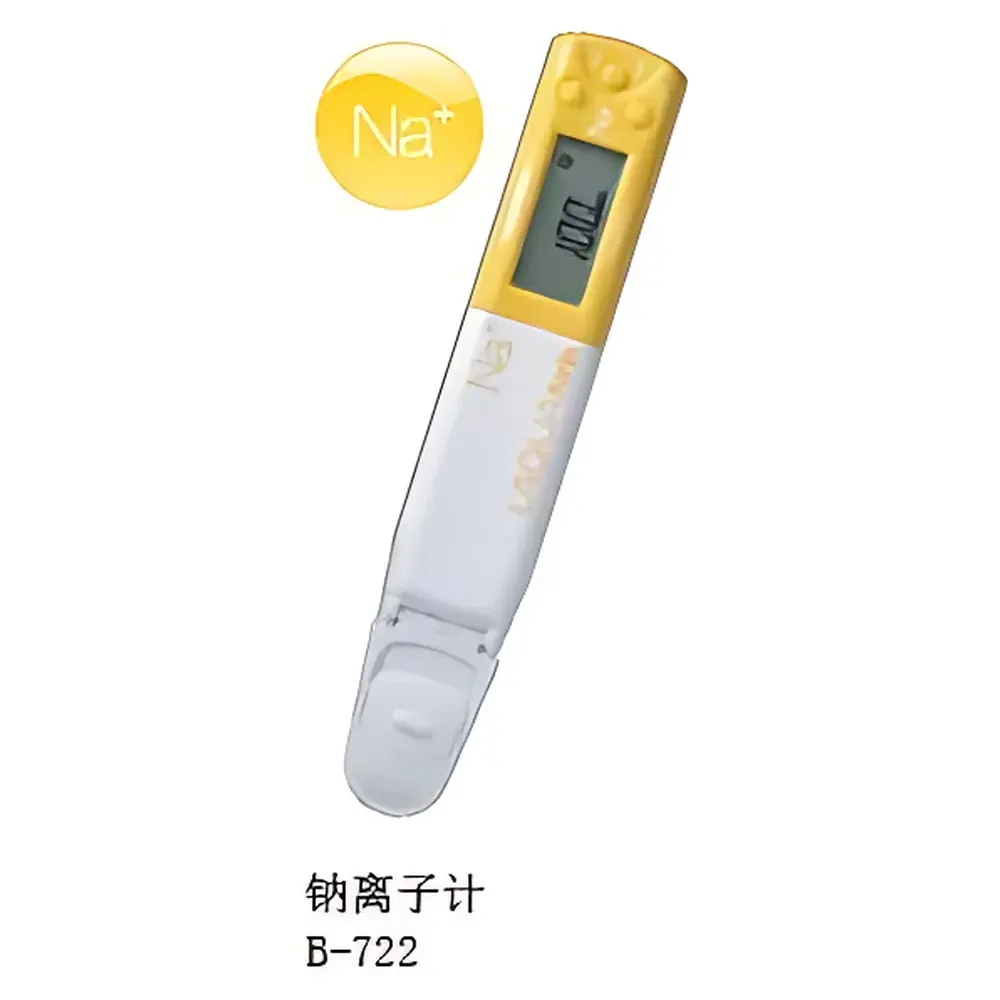
HORIBA B-722 Portable Sodium Ion Meter (Pen-Type)
| Brand | HORIBA |
|---|---|
| Origin | Japan |
| Model | B-722 |
| Measurement Principle | Ion-Selective Electrode (ISE) Method |
| Measurement Range | 23–2300 ppm (mg/L) [1.0 × 10⁻³ – 1.0 × 10⁻¹ mol/L] |
| Minimum Sample Volume | 0.05 mL × 2 or ≥0.3 mL |
| Calibration | Two-Point Calibration |
| Accuracy | ±10% of reading |
| Temperature Compensation | Automatic (2%/°C fixed coefficient) |
| Auto-Hold Function | Yes |
| Ingress Protection Rating | IP67 |
| Operating Environment | 5–40 °C, <85% RH (non-condensing) |
| Power Supply | Two CR2032 batteries |
| Dimensions (L×W×H) | 164 × 29 × 20 mm (excl. protrusions) |
| Weight | Approx. 50 g (instrument only, batteries excluded) |
Overview
The HORIBA B-722 Portable Sodium Ion Meter is a compact, field-deployable pen-type analyzer engineered for rapid, on-site quantification of sodium ion concentration in aqueous samples. It operates on the potentiometric principle using a solid-state sodium-selective electrode (Na⁺-ISE), delivering direct millivolt response proportional to the logarithm of Na⁺ activity in solution—consistent with the Nernst equation. Designed for environmental monitoring, wastewater treatment, boiler water management, and desalination process control, the B-722 eliminates the need for benchtop instrumentation in routine field checks. Its miniaturized architecture integrates a stable reference system and temperature-compensated circuitry, enabling reliable measurements without external modules or calibration buffers beyond standard Na⁺ solutions. The device conforms to fundamental electrochemical measurement standards under ISO 17025-accredited laboratory practices when used with traceable calibration standards.
Key Features
- True pen-form factor: 164 mm length × 29 mm diameter, weighing only 50 g—optimized for one-handed operation and pocket portability.
- IP67-rated enclosure: Fully protected against dust ingress and immersion in 1 m of water for up to 30 minutes—suitable for humid, outdoor, or splash-prone environments.
- Two-point calibration protocol: Supports calibration with certified Na⁺ standards (e.g., 100 ppm and 1000 ppm NaCl solutions), ensuring traceable accuracy across the full 23–2300 ppm range.
- Automatic temperature compensation (ATC): Applies a fixed 2%/°C correction factor based on integrated thermistor input, minimizing thermal drift during ambient field use.
- Auto-hold function: Freezes display upon signal stabilization (±0.5 mV over 2 sec), reducing operator dependency and improving repeatability in variable lighting or motion conditions.
- Low-power design: Dual CR2032 coin cells provide >200 hours of continuous operation; battery status indicator alerts prior to voltage drop below operational threshold.
Sample Compatibility & Compliance
The B-722 is validated for use with natural waters, treated effluents, cooling tower fluids, and low-TDS industrial process streams. It exhibits minimal interference from K⁺ (selectivity coefficient log KNa,K ≈ −2.8), Ca²⁺, and Mg²⁺ at typical environmental concentrations (5000 µS/cm EC), it complies with ASTM D1129 and ISO 10523 guidelines for portable ion analysis when operated within specified environmental limits (5–40 °C, non-condensing humidity). Device firmware and calibration records support GLP documentation requirements; however, full 21 CFR Part 11 compliance requires integration with HORIBA’s optional data logging accessories.
Software & Data Management
As a standalone handheld instrument, the B-722 does not feature onboard memory or Bluetooth/Wi-Fi connectivity. All measurements are displayed in real time on its LCD screen with no internal storage. For audit-trail compliance, users are advised to manually record readings alongside calibration date, buffer lot numbers, sample ID, and environmental conditions. When paired with HORIBA’s optional B-700 Series Data Logger (sold separately), raw mV output and temperature data can be captured at 1 Hz intervals and exported as CSV files compatible with LIMS platforms. Firmware updates are not field-upgradable; calibration verification and sensor diagnostics are performed via built-in self-test routines accessible through service mode.
Applications
- Environmental field surveys: Rapid screening of Na⁺ in surface water, groundwater, and estuarine mixing zones to assess salinity intrusion or anthropogenic contamination.
- Power plant water chemistry: Monitoring sodium breakthrough in condensate polishing systems and feedwater circuits—critical for detecting cation resin exhaustion.
- Food & beverage QC: Spot-checking sodium content in rinse waters, brine tanks, and post-CIP validation samples where lab turnaround delays impact release decisions.
- Academic teaching labs: Demonstrating ion-selective electrode theory, Nernstian behavior, and calibration linearity without requiring complex electrochemical workstations.
- Emergency response: First-responder assessment of sodium levels in floodwaters or post-industrial spill scenarios where rapid triage informs containment strategy.
FAQ
What is the recommended calibration frequency for routine field use?
For daily field deployment, perform two-point calibration at start-of-shift using fresh, certified Na⁺ standards. Re-calibrate if ambient temperature shifts by >5 °C or after every 10 samples in high-salinity matrices.
Can the B-722 measure sodium in seawater or high-conductivity samples?
No. Seawater (≈10,000 ppm Na⁺) exceeds the upper detection limit. Use only in samples ≤2300 ppm Na⁺ and conductivity <5 mS/cm to maintain ISE selectivity and avoid junction potential errors.
Is electrode replacement required, and what is the expected service life?
The integrated Na⁺-ISE sensor is not user-replaceable. Under proper storage (in 100 ppm NaCl solution) and weekly cleaning with deionized water, functional lifespan typically exceeds 18 months with consistent ±10% accuracy.
Does the device meet any international regulatory standards for reporting?
While the B-722 itself is not certified to ISO/IEC 17025, its measurement methodology aligns with ISO 10304-1 for ion chromatography cross-validation and supports data integrity requirements under EU Water Framework Directive Annex V sampling protocols.
How does temperature compensation affect accuracy outside the 5–40 °C range?
Operation below 5 °C risks electrolyte crystallization in the reference junction; above 40 °C accelerates membrane degradation. No compensation is applied outside this range—measurements are disabled or flagged as invalid.







