
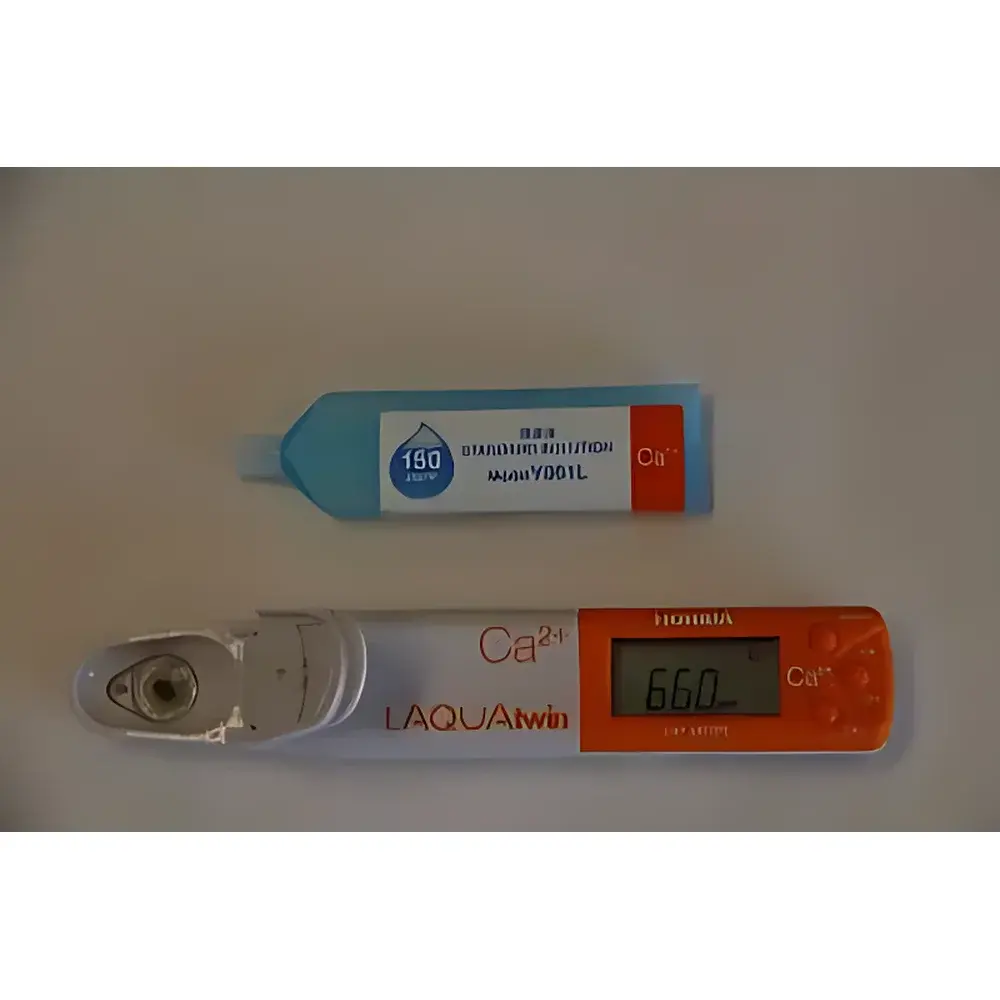
HORIBA B-751 Portable Calcium Ion Meter
| Brand | HORIBA |
|---|---|
| Origin | Japan |
| Model | B-751 |
| Measurement Principle | Ion-Selective Electrode (ISE) Method |
| Measuring Range | 40–4000 ppm (mg/L) Ca²⁺ [1.0 × 10⁻³ – 1.0 × 10⁻¹ mol/L] |
| Minimum Sample Volume | 0.05 mL × 2 or ≥0.3 mL |
| Calibration | Two-Point Calibration |
| Accuracy | ±20% of reading |
| Temperature Compensation | Yes (automatic, 2%/°C fixed coefficient) |
| Auto-Hold | Yes |
| Ingress Protection | IP67 |
| Operating Environment | 5–40 °C, RH <85% (non-condensing) |
| Power Supply | Two CR2032 batteries |
| Dimensions (L×W×H) | 164 × 29 × 20 mm (excl. protrusions) |
| Weight | Approx. 50 g (instrument only, excluding batteries) |
Overview
The HORIBA B-751 is a compact, handheld calcium ion meter engineered for rapid, field-deployable quantification of free Ca²⁺ in aqueous samples using solid-state ion-selective electrode (ISE) technology. Unlike optical or titrimetric methods, the B-751 employs a potentiometric measurement principle: the calcium-selective membrane generates a Nernstian potential shift proportional to the logarithm of Ca²⁺ activity in solution. This enables direct, real-time concentration readout without reagents or sample digestion. Designed specifically for environmental monitoring workflows—including drinking water assessment, wastewater effluent verification, aquaculture management, and irrigation source screening—the instrument delivers trace-level detection capability within a robust, pocket-sized form factor. Its measurement range spans 40–4000 mg/L (1.0 × 10⁻³ – 1.0 × 10⁻¹ mol/L), covering regulatory thresholds for hardness evaluation (e.g., WHO guidelines), scaling risk assessment in industrial cooling systems, and nutrient balance monitoring in hydroponic operations.
Key Features
- Ion-selective electrode (ISE) sensor with optimized Ca²⁺-specific membrane chemistry for minimized interference from Mg²⁺, Na⁺, and K⁺ under typical freshwater matrices
- Ultra-low sample requirement: as little as 0.05 mL per measurement—ideal for limited-volume field sampling or microcosm studies
- Two-point calibration protocol using standardized Ca²⁺ reference solutions (e.g., 100 ppm and 1000 ppm) to ensure traceable accuracy across the operational range
- Integrated temperature compensation with fixed 2%/°C coefficient, eliminating manual correction during ambient field use
- IP67-rated enclosure provides full protection against dust ingress and immersion in water up to 1 m for 30 minutes—validated for outdoor deployment in rain, high-humidity greenhouses, or splash-prone treatment plant environments
- Auto-hold function freezes stable readings after signal stabilization, reducing operator variability in manual recording
- Low-power design powered by two commercially available CR2032 coin cells, supporting >5,000 measurements per battery set under typical usage conditions
Sample Compatibility & Compliance
The B-751 is validated for use with natural waters (surface water, groundwater, drinking water), treated effluents, nutrient solutions, and low-TDS process streams. It is not intended for highly acidic (pH 10,000 µS/cm) samples without matrix-matched calibration. While the device itself does not carry CE marking or FDA 510(k) clearance, its measurement methodology aligns with ISO 10523 (water quality — determination of pH) and ASTM D511 (standard test method for calcium in water) principles when used with appropriate calibration standards and procedural controls. For GLP-compliant reporting, users are advised to maintain calibration logs, electrode response time records, and environmental condition documentation per laboratory SOPs.
Software & Data Management
The B-751 operates as a standalone, embedded-system instrument with no onboard data logging or USB/Bluetooth connectivity. All measurements are displayed in real time on the integrated LCD screen and must be manually recorded. This architecture prioritizes reliability, electromagnetic immunity, and minimal maintenance—critical for unattended operation in remote monitoring stations or mobile lab vehicles. For laboratories requiring electronic data capture, integration is achieved via external digital loggers or smartphone-based image capture of screen displays, followed by manual entry into LIMS or Excel-based QA/QC tracking sheets. The absence of firmware updates or cloud synchronization eliminates cybersecurity concerns associated with connected instrumentation in regulated utility infrastructure.
Applications
- Field verification of calcium hardness compliance per EPA Method 130.1 and EU Drinking Water Directive (98/83/EC) Annex I parametric values
- Rapid assessment of scaling potential in reverse osmosis feedwater and boiler feed systems
- Real-time monitoring of Ca²⁺ depletion or accumulation in recirculating aquaculture systems (RAS)
- Quality control of agricultural lime dissolution efficacy and soil leachate analysis
- Educational demonstrations of ion activity relationships and Nernst equation behavior in undergraduate analytical chemistry labs
- Pre-screening tool prior to lab-based ICP-OES or AAS analysis to prioritize sample submission
FAQ
What sample volume is required for a valid measurement?
A minimum of 0.05 mL per electrode pair is required; however, volumes ≥0.3 mL are recommended to ensure stable potential development and minimize air bubble interference.
Does the B-751 require pH adjustment before measurement?
No pH adjustment is necessary for samples within pH 4–11; outside this range, Ca²⁺ speciation shifts may affect ISE response—buffering to pH 7 is advised for maximum accuracy.
Can the B-751 measure total calcium or only free Ca²⁺?
It measures free (hydrated, ionic) Ca²⁺ activity—not total calcium. Chelated or precipitated forms (e.g., CaCO₃, CaEDTA) are not detected.
How often should the electrode be calibrated?
Calibration is required before each measurement session and after every 10–15 samples in continuous use; drift exceeding ±5% of mid-range value warrants recalibration.
Is the electrode replaceable separately from the main unit?
Yes—the Ca²⁺ ISE sensor module is a user-replaceable consumable (HORIBA part no. 9301-10B-001); full unit replacement is not required upon sensor exhaustion.
Related Products







