
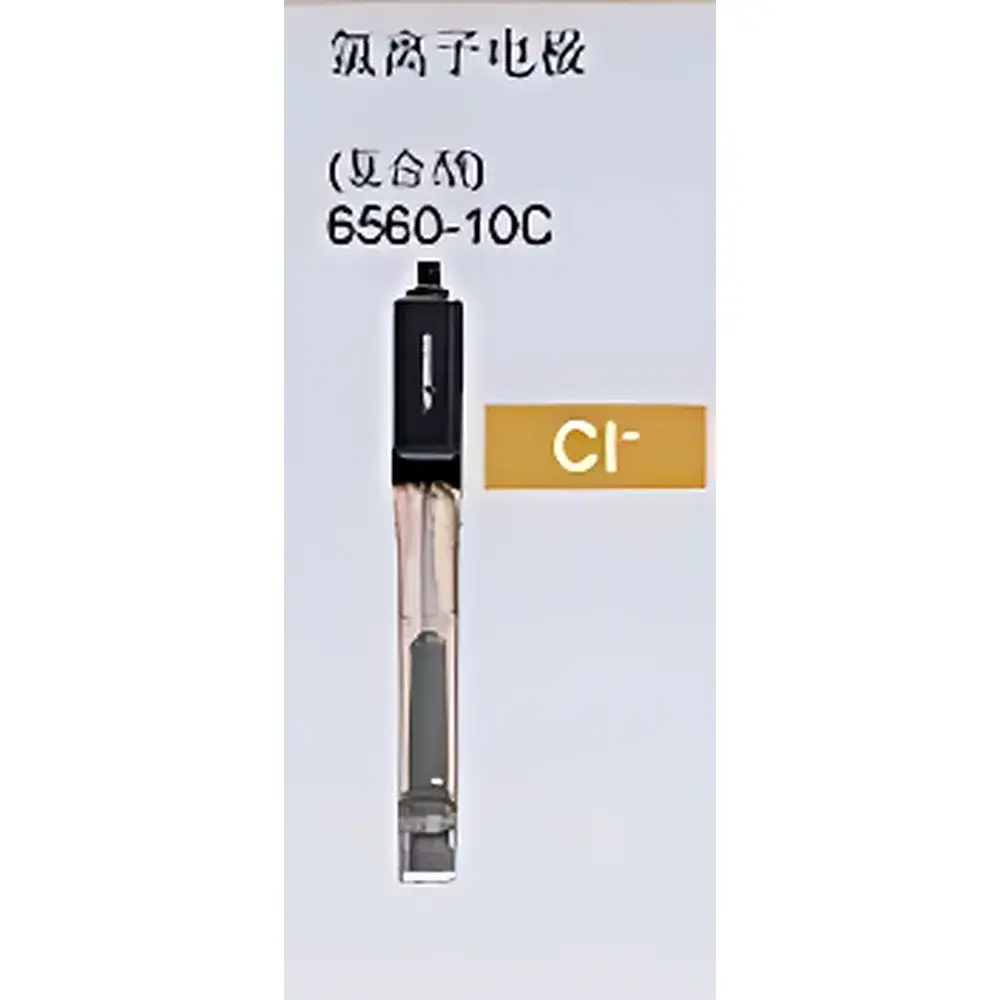
HORIBA 6560-10C Chloride Ion-Selective Electrode (ISE)
| Brand | HORIBA |
|---|---|
| Origin | Japan |
| Model | 6560-10C |
| Measurement Range | 0.4–35,000 ppm Cl⁻ |
| Electrode Type | Composite (Integrated Reference) |
| Compatible Instruments | F-72, F-73, F-74, F-74BW, D-53 |
| Catalog No. | 3014093430 (Legacy: 9003014500) |
Overview
The HORIBA 6560-10C is a robust, composite-type chloride ion-selective electrode engineered for high-precision potentiometric measurement of chloride ion activity in aqueous solutions. Based on the principle of selective membrane potential development—governed by the Nernst equation—the electrode employs a solid-state, polyvinyl chloride (PVC)-based ionophore membrane optimized for Cl⁻ selectivity over common interferents such as bromide, iodide, and nitrate. Its integrated reference system eliminates the need for an external reference electrode, reducing setup complexity and improving measurement stability in field and laboratory environments. Designed specifically for integration with HORIBA’s benchtop (F-series) and portable (D-53) water quality analyzers, the 6560-10C delivers reliable, reproducible results across a wide dynamic range—from low-level environmental monitoring (e.g., drinking water compliance) to high-concentration industrial effluent analysis.
Key Features
- Composite construction: Integrated Ag/AgCl reference element and Cl⁻-selective sensing membrane in a single, rugged housing—minimizes junction potential drift and simplifies calibration.
- Wide linear response range: 0.4–35,000 ppm Cl⁻ (≈10−5–1 M), enabling direct measurement without sample dilution in most routine applications.
- Optimized for low-maintenance operation: No internal electrolyte refilling required; stable baseline performance over extended periods with proper storage (wet or hydrated).
- Chemical resistance: Housing material compatible with pH 2–12 and standard aqueous matrices including wastewater, surface water, groundwater, and brackish samples.
- Interference profile characterized per ISO 10304-1 and ASTM D6508: Demonstrates <0.1% relative error from 100× excess Br⁻ or NO₃⁻ under controlled ionic strength conditions.
- Quick-response design: Achieves 95% signal stabilization within ≤60 seconds in stirred samples at 25 °C.
Sample Compatibility & Compliance
The 6560-10C is validated for use in natural waters, treated effluents, process streams, and regulatory-compliant monitoring programs. It meets functional requirements outlined in EPA Method 300.0 (Ion Chromatography – Alternative ISE Validation) and supports data integrity frameworks aligned with GLP and GMP principles. When used with HORIBA F-74BW or D-53 analyzers, the system enables traceable calibration via two-point (low/high) standardization using certified NaCl reference solutions (e.g., NIST-traceable 10 mg/L and 1000 mg/L Cl⁻). Users must maintain consistent ionic strength (via background electrolyte addition, e.g., 0.1 M KNO₃) and monitor pH (optimal 4–8) to mitigate H⁺/OH⁻ interference—particularly critical in soft or alkaline waters. The electrode is not recommended for highly sulfidic, protein-rich, or viscous non-aqueous media without pretreatment.
Software & Data Management
When connected to HORIBA’s F-series analyzers or D-53 handheld unit, the 6560-10C interfaces with firmware supporting automatic temperature compensation (ATC), slope verification, and real-time Nernstian deviation alerts. Data logging includes timestamped mV readings, calculated concentration (ppm or mol/L), electrode slope (%), and offset (mV)—all exportable via USB or RS-232 to CSV or Excel-compatible formats. For regulated laboratories, optional HORIBA LabManager software provides audit trail functionality compliant with FDA 21 CFR Part 11 requirements, including user authentication, electronic signatures, and immutable record retention for calibration logs and measurement history.
Applications
- Drinking water compliance testing per WHO and EU Directive 98/83/EC (max. 250 mg/L Cl⁻).
- Wastewater discharge monitoring in municipal and industrial treatment plants (e.g., chloride load tracking pre-/post-tertiary treatment).
- Corrosion control in cooling towers and boiler feedwater systems where Cl⁻ concentration directly impacts pitting risk.
- Soil leachate and pore-water analysis in environmental site assessments (ESA) and landfill monitoring networks.
- Educational labs for teaching ion-selective electrode theory, calibration curves, and selectivity coefficient determination (log KCl,X).
- Quality control in food processing (e.g., brine salinity in canned vegetables or cheese whey).
FAQ
What is the recommended storage solution for the 6560-10C between measurements?
Store immersed in 0.001 M NaCl solution or deionized water—never dry. Prolonged dry storage may desensitize the membrane and increase response time.
Can the 6560-10C be used with non-HORIBA meters?
Yes—if the meter supports BNC input, mV mode, and manual slope/offset entry—but full functionality (e.g., auto-recognition, diagnostic alerts) requires HORIBA F- or D-series instrumentation.
How often should calibration be performed?
Daily for routine QC; before each analytical batch in regulated settings; after electrode cleaning or prolonged storage.
Does the electrode require conditioning prior to first use?
Yes—soak in 0.001 M NaCl for ≥2 hours to hydrate the membrane and stabilize the reference potential.
Is the 6560-10C suitable for seawater analysis?
Yes—its upper limit (35,000 ppm) covers typical seawater Cl⁻ (~19,000 ppm); however, verify ionic strength compensation and consider matrix-matched standards for highest accuracy.
Related Products







