
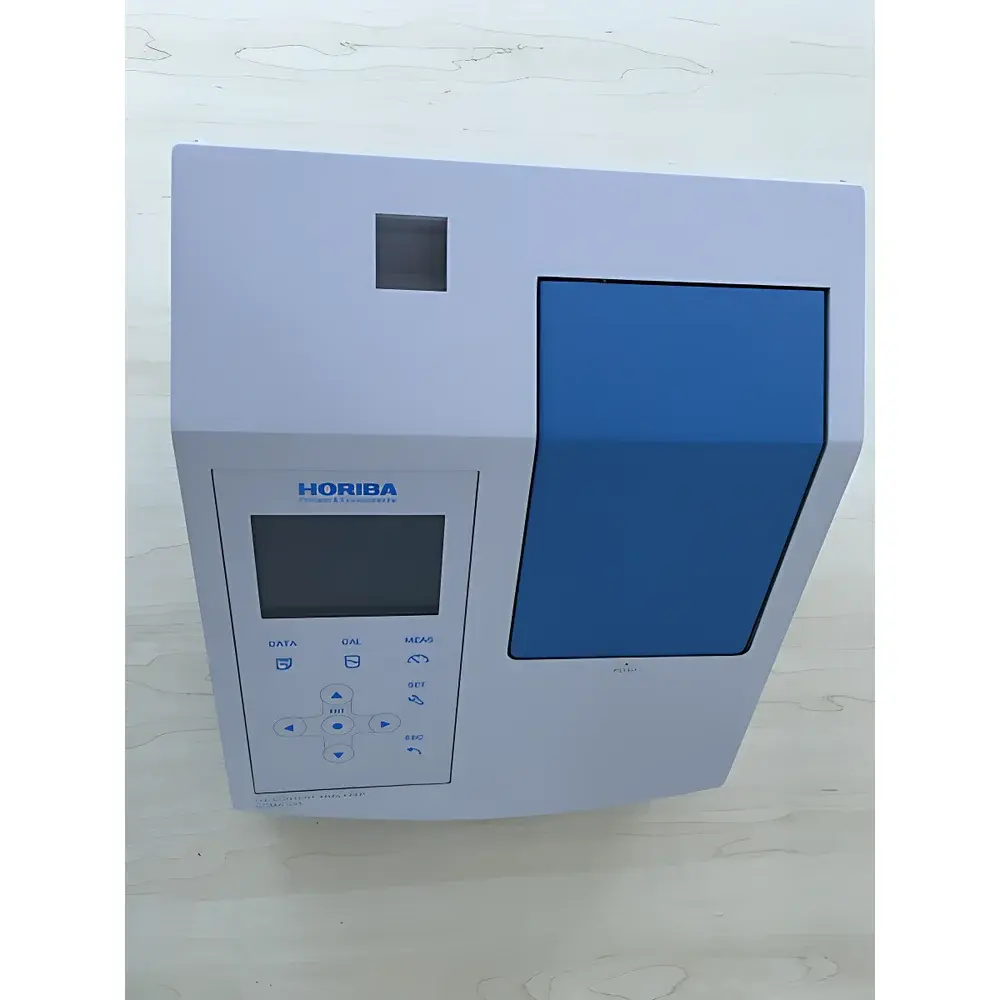
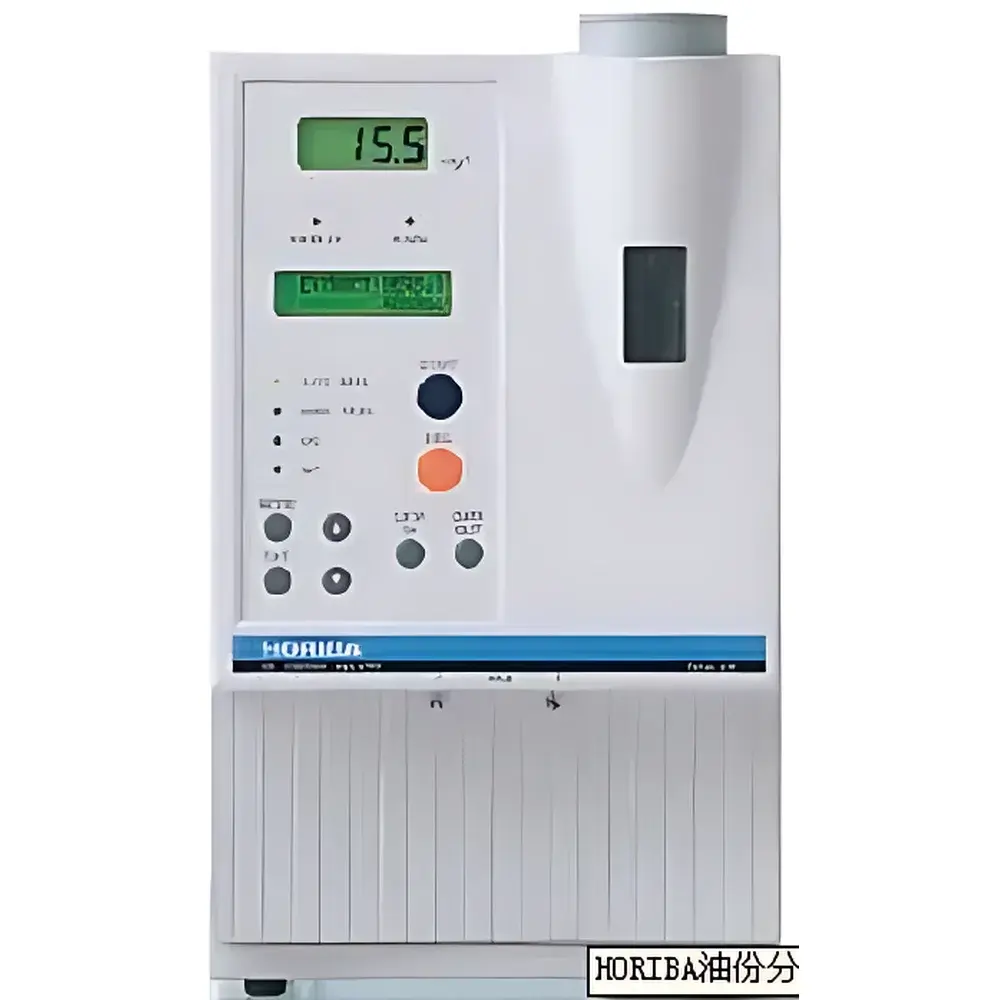
HORIBA OCMA-550 Oil Content Analyzer
| Brand | HORIBA |
|---|---|
| Origin | Japan |
| Model | OCMA-550 |
| Instrument Type | Laboratory |
| Principle | Non-Dispersive Infrared (NDIR) Spectrophotometry |
| Measurement Range | 0–200 mg/L (dynamic full-scale) |
| Accuracy | ±0.2 mg/L (0–10 mg/L), ±2 mg/L (10–100 mg/L), ±4 mg/L (100–200 mg/L) |
| Resolution | 0.1 mg/L |
| Extractant | S-316 (trichloroethylene substitute) |
| Optional Accessory | Solvent Regenerator SR-305 |
Overview
The HORIBA OCMA-550 Oil Content Analyzer is a compact, benchtop laboratory instrument engineered for precise quantification of hydrocarbon oil content in aqueous matrices—including freshwater, seawater, industrial process water, and wastewater effluents. It operates on the principle of non-dispersive infrared (NDIR) absorption spectroscopy, targeting the characteristic C–H stretching vibration bands near 2930 cm⁻¹ to selectively detect aliphatic hydrocarbons. Unlike conventional gravimetric or fluorescence-based methods, the OCMA-550 employs solvent extraction followed by NDIR measurement, delivering high specificity for total petroleum hydrocarbons (TPH) without interference from humic substances or chlorophyll. Its fully integrated extraction and analysis workflow eliminates manual transfer steps, reducing analyst exposure and minimizing cross-contamination risk. Designed for routine compliance monitoring, the system supports regulatory frameworks including EPA Method 1664A (revision B), ISO 9377-2, and JIS K 0102, and is routinely deployed in municipal wastewater treatment plants, petrochemical facilities, marine environmental monitoring stations, and industrial QC laboratories.
Key Features
- Single-range dynamic detection capability from 0 to 200 mg/L—no manual range switching required, ensuring consistent calibration integrity across low- and high-concentration samples.
- Digital display with real-time status feedback, error diagnostics, and multilingual interface (English default), supporting traceable operational transparency.
- Proprietary precision syringe-based fluid handling system ensures exact volumetric delivery of both sample and S-316 extractant, eliminating pipetting variability and enabling repeatable phase separation.
- Integrated solvent recovery compatibility via optional SR-305 Solvent Regenerator—a dual-bed column system utilizing activated carbon and activated alumina to restore S-316 purity over multiple cycles, significantly lowering consumable costs and waste disposal burden.
- Rugged optical path design with temperature-stabilized IR source and thermopile detector ensures long-term signal stability and minimal drift under continuous operation.
- Compliant with GLP documentation requirements: all measurements are timestamped, user-ID logged, and raw absorbance data retained internally for audit readiness.
Sample Compatibility & Compliance
The OCMA-550 accepts liquid samples with suspended solids ≤50 mg/L and salinity up to 3.5% (seawater-equivalent). It is validated for use with clarified, filtered, or centrifuged samples per ASTM D7066 and ISO 9377-2 protocols. The system meets functional equivalence to EPA 1664A for TPH determination in discharge monitoring applications. All firmware and hardware configurations support 21 CFR Part 11-compliant data integrity when paired with HORIBA’s optional LIMS-integrated software package (OCMA-Link v3.x), providing electronic signatures, audit trails, and secure user access control.
Software & Data Management
Data acquisition and reporting are managed via the embedded OCMA Control Interface—a menu-driven firmware platform that stores up to 1,000 measurement records with sample ID, operator ID, date/time stamp, and raw absorbance values. Export is supported via USB 2.0 to CSV or PDF formats. When connected to OCMA-Link software (Windows-based), users gain advanced capabilities including calibration curve management (linear, quadratic, or multi-point), method validation templates (accuracy, precision, LOD/LOQ), automated report generation compliant with ISO/IEC 17025, and integration with enterprise LIMS via HL7 or ASTM E1384 interfaces.
Applications
- Regulatory compliance testing of industrial effluents prior to discharge into municipal sewer systems or natural waterways.
- Monitoring oil-in-water concentrations in cooling tower blowdown, bilge water, and produced water from offshore platforms.
- Verification of oil removal efficiency in dissolved air flotation (DAF), coalescing plate separators, and membrane filtration units.
- Environmental impact assessments for coastal development projects requiring baseline and post-construction seawater oil profiling.
- Research-grade quantification of hydrocarbon biodegradation kinetics in microcosm studies under controlled aerobic/anaerobic conditions.
FAQ
What extractant is required for the OCMA-550, and is it hazardous?
The instrument uses S-316—a non-ozone-depleting, low-toxicity trichloroethylene (TCE) substitute approved under JIS K 0102 and EPA Method 1664A. S-316 exhibits superior extraction efficiency for C10–C40 aliphatics and reduced volatility versus traditional solvents.
Can the OCMA-550 measure emulsified oil or only free-phase oil?
It quantifies total extractable petroleum hydrocarbons (TEPH), including dissolved, dispersed, and emulsified fractions stabilized below the phase separation threshold—provided samples are homogenized and filtered per standard protocol (e.g., 0.45 µm membrane filtration prior to extraction).
Is the SR-305 Solvent Regenerator compatible with other HORIBA models?
The SR-305 is specifically engineered for S-316 regeneration in OCMA-550 and OCMA-500 systems; it is not interoperable with non-OCMA platforms or alternative solvents.
How often does the optical system require recalibration?
Factory calibration remains stable for ≥12 months under normal lab conditions; annual verification using certified reference standards (e.g., NIST-traceable mineral oil in water at 5, 50, and 150 mg/L) is recommended per ISO/IEC 17025 clause 7.7.
Does the OCMA-550 support remote monitoring or network connectivity?
Standalone operation is standard; Ethernet or Wi-Fi connectivity requires OCMA-Link v3.x with optional communication module (part no. OCMA-NET-01), enabling SNMP-based device health monitoring and scheduled data push to cloud storage.
Related Products







