
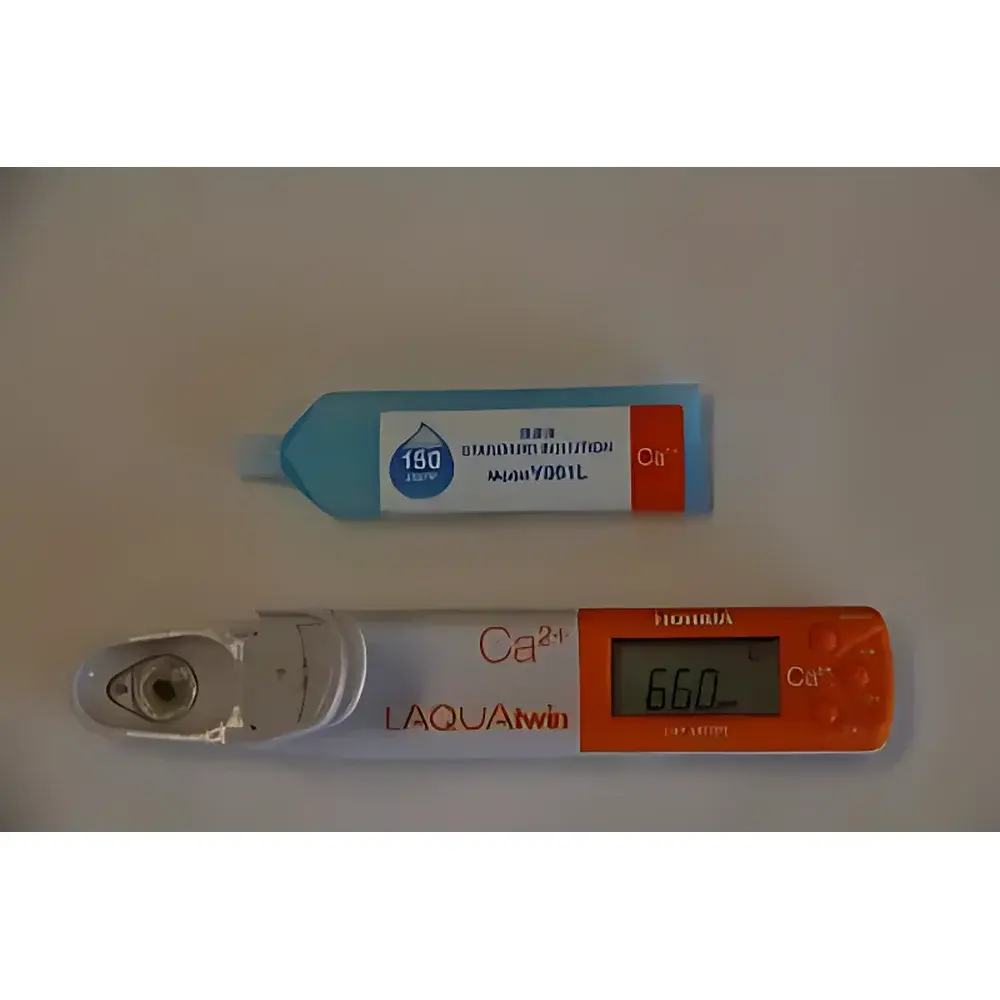
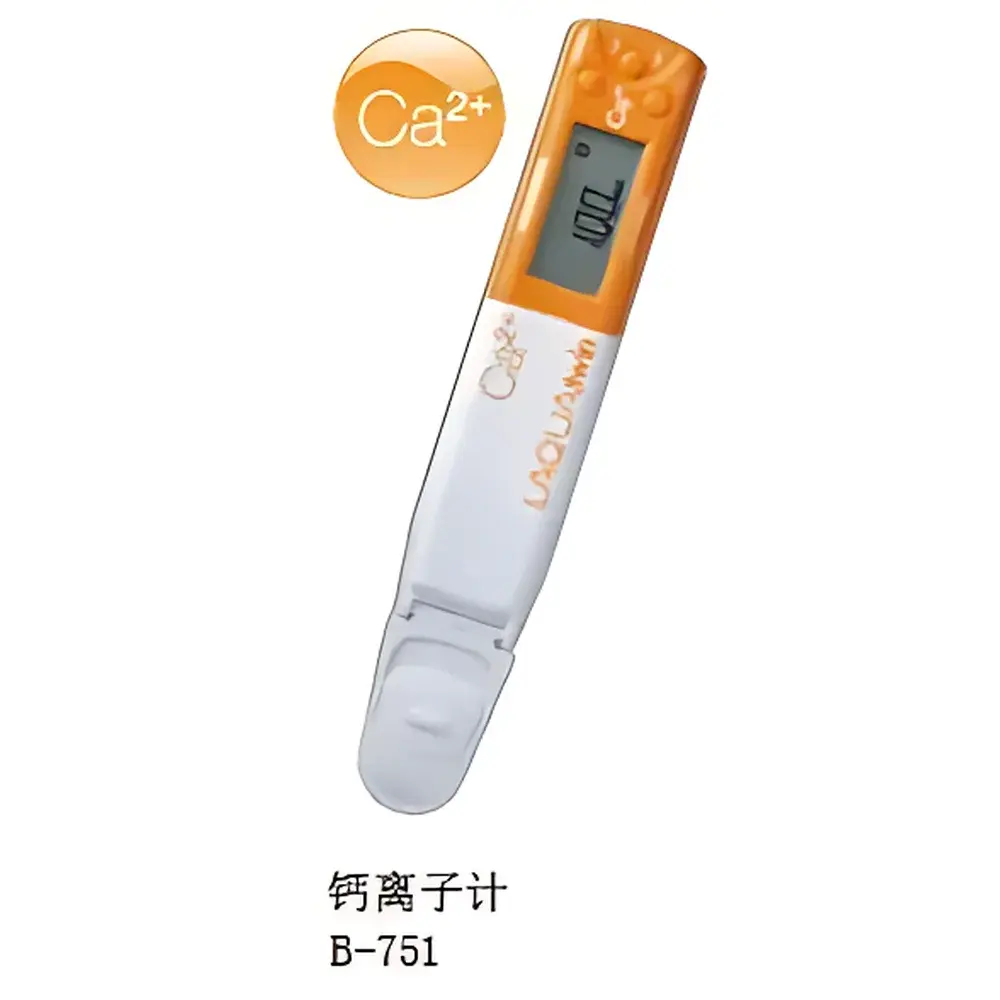
HORIBA B-751 Portable Calcium Ion Meter
| Brand | HORIBA |
|---|---|
| Origin | Japan |
| Model | B-751 |
| Measurement Principle | Ion-Selective Electrode (ISE) Method |
| Measurement Range | 40–4000 ppm (mg/L) Ca²⁺ [1.0 × 10⁻³ – 1.0 × 10⁻¹ mol/L] |
| Minimum Sample Volume | 0.05 mL × 2 or ≥0.3 mL |
| Calibration | Single-point calibration |
| Accuracy | ±20% of reading |
| Temperature Compensation | Automatic (NTC thermistor) |
| Auto-Hold | Yes |
| Ingress Protection | IP67 |
| Operating Environment | 5–40 °C, RH <85% (non-condensing) |
| Power Supply | Two CR2032 batteries |
| Dimensions (L×W×H) | 164 × 29 × 20 mm (excl. protrusions) |
| Weight | ~50 g (instrument only) |
Overview
The HORIBA B-751 is a compact, handheld calcium ion meter engineered for rapid, on-site quantitative analysis of free Ca²⁺ concentration in aqueous environmental and process water samples. It employs a solid-state, potentiometric ion-selective electrode (ISE) configured in a robust pen-style housing—optimized for field deployment where portability, ruggedness, and minimal sample consumption are critical. Unlike optical or colorimetric methods, the B-751 delivers direct electrochemical measurement based on the Nernst equation, providing real-time response to changes in calcium activity without reagent addition or sample digestion. Its design targets routine monitoring applications including drinking water compliance verification, irrigation water quality assessment, aquaculture management, and pretreatment validation in industrial wastewater streams. The instrument operates independently of pH drift within its specified range and incorporates built-in temperature compensation using an integrated NTC thermistor, ensuring stable readings across variable ambient conditions typical of outdoor sampling environments.
Key Features
- Pen-form factor with IP67-rated enclosure: Dust-tight and submersible up to 1 m for 30 minutes—enabling reliable use in humid, rainy, or splash-prone field conditions without protective housings or enclosures.
- Ultra-low sample requirement: Valid measurements achievable with as little as 0.05 mL per test (dual-point sampling), reducing waste and enabling analysis of limited-volume samples such as pore water extracts or microcosm effluents.
- Integrated automatic temperature compensation (ATC): Compensates for thermal effects on electrode potential using a calibrated NTC sensor, eliminating manual correction and minimizing operator-induced error.
- Auto-hold functionality: Freezes the stabilized reading upon signal convergence—critical for single-operator field use where visual confirmation must be synchronized with sample handling.
- Battery-operated autonomy: Powered by two standard CR2032 lithium coin cells, delivering >10,000 measurements per set under typical usage; low-battery indicator alerts prior to performance degradation.
- Calibration simplicity: Supports single-point calibration using certified Ca²⁺ standard solutions (e.g., 200 ppm or 1000 ppm), compatible with common laboratory-grade reference materials traceable to NIST SRMs.
Sample Compatibility & Compliance
The B-751 is validated for use with clear, low-turbidity aqueous matrices including potable water, surface water, groundwater, treated effluent, and nutrient solutions. It is not intended for highly viscous, suspended-solid-laden, or strongly chelated samples (e.g., EDTA-treated waters) without prior conditioning. While the device itself does not carry formal regulatory certification, its measurement methodology aligns with principles outlined in ASTM D511-20 (Standard Test Methods for Calcium in Water) and ISO 10523:2008 (Water quality — Determination of pH). Data generated may support internal QA/QC protocols and preliminary screening under GLP-compliant workflows, though definitive compliance reporting requires confirmatory lab-based ICP-OES or titrimetric analysis per US EPA Method 200.7 or ISO 11885.
Software & Data Management
The B-751 operates as a standalone, firmware-driven instrument with no onboard memory or digital interface. All measurements are displayed in real time on a high-contrast LCD and must be manually recorded. This architecture eliminates software validation requirements (e.g., FDA 21 CFR Part 11) and ensures immunity to firmware corruption, cybersecurity vulnerabilities, or driver compatibility issues. For laboratories requiring audit trails, users may integrate the B-751 into structured paper-based or LIMS-linked observation protocols—documenting operator ID, location, time stamp, calibration lot number, and raw reading alongside environmental notes. Optional external Bluetooth adapters (not supplied) may be retrofitted via third-party accessories for basic serial logging, though HORIBA does not validate or support such configurations.
Applications
- Field verification of calcium hardness in municipal drinking water distribution systems (per WHO Guideline 12.2 and EU Directive 2020/2184).
- Rapid assessment of Ca²⁺ availability in agricultural irrigation sources to prevent soil cation imbalance or drip emitter scaling.
- Pre-screening of cooling tower blowdown for scale risk evaluation (LSI/RSI calculation support).
- Monitoring calcium supplementation in recirculating aquaculture systems (RAS) to maintain optimal osmoregulation in finfish and crustaceans.
- Educational demonstrations of ion activity, electrode selectivity, and Nernstian behavior in undergraduate environmental chemistry labs.
- Emergency response triage for suspected calcium contamination following industrial spills or landfill leachate incursion.
FAQ
What is the recommended calibration frequency?
For routine field use, calibrate before each sampling session or every 8 hours of continuous operation. If measuring across wide concentration ranges (>10× span), perform calibration at mid-range and verify at extremes.
Can the B-751 measure total calcium or only free Ca²⁺?
It measures free (hydrated, electrochemically active) Ca²⁺ ions only. Chelated or precipitated calcium (e.g., CaCO₃, CaEDTA) does not contribute to the signal and requires acid digestion or complexometric titration for quantification.
Is temperature compensation adjustable or fixed?
Compensation follows a fixed 2%/°C coefficient per the Nernst slope for divalent cations—no user adjustment is available, consistent with ISO 7888 and ASTM D1129 conventions for portable ISE meters.
Does the electrode require storage solution?
Yes. Store the Ca²⁺ ISE tip immersed in 100 ppm Ca²⁺ standard or dedicated ISE storage solution when not in use. Never store dry or in deionized water, as this accelerates membrane dehydration and reference junction clogging.
How often should the electrode be cleaned or replaced?
Clean the sensing membrane weekly with mild detergent and soft brush if exposed to organic fouling; rinse thoroughly. Replace the electrode module every 12–18 months under regular use, or sooner if response time exceeds 30 seconds or calibration slope deviates >15% from nominal 29.5 mV/decade at 25°C.
Related Products







