
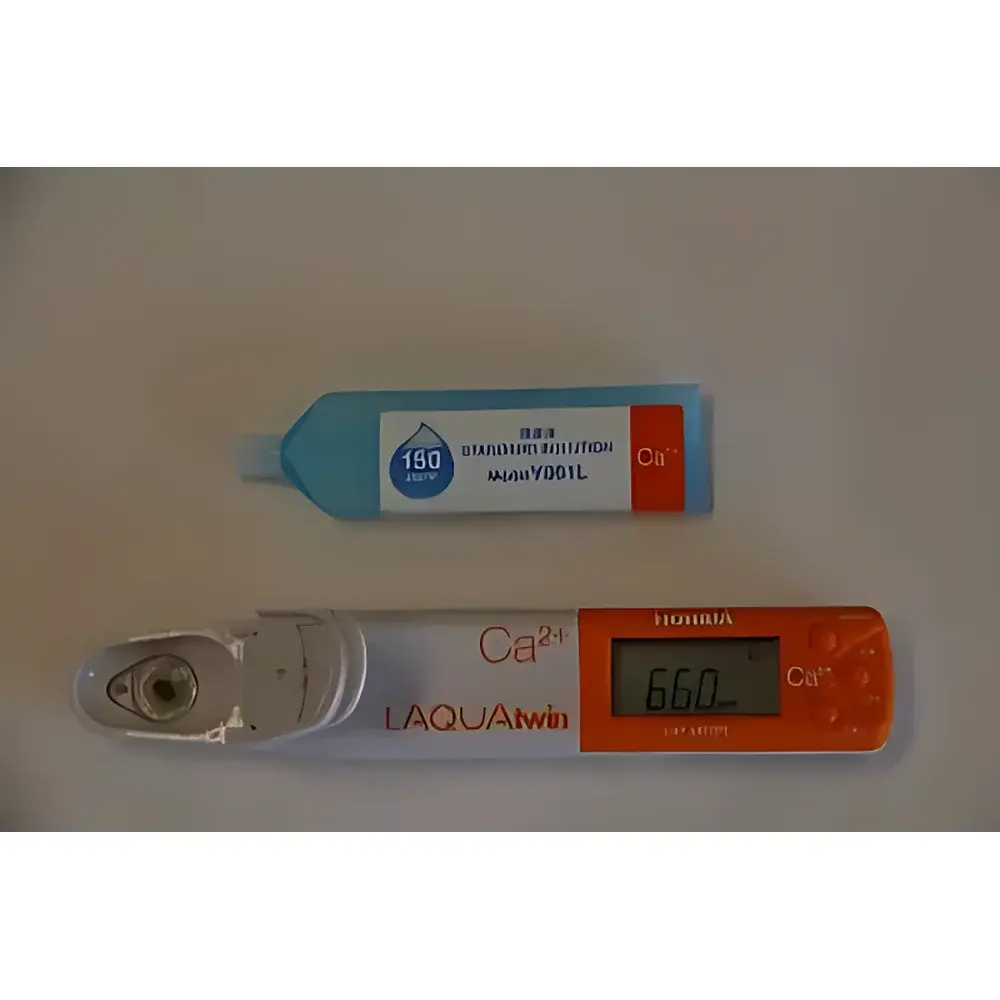
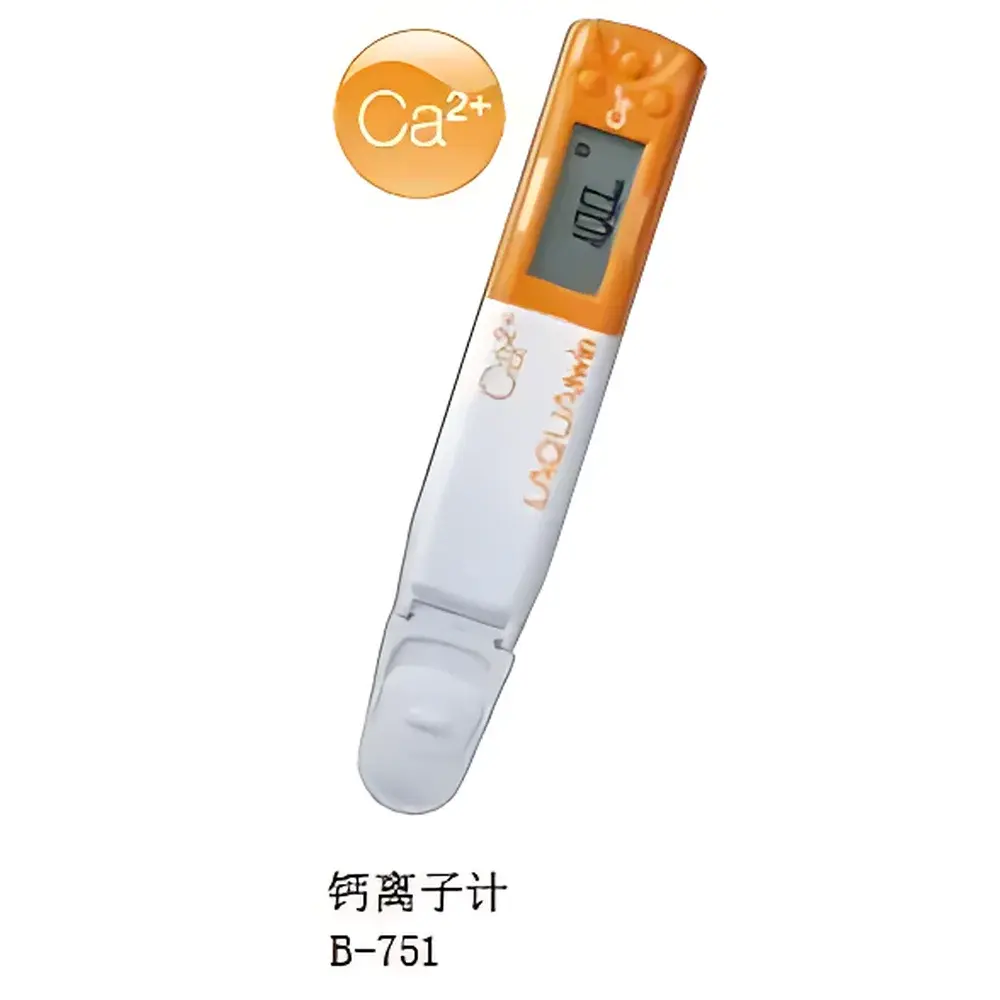
HORIBA B-751 Portable Calcium Ion Meter
| Brand | HORIBA |
|---|---|
| Origin | Japan |
| Model | B-751 |
| Measurement Principle | Ion-Selective Electrode (ISE) Method |
| Measuring Range | 40–4000 ppm (mg/L) Ca²⁺ [1.0 × 10⁻³ – 1.0 × 10⁻¹ mol/L] |
| Minimum Sample Volume | 0.05 mL × 2 or ≥0.3 mL |
| Calibration | Two-Point Calibration |
| Accuracy | ±20% of reading |
| Temperature Compensation | Yes (automatic, 2%/°C fixed coefficient) |
| Auto-Hold | Yes |
| Ingress Protection | IP67 |
| Operating Environment | 5–40 °C, RH <85% (non-condensing) |
| Power Supply | Two CR2032 batteries |
| Dimensions (L×W×H) | 164 × 29 × 20 mm (excl. protrusions) |
| Weight | Approx. 50 g (instrument only, batteries excluded) |
Overview
The HORIBA B-751 is a compact, handheld calcium ion meter engineered for rapid, on-site quantification of free Ca²⁺ concentration in aqueous samples using potentiometric ion-selective electrode (ISE) technology. Unlike optical or colorimetric methods, the B-751 employs a solid-state calcium-selective membrane electrode that generates a Nernstian potential response proportional to the logarithm of Ca²⁺ activity in solution. This principle enables direct, interference-resistant measurement without reagents or sample digestion—critical for field-deployable water quality verification. Designed for environmental monitoring, aquaculture, irrigation management, and wastewater pre-screening, the B-751 delivers consistent readings across diverse matrices including freshwater, brackish water, and treated effluents. Its miniaturized architecture integrates a microprocessor-controlled analog front-end with temperature-compensated signal conditioning, ensuring stable output under variable ambient conditions.
Key Features
- True portable form factor: 164 mm × 29 mm × 20 mm; weight ≈ 50 g (instrument only), enabling single-hand operation and pocket storage.
- IP67-rated enclosure: Fully protected against dust ingress and immersion in 1 m of water for up to 30 minutes—validated for outdoor, humid, or splash-prone environments.
- Two-point calibration protocol: Supports bracketing calibration with standard solutions spanning the full 40–4000 ppm measurement range, improving linearity and minimizing drift.
- Automatic temperature compensation (ATC): Applies a fixed 2%/°C correction factor based on integrated thermistor input, aligning measured potential to 25 °C reference conditions per ISE convention.
- Auto-hold function: Freezes display upon signal stabilization (±0.5% change over 3 s), eliminating manual timing errors during field sampling.
- Low-power design: Dual CR2032 coin cells provide >10,000 measurements per set under typical usage, with auto-shutdown after 10 min of inactivity.
Sample Compatibility & Compliance
The B-751 is optimized for use with low-turbidity, non-viscous aqueous solutions. It maintains accuracy in samples with pH 4–10 and total dissolved solids (TDS) ≤ 5000 ppm. While designed primarily for Ca²⁺, its electrode architecture minimizes cross-sensitivity to Na⁺, K⁺, and Mg²⁺ at typical environmental concentrations (<100 ppm). The instrument complies with IEC 60529 (IP67), ISO 8655-5 (volumetric accuracy for small-volume handling), and JIS Z 8401 (numerical rounding for analytical instrumentation). It supports GLP-aligned data integrity through traceable calibration logs (user-recorded) and is compatible with laboratory quality systems requiring documented field measurement procedures per ISO/IEC 17025:2017 Clause 7.7.
Software & Data Management
The B-751 operates as a standalone, embedded-system device with no onboard memory or digital interface. All data acquisition, processing, and display occur within the instrument’s firmware—eliminating software dependencies and cybersecurity exposure. Users manually record results alongside calibration dates, standard lot numbers, and environmental conditions (temperature, sample ID) in field notebooks or LIMS-compatible spreadsheets. For audit readiness, laboratories commonly pair the B-751 with controlled calibration certificate templates aligned with ISO/IEC 17025 requirements. While not FDA 21 CFR Part 11 compliant (lacking electronic signature capability), it satisfies basic GMP field-testing needs where handwritten records are authorized and validated.
Applications
- Environmental field surveys: Rapid screening of surface water, groundwater, and stormwater runoff for calcium hardness compliance with WHO guidelines (≤200 mg/L).
- Aquaculture management: Monitoring Ca²⁺ levels critical for shell formation in mollusks and exoskeleton development in crustaceans.
- Irrigation water assessment: Evaluating scaling potential in drip and micro-sprinkler systems where Ca²⁺ > 120 ppm increases precipitate risk.
- Drinking water distribution: Spot-checking residual calcium post-softening or lime stabilization processes.
- Educational laboratories: Demonstrating ion-selective potentiometry principles with minimal setup and consumables.
FAQ
What sample volume is required for reliable measurement?
A minimum of 0.05 mL applied twice (e.g., two 50 µL drops) or a single volume ≥0.3 mL is recommended to ensure full electrode membrane coverage and stable potential equilibrium.
Does the B-751 require pH adjustment prior to measurement?
No—calcium ISE response is inherently pH-dependent above pH 10 due to hydroxide interference; however, the B-751’s specified operating range (pH 4–10) ensures valid readings without buffer addition in most natural and treated waters.
Can the same electrode be used for other ions?
No—the B-751 uses a dedicated calcium-selective membrane electrode; HORIBA offers separate models (e.g., B-722 for Na⁺, B-731 for K⁺) with ion-specific sensing elements.
How often should calibration be performed?
Calibrate before each measurement session and whenever ambient temperature changes by >5 °C or after cleaning the electrode; daily calibration is recommended for routine QC programs.
Is the instrument suitable for seawater analysis?
Not recommended—high ionic strength (>35,000 ppm TDS) and competing cations (e.g., Mg²⁺ at ~1300 ppm) exceed the B-751’s interference tolerance and may cause significant activity coefficient deviation.
Related Products







