
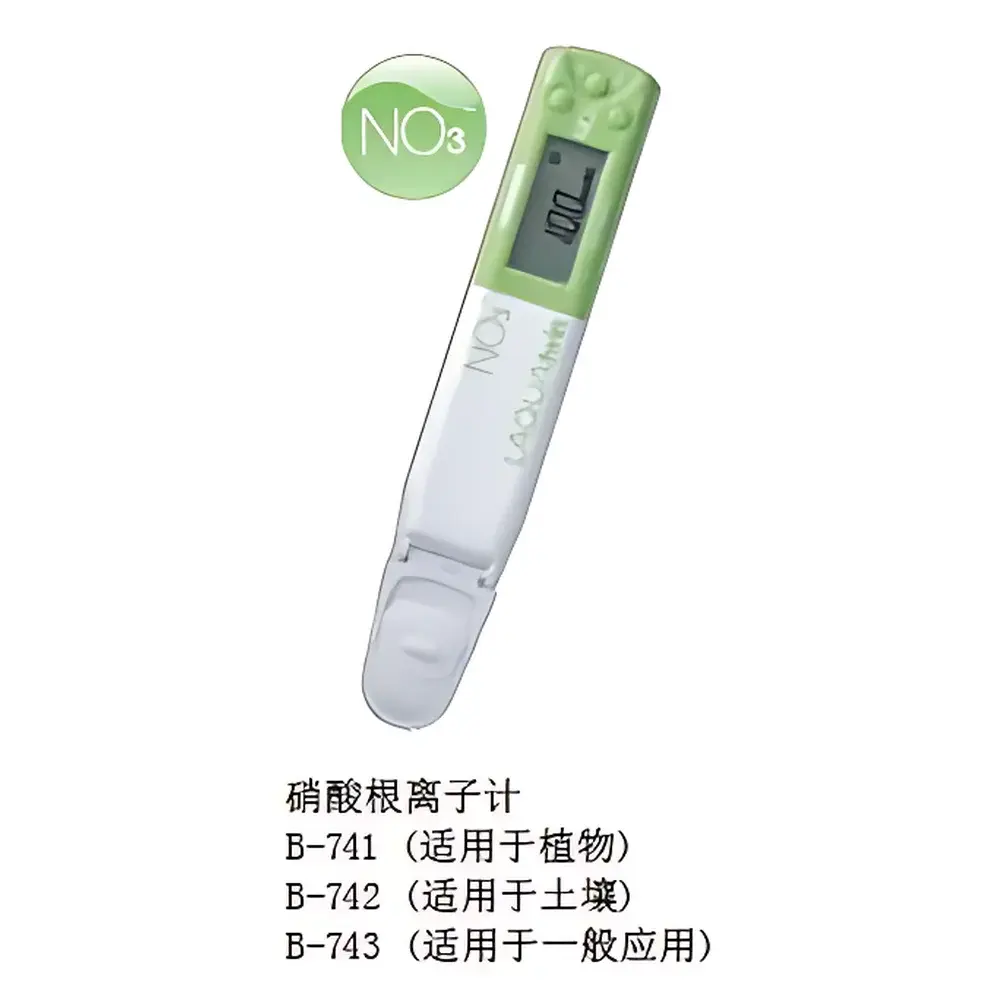
HORIBA B-743 Nitrate Ion Meter
| Brand | HORIBA |
|---|---|
| Origin | Japan |
| Model | B-743 Portable Nitrate Ion Meter |
| Measurement Principle | Solid-State Ion-Selective Electrode (ISE) Method |
| Measuring Range | NO₃⁻: 62–6,200 ppm (mg/L) [1.0 × 10⁻³ – 1.0 × 10⁻¹ mol/L] |
| NO₃⁻–N | 14–1,400 ppm (mg/L) |
| Accuracy | ±10% of reading |
| Calibration | Two-point calibration with standard solutions |
| Temperature Compensation | Automatic (NTC sensor, 2%/°C fixed coefficient) |
| Sample Volume | ≥0.05 mL (dual measurement mode) or ≥0.3 mL (single measurement) |
| Environmental Rating | IP67 |
| Operating Temperature/Humidity | 5–40 °C, RH <85% non-condensing |
| Power Supply | Two CR2032 lithium coin cells |
| Dimensions/Weight | 164 × 29 × 20 mm (L×W×H), approx. 50 g (instrument only) |
Overview
The HORIBA B-743 Nitrate Ion Meter is a compact, handheld ion-selective electrode (ISE)-based analyzer engineered for rapid, on-site quantification of nitrate (NO₃⁻) concentration in aqueous environmental samples. Designed for field-deployable water quality assessment, it operates on the potentiometric principle: a solid-state nitrate-selective membrane generates a Nernstian voltage response proportional to the logarithm of NO₃⁻ activity in solution. This enables direct, interference-resistant measurement without sample digestion or reagent addition—critical for time-sensitive monitoring in rivers, lakes, groundwater wells, agricultural runoff, and wastewater effluents. Unlike optical or colorimetric methods, the B-743 eliminates reliance on chromogenic reagents, reducing consumable costs and operator variability. Its micro-volume sampling capability (as low as 0.05 mL per dual-point measurement) conserves precious field samples while maintaining analytical integrity under variable ambient conditions.
Key Features
- Robust solid-state nitrate ISE sensor with stable, low-drift potential output over extended field use
- Automatic temperature compensation using integrated NTC thermistor (2%/°C fixed coefficient), compliant with ASTM D1129 and ISO 5667-3 guidelines for temperature-dependent ion activity correction
- IP67-rated enclosure ensures full protection against dust ingress and immersion in water up to 1 m for 30 minutes—validated per IEC 60529 standards
- Auto-hold function freezes stabilized readings upon signal convergence, minimizing observer bias during manual data recording
- Two-point calibration protocol supports traceable adjustment using certified nitrate standard solutions (e.g., 100 ppm and 1,000 ppm NO₃⁻), aligning with EPA Method 300.0 calibration requirements
- Low-power design powered by two CR2032 batteries, delivering >2,000 measurements per set under typical usage conditions
- Ergonomic pen-style form factor (164 × 29 × 20 mm, ~50 g) optimized for single-hand operation in confined or remote sampling locations
Sample Compatibility & Compliance
The B-743 is validated for use with natural waters, treated effluents, irrigation water, and nutrient solutions exhibiting pH 2–12 and conductivity ≤10 mS/cm. It demonstrates minimal interference from common anions including chloride (<500 mg/L), sulfate (<200 mg/L), and bicarbonate (<100 mg/L), as confirmed per HORIBA’s ISE selectivity coefficient data (log KNO₃⁻,Cl⁻ = −2.8). The instrument complies with ISO/IEC 17025 general requirements for competence of testing and calibration laboratories when operated within specified environmental limits (5–40 °C, RH <85% non-condensing). While not intended for regulated GLP/GMP environments requiring 21 CFR Part 11 electronic signature support, its calibration log, date/time stamp, and stability indicators meet basic field audit requirements under US EPA Region 10 Field Sampling Guidance.
Software & Data Management
The B-743 operates as a standalone, firmware-controlled device with no embedded Bluetooth, USB, or PC connectivity. All measurement data—including raw mV output, compensated concentration, temperature, calibration status, and timestamp—is displayed on a high-contrast LCD and retained in volatile memory until power-off. Users manually transcribe results into field notebooks or LIMS-compatible spreadsheets. For traceability, each calibration event must be documented externally with standard solution lot numbers, preparation dates, and operator ID. Though lacking digital export, the device’s deterministic analog-to-digital conversion and factory-traceable sensor calibration ensure reproducibility across instruments—a prerequisite for inter-laboratory comparison studies referenced in ISO 5667-14.
Applications
- Field screening of nitrate contamination in drinking water sources to assess compliance with WHO guideline values (50 mg/L NO₃⁻) and EU Drinking Water Directive limits
- Routine monitoring of leaching losses from fertilized cropland and manure-applied fields, supporting nutrient management planning per USDA NRCS standards
- Verification of denitrification efficiency in constructed wetlands and bioreactors through longitudinal inflow/outflow profiling
- Point-of-use verification of reverse osmosis or ion exchange system performance in rural water supply systems
- Academic and citizen science projects requiring low-cost, portable nitrate quantification without laboratory infrastructure
FAQ
What is the minimum detectable nitrate concentration?
The lower limit of quantitation (LLOQ) is 62 ppm NO₃⁻ (14 ppm as NO₃⁻–N), corresponding to 1.0 × 10⁻³ mol/L, as defined by the manufacturer’s stated measurement range and ±10% accuracy specification.
Can the B-743 measure nitrate in soil extracts or high-salinity seawater?
It is validated for freshwater matrices only. Soil extracts require filtration to <0.45 µm and dilution to reduce turbidity and ionic strength; seawater (≈19,000 ppm Cl⁻) exceeds recommended chloride interference thresholds and is not supported.
How often does the sensor require recalibration?
Calibration is required before each measurement session and after prolonged storage (>7 days), following HORIBA’s maintenance protocol—verified via bracketing standards prior to critical sampling.
Is the electrode replaceable?
Yes. The nitrate ISE module (HORIBA part number 743-ISE-NO3) is a user-replaceable consumable with a typical service life of 12–18 months under routine field use.
Does the device comply with ISO or ASTM standard test methods?
While not certified to a single published method, its operating principle and performance specifications align with the technical foundations of ASTM D3370 (sampling of water) and ISO 5667-3 (preservation and handling), and its calibration approach reflects best practices outlined in EPA Method 300.0 for ion-selective electrode analysis.
Related Products







