
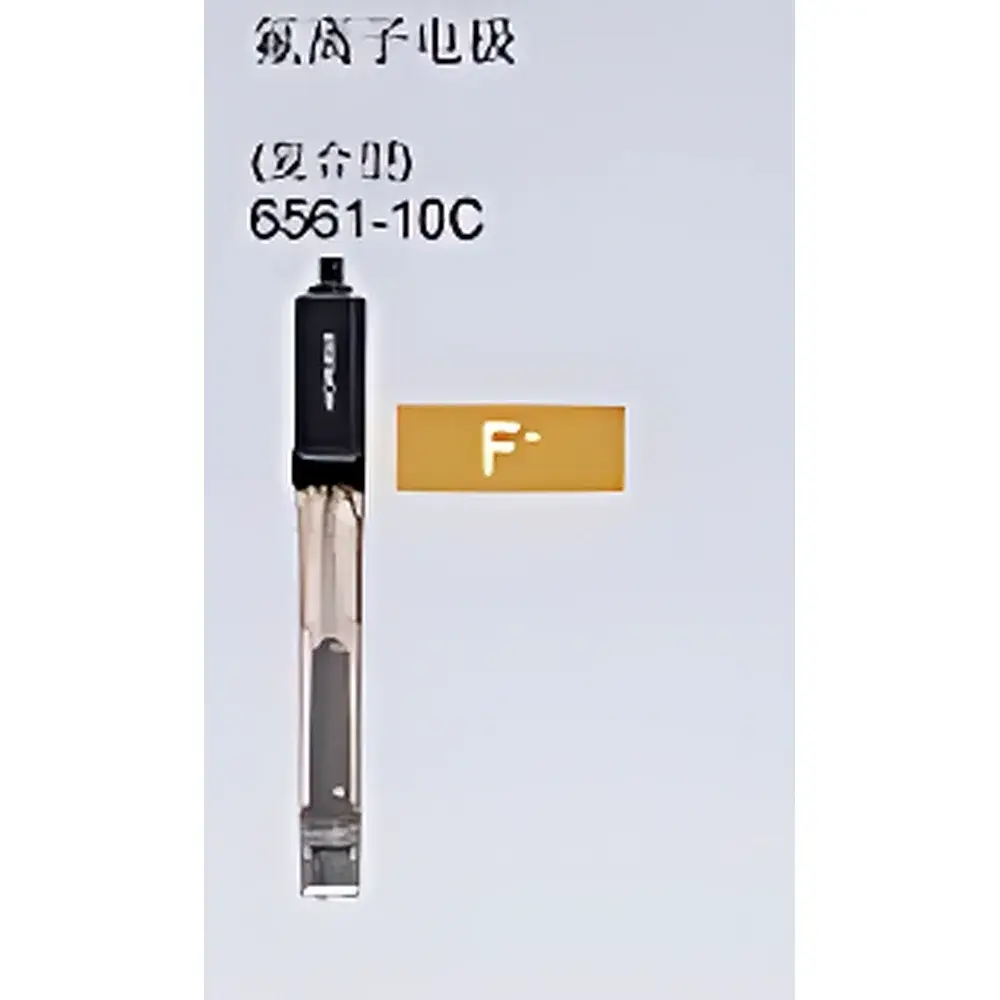
HORIBA 6561-10C Composite Fluoride Ion-Selective Electrode
| Brand | HORIBA |
|---|---|
| Origin | Japan |
| Model | 6561-10C |
| Measurement Range | 0.02–19,000 ppm F⁻ |
| Electrode Type | Composite (integrated reference), no external reference electrode required |
| Compatible Instruments | HORIBA F-72, F-73, F-74, F-74BW (benchtop) |
| Compliance | Designed for ASTM D1179, ISO 10304-1, and EPA Method 300.0 applications in water quality testing |
Overview
The HORIBA 6561-10C is a robust, integrated composite fluoride ion-selective electrode engineered for precise, direct potentiometric measurement of free fluoride ions (F⁻) in aqueous samples. Based on a lanthanum fluoride (LaF₃) single-crystal membrane, the electrode operates via the Nernstian principle—generating a stable, logarithmic potential response proportional to the activity of fluoride ions across a wide dynamic range (0.02–19,000 ppm F⁻, equivalent to ~1×10⁻⁶ M to ~1 M). Its composite design incorporates a built-in double-junction Ag/AgCl reference system, eliminating the need for separate reference electrodes and minimizing liquid junction potential drift. This architecture ensures high reproducibility (< ±2% RSD over 24 h), rapid response time (< 30 s to 95% equilibrium), and long-term stability under routine laboratory or field-deployed conditions. The electrode is optimized for use in complex matrices including drinking water, wastewater, industrial effluents, groundwater, and fluoride-spiked calibration standards.
Key Features
- Integrated composite construction: Eliminates external reference electrode dependency and reduces setup complexity and contamination risk.
- Lanthanum fluoride (LaF₃) crystal membrane: Provides high selectivity for F⁻ with minimal interference from common anions (e.g., Cl⁻, NO₃⁻, SO₄²⁻) when used with appropriate ionic strength adjuster (ISA) solutions.
- Wide linear dynamic range: Covers regulatory-relevant concentrations—from sub-ppb detection capability (0.02 ppm) up to saturated fluoride solutions (19,000 ppm)—enabling both compliance monitoring and process control applications.
- Chemically resistant body: PTFE and epoxy housing withstands exposure to acidic, alkaline, and oxidizing environments typical in environmental sampling protocols.
- Standard BNC connector and 1 m coaxial cable: Ensures compatibility with HORIBA benchtop analyzers (F-72/F-73/F-74/F-74BW) and portable meters (D-53), as well as third-party pH/mV meters meeting ISE input specifications (±2000 mV, input impedance >10¹² Ω).
- Temperature compensation ready: Supports automatic temperature correction when paired with HORIBA’s integrated temperature probe (e.g., TP-70 series) per NIST-traceable calibration routines.
Sample Compatibility & Compliance
The 6561-10C is validated for use in natural waters, treated effluents, and prepared standard solutions within pH 5.0–8.0. Outside this range, hydroxide interference (OH⁻) increases significantly; therefore, pH adjustment using TISAB II (Total Ionic Strength Adjustment Buffer) is mandatory for accurate quantification. The electrode meets functional requirements outlined in key regulatory methods: ASTM D1179 (fluoride in water), ISO 10304-1 (determination of dissolved anions by ion chromatography—used as orthogonal verification), and U.S. EPA Method 300.0 (determination of anions by ion-selective electrode). It supports GLP-compliant workflows when deployed with HORIBA’s certified calibration kits and audit-trail-enabled software platforms. No hazardous materials are used in membrane fabrication; all components comply with RoHS Directive 2011/65/EU.
Software & Data Management
When connected to HORIBA’s F-series benchtop analyzers or D-53 portable meter, the 6561-10C interfaces with HORIBA Lab Solutions Software (v4.2+), enabling automated calibration (single-point, two-point, or multi-point), real-time slope monitoring (typically −57.0 to −59.2 mV/decade at 25 °C), and drift diagnostics. All measurements are timestamped, tagged with operator ID, and stored with full metadata—including temperature, mV reading, calculated concentration, and calibration history. Data export supports CSV, PDF, and XML formats compatible with LIMS integration. For regulated environments, optional 21 CFR Part 11 compliance packages provide electronic signature enforcement, audit trail logging, and user access controls.
Applications
- Regulatory compliance testing for fluoride in public drinking water supplies (WHO guideline: ≤1.5 mg/L; U.S. EPA MCL: 4.0 mg/L).
- Monitoring fluoride removal efficiency in activated alumina or bone char treatment systems.
- Quality control of fluoridated toothpaste, mouthwash, and pharmaceutical rinses.
- Industrial hygiene assessment in aluminum smelting, semiconductor etching, and phosphate fertilizer production facilities.
- Educational laboratories for teaching ion-selective electrode theory, Nernst equation derivation, and calibration curve methodology.
- Field-based screening of groundwater contamination near landfill leachate plumes or geothermal discharge zones.
FAQ
What is the recommended storage solution for the 6561-10C electrode?
Store vertically in 1×10⁻³ M NaF solution or HORIBA’s dedicated storage solution (Cat. No. 085-50010) to maintain membrane hydration and prevent crystallization. Never store dry or in deionized water.
Can the 6561-10C be used without TISAB?
No. TISAB II must be added to all samples and standards at a 1:1 v/v ratio to buffer pH, mask interfering ions (e.g., Al³⁺, Fe³⁺), and ensure constant ionic strength for Nernstian response.
How often should calibration be performed?
Perform two-point calibration before each analytical session. Verify calibration integrity every 2 hours during extended use or after measuring samples with >1000 ppm F⁻.
Is the electrode compatible with non-HORIBA meters?
Yes—if the meter provides stable mV input with ≥10¹² Ω input impedance, manual temperature entry, and supports ISE slope calculation. Validation against HORIBA-certified standards is strongly recommended.
What causes slow response or erratic readings?
Common causes include dried membrane surface, air bubbles in the junction, expired or contaminated TISAB, or sample pH outside 5.0–8.0. Clean the sensing tip with lint-free tissue and rinse thoroughly with DI water between measurements.
Related Products







