
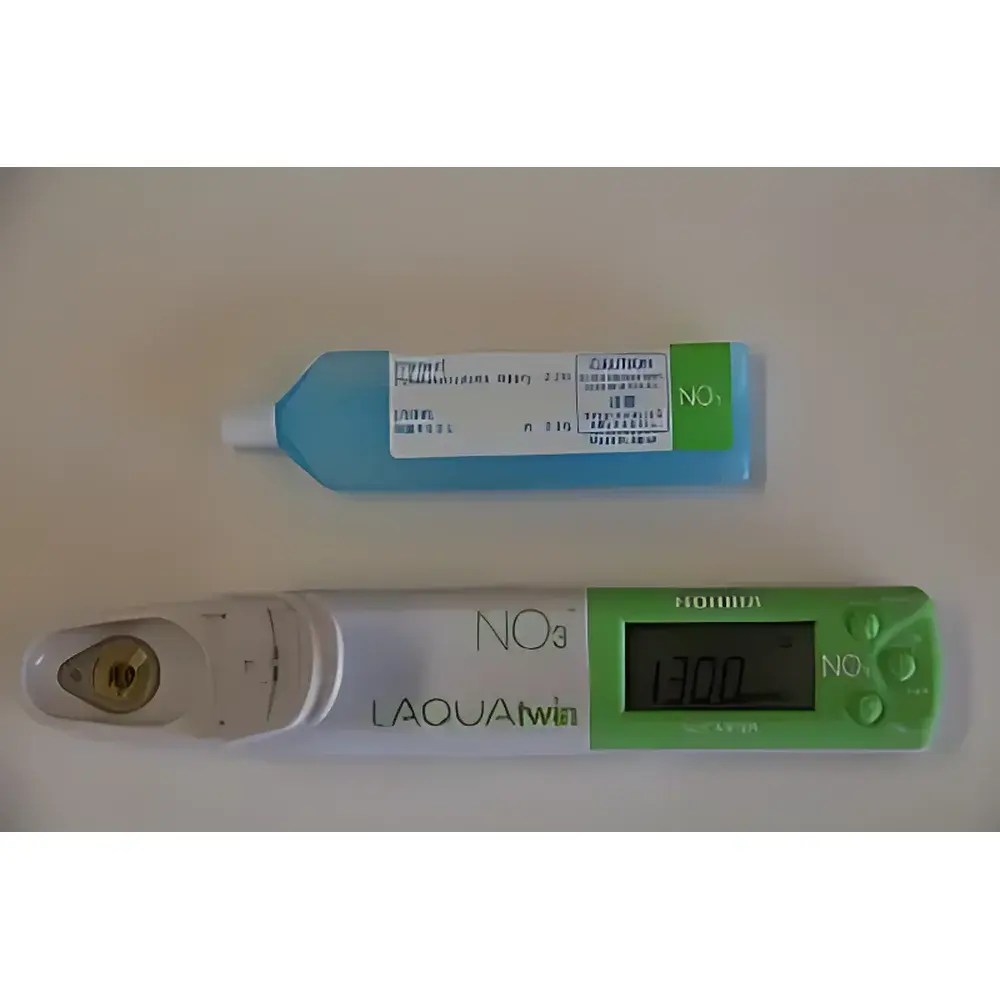
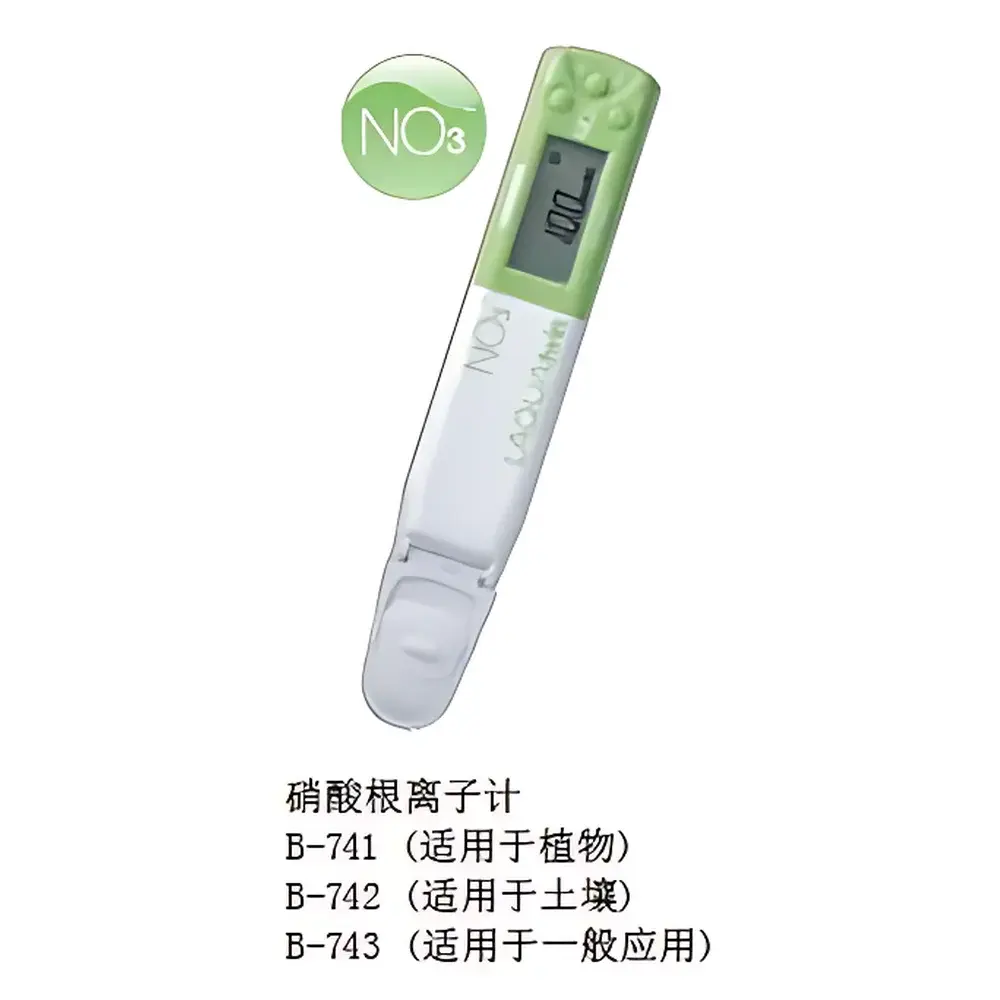
HORIBA B-743 Nitrate Ion Meter
| Brand | HORIBA |
|---|---|
| Origin | Japan |
| Model | B-743 Nitrate Pen-Type Ion Meter |
| Measurement Principle | Ion-Selective Electrode (ISE) Method |
| Measurement Range (NO₃⁻) | 62–6,200 ppm (mg/L) [10⁻³–10⁻¹ mol/L] |
| Measurement Range (NO₃⁻–N) | 14–1,400 ppm (mg/L) |
| Minimum Sample Volume | 0.05 mL × 2 or ≥0.3 mL |
| Calibration | Two-Point Calibration |
| Accuracy | ±10% of reading |
| Temperature Compensation | Automatic (fixed 2%/°C coefficient) |
| Auto-Hold Function | Yes |
| Ingress Protection Rating | IP67 |
| Operating Environment | 5–40 °C, RH <85% (non-condensing) |
| Power Supply | Two CR2032 batteries |
| Dimensions (L×W×H) | 164 × 29 × 20 mm (excl. protrusions) |
| Weight | Approx. 50 g (instrument only, excl. batteries) |
Overview
The HORIBA B-743 Nitrate Ion Meter is a compact, field-deployable pen-type analyzer engineered for rapid, on-site quantification of nitrate (NO₃⁻) concentration in aqueous environmental samples. It operates on the principle of ion-selective electrode (ISE) potentiometry, where a solid-state nitrate-selective membrane generates a Nernstian potential response proportional to the logarithm of NO₃⁻ activity in solution. This electrochemical measurement method enables direct, reagent-free analysis without sample digestion or colorimetric development—making it especially suitable for routine monitoring of surface water, groundwater, wastewater effluents, agricultural runoff, and drinking water sources. The instrument’s design prioritizes operational simplicity and ruggedness: its sealed, handheld form factor integrates a built-in reference electrode and sensing element in a single probe tip, eliminating external junctions or refillable electrolytes that compromise long-term stability in variable field conditions.
Key Features
- True Pen-Style Portability: Weighing only ~50 g and measuring 164 mm in length, the B-743 is optimized for one-handed operation during field surveys, emergency response, or mobile lab workflows—no external power supply or data logger required.
- IP67-Rated Enclosure: Fully protected against dust ingress and immersion in water up to 1 m for 30 minutes, ensuring reliable performance in humid, rainy, or splash-prone environments including stream banks, irrigation ditches, and treatment plant perimeters.
- Two-Point Calibration Protocol: Supports calibration using standard nitrate solutions spanning the full measurement range (e.g., 100 ppm and 1,000 ppm NO₃⁻), enabling linearization of sensor response and compensation for interferences from common anions such as chloride and sulfate within typical environmental matrices.
- Automatic Temperature Compensation (ATC): Applies a fixed temperature coefficient of 2%/°C to correct measured mV signals, aligning readings to 25 °C reference conditions—critical for maintaining comparability across diurnal or seasonal field measurements.
- Auto-Hold Function: Freezes stable readings on-screen once signal drift falls below 0.1 mV/s for ≥2 seconds, minimizing operator-dependent timing errors during manual sampling in turbulent or low-flow conditions.
- Low-Volume Sampling Capability: Validated for accurate measurement with as little as 0.05 mL × 2 replicate aliquots—or ≥0.3 mL for single-point analysis—reducing sample collection burden in remote or constrained-access locations.
Sample Compatibility & Compliance
The B-743 is validated for use with natural waters, treated effluents, and nutrient-enriched agricultural drainage. It exhibits minimal interference from pH (range 2–12), conductivity (5 ppm free chlorine), its ISE response remains stable under GLP-aligned handling protocols. The device complies with IEC 60529 (IP67), JIS Z 8401 (numerical rounding for reporting), and supports traceable calibration practices aligned with ISO/IEC 17025 clause 7.7 (sampling and measurement uncertainty). Though not certified for regulatory submission under EPA Method 300.0 or ISO 10304-1, it serves as a robust screening tool preceding confirmatory laboratory analysis.
Software & Data Management
The B-743 operates as a standalone instrument with no embedded memory or Bluetooth/Wi-Fi connectivity. All measurement data are displayed in real time on a high-contrast LCD and must be manually recorded. This architecture eliminates firmware update dependencies, cybersecurity vulnerabilities, or proprietary software licensing—enhancing long-term operational continuity in resource-limited settings. For audit-trail compliance, users are advised to log readings alongside field metadata (date/time, GPS coordinates, sample ID, calibration verification status) in paper-bound or validated electronic lab notebooks (ELNs) meeting FDA 21 CFR Part 11 requirements for handwritten entries. Calibration standards should be traceable to NIST SRM 3188 (nitrate in water) or equivalent certified reference materials.
Applications
- Routine nitrate surveillance in watershed management programs and citizen science initiatives
- Pre-screening of drinking water wells for compliance with WHO guideline value (50 mg/L NO₃⁻) or EU Drinking Water Directive limit (50 mg/L)
- On-farm monitoring of fertilizer leaching risk in tile-drained cropland
- Verification of denitrification efficiency in constructed wetlands and bioreactors
- Field validation of online nitrate analyzers during commissioning or maintenance outages
- Education and training in environmental chemistry laboratories, emphasizing ISE fundamentals and field method validation
FAQ
What is the recommended storage condition for the B-743 between uses?
Store upright with protective cap engaged, in a cool, dry location (10–25 °C); avoid prolonged exposure to direct sunlight or high-humidity cabinets.
Can the B-743 measure nitrate-nitrogen (NO₃⁻–N) directly?
Yes—the instrument displays both NO₃⁻ (mg/L) and NO₃⁻–N (mg/L) simultaneously, with automatic stoichiometric conversion (NO₃⁻–N = NO₃⁻ × 0.226) applied internally.
How often should calibration be performed?
Perform two-point calibration before each field session; repeat if ambient temperature shifts >5 °C or after measuring >10 samples in heterogeneous matrices.
Is electrode replacement possible?
No—the nitrate ISE and reference elements are integrated into a non-serviceable probe assembly; the entire unit is replaced upon signal degradation or physical damage.
Does the B-743 require sample filtration prior to measurement?
Yes—turbid or particulate-laden samples must be filtered through a 0.45 µm membrane to prevent clogging of the junction and ensure reproducible diffusion kinetics at the membrane interface.
Related Products







