
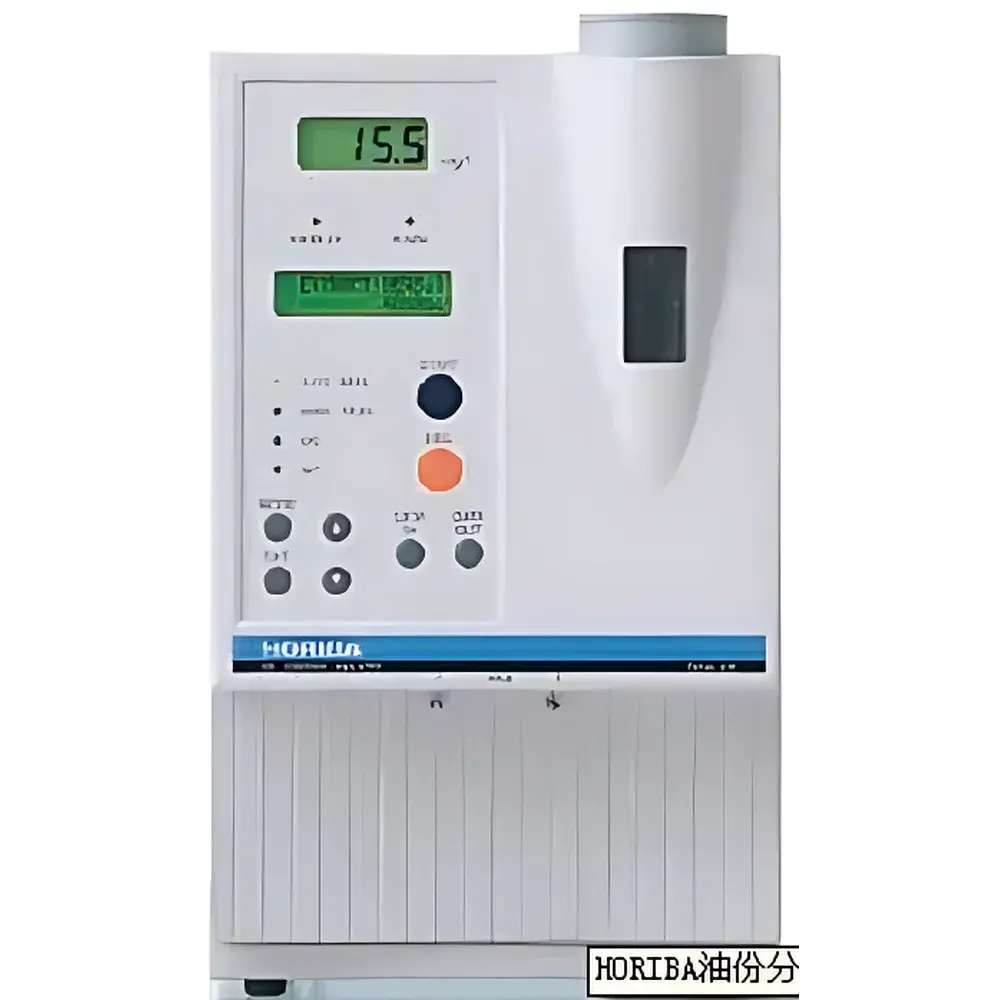
HORIBA OCMA-310/315 Oil Content Analyzer
| Brand | HORIBA |
|---|---|
| Origin | Japan |
| Model | OCMA-310 / OCMA-315 |
| Detection Method | Solvent Extraction + Non-Dispersive Infrared (NDIR) Absorption |
| Detection Range | 0–200 mg/L (dynamic, single-range) |
| Sample Matrix | Freshwater, Seawater, Wastewater |
| Repeatability | ±0.2 mg/L ±1 digit (0–10 mg/L), ±2 mg/L ±1 digit (10–100 mg/L), ±4 mg/L ±1 digit (100–200 mg/L) |
| Extractant | OCMA-310 → S-316 (trichloroethylene substitute) |
| Optional Accessory | Solvent Regenerator SR-305 (activated carbon + activated alumina column) |
Overview
The HORIBA OCMA-310 and OCMA-315 are benchtop oil content analyzers engineered for precise, routine quantification of hydrocarbon contaminants in aqueous environmental matrices—including municipal and industrial wastewater, surface water, estuarine samples, and seawater. Both models operate on the principle of solvent extraction followed by non-dispersive infrared (NDIR) absorption spectroscopy at characteristic C–H stretching vibration bands (~2960–2850 cm⁻¹). This method conforms to internationally recognized protocols for total petroleum hydrocarbon (TPH) measurement, including ASTM D7066, ISO 9377-2, and JIS K 0102. Unlike gravimetric or fluorescence-based alternatives, the OCMA series delivers direct mass concentration output (mg/L) without calibration curve interpolation across multiple ranges—enabled by a dynamically linear photodetector system and temperature-stabilized optical path.
Key Features
- Single-range dynamic detection from 0 to 200 mg/L—eliminates manual range switching and associated operator error or downtime.
- Digital display with real-time error logging and status diagnostics in English, supporting multilingual laboratory environments and audit-ready operation.
- Proprietary syringe-based fluid handling system ensures repeatable, volumetrically accurate delivery of both sample water (typically 10 mL) and extractant (S-316 or H-997), minimizing carryover and cross-contamination.
- Integrated solvent recovery compatibility via optional SR-305 regenerator—utilizing dual-layer adsorption columns (activated carbon + activated alumina) to extend solvent lifecycle and reduce hazardous waste generation per EPA 40 CFR Part 261 guidelines.
- Robust architecture designed for unattended operation in field laboratories, wastewater treatment plants, and coastal monitoring stations—IP54-rated enclosure, low power consumption (<60 W), and minimal maintenance intervals.
Sample Compatibility & Compliance
The OCMA-310/315 accepts raw, filtered, or centrifuged aqueous samples without pre-concentration or derivatization. It is validated for use with turbid, saline, and organically complex matrices—demonstrating negligible interferences from humic substances, chlorophyll-a, or dissolved organic carbon (DOC) under standard operating conditions. Regulatory alignment includes support for GLP-compliant data acquisition (with optional RS-232/USB logging), traceability of instrument parameters (lamp intensity, detector gain, zero baseline), and adherence to ISO/IEC 17025 method validation requirements. While not intrinsically compliant with FDA 21 CFR Part 11, the system supports external electronic lab notebook (ELN) integration for full audit trail management.
Software & Data Management
Data output is provided via analog voltage (0–1 V DC proportional to concentration) and digital serial interface (RS-232), enabling seamless integration into SCADA systems, LIMS platforms, or custom Python/Matlab acquisition scripts. Internal memory stores up to 1,000 measurement records with timestamp, operator ID (manual entry), and error flags. No proprietary software is required; raw output files (.csv or .txt) are generated upon request via terminal command or front-panel export. Firmware updates are delivered via USB flash drive and include version-controlled changelogs aligned with IEC 62304 medical device software standards—reflecting HORIBA’s rigorous development lifecycle for analytical instrumentation.
Applications
- Effluent monitoring at industrial discharge points (e.g., petrochemical, metal finishing, food processing) per local regulatory thresholds (e.g., EU Directive 2000/60/EC, US EPA NPDES limits).
- Baseline and post-spill assessment in marine and estuarine ecosystems—particularly where rapid turnaround (<10 min/sample) and field-deployable reliability are critical.
- Performance verification of oil-water separators, API tanks, and dissolved air flotation (DAF) units in municipal wastewater treatment facilities.
- Method comparison studies against GC-FID or UV-Vis reference techniques, leveraging NDIR’s superior specificity for aliphatic and aromatic hydrocarbons over polar interferents.
- Long-term trend analysis in river basin management programs requiring consistent, operator-independent data across seasonal salinity gradients.
FAQ
What solvents are compatible with the OCMA-310 and OCMA-315?
OCMA-310 uses S-316—a non-ozone-depleting, low-toxicity trichloroethylene substitute formulated for high extraction efficiency and low IR background absorbance. OCMA-315 employs H-997, a refined hexane-based solvent optimized for marine samples with elevated chloride content.
Can the SR-305 solvent regenerator be used with both models?
Yes—the SR-305 is chemically agnostic to either S-316 or H-997 and achieves >95% solvent recovery after 50–100 extractions, verified by FTIR spectral overlay and blank residual analysis.
Is calibration verification required before each batch?
Per ISO 8466-1, a system suitability check using certified reference material (CRM) at 10 mg/L and 100 mg/L is recommended daily; full multi-point calibration is advised weekly or after solvent change.
How does the instrument handle emulsified oil in wastewater samples?
The built-in extraction protocol includes vigorous mechanical mixing (via syringe pulsation) and phase separation time (≥2 min), effectively breaking most stable oil-in-water emulsions without surfactant addition.
Does the analyzer meet requirements for regulatory reporting under ISO 9377-2?
Yes—the OCMA-310/315 satisfies all instrumental performance criteria in Clause 7.2 (linearity, detection limit, repeatability) and Annex B (extraction efficiency validation) when operated per HORIBA’s documented SOPs.







