
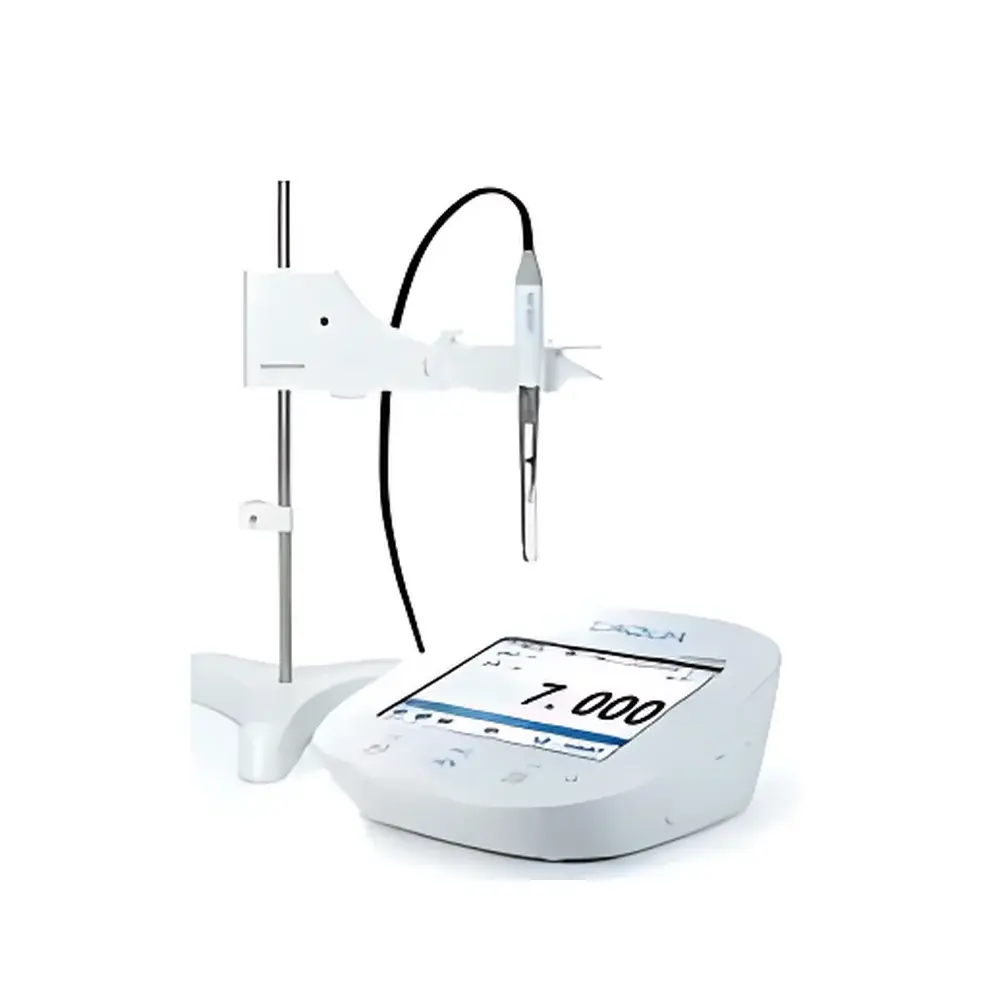
HORIBA F-70 Series Multi-Parameter Benchtop Water Quality Analyzer
| Brand | HORIBA |
|---|---|
| Origin | Japan |
| Model | F-70 Series |
| Instrument Type | Benchtop |
| Parameter Types | pH, ORP, Ion Concentration, Conductivity, Resistivity, Salinity, TDS, Temperature |
| pH Range | 0.000–14.000 |
| pH Resolution & Accuracy | 0.001 |
| Calibration Buffers | pH 4.01, 7.00, 9.21 |
| Measurement Principle | Glass Electrode (pH), Ion-Selective Electrode (ISE), AC Two-Electrode Conductometry (Conductivity) |
| Compliance | JIS, USP <645>, EP 2.2.38, JP/CP Pharmacopoeial Standards |
| Data Storage | Up to 2000 datasets (F-72/F-73/F-74) |
| Connectivity | USB host/device, optional thermal printer interface |
| Display | Capacitive touchscreen (F-74BW), multilingual UI (English, Japanese, Chinese, Korean) |
Overview
The HORIBA F-70 Series is a high-precision, benchtop multi-parameter water quality analyzer engineered for regulated laboratory environments requiring strict adherence to pharmacopoeial and industrial water specifications. Designed and manufactured in Japan, the F-70 platform integrates electrochemical measurement principles—including potentiometric glass electrode detection for pH and redox potential (ORP), ion-selective electrode (ISE) methodology for monovalent/multivalent ion quantification, and AC two-electrode conductometry for conductivity—into a single, modular architecture. Its measurement engine supports full traceability per GLP and GMP requirements, with built-in calibration verification, sensor diagnostics, and real-time error flagging aligned with ISO/IEC 17025 and FDA 21 CFR Part 11 data integrity expectations. The system is explicitly validated for purified water (PW), water for injection (WFI), and clean steam condensate testing per USP , European Pharmacopoeia 2.2.38, Japanese Pharmacopoeia (JP), and Chinese Pharmacopoeia (CP) standards.
Key Features
- Modular channel configuration across F-71 through F-74BW models: F-71 (pH/ORP only); F-72 (pH/ORP/ION dual-channel); F-73 (pH/ORP/ION + COND/RESI/SAL/TDS dual-channel); F-74 and F-74BW (full parameter suite with enhanced diagnostics and capacitive touchscreen interface)
- High-resolution pH measurement: 0.001 pH resolution and accuracy over full 0.000–14.000 range, with automatic temperature compensation (ATC) and NIST-traceable calibration validation
- Pharmacopoeia-compliant periodic verification mode: preconfigured test sequences for USP conductivity acceptance criteria, EP resistivity pass/fail thresholds, and JP/CP salinity limits
- Intelligent on-screen navigation: step-by-step guided calibration, electrode health assessment, and fault diagnosis with contextual help and maintenance scheduling
- Robust data governance: 2000-entry internal memory (F-72/F-73/F-74), timestamped records with operator ID, sensor serial tracking, and USB export to CSV or Excel-compatible formats
- Regulatory-ready connectivity: dual USB ports supporting simultaneous connection to PC (for data archiving and remote configuration via HORIBA LabSolutions software) and certified thermal printers (e.g., Brother QL-series) for audit-trail hardcopy generation
Sample Compatibility & Compliance
The F-70 Series accommodates aqueous samples across pharmaceutical, biotech, semiconductor, and municipal water treatment applications. It accepts standard combination pH electrodes (e.g., HORIBA 9615S-10D), ORP sensors (9616S-10D), ISEs (e.g., fluoride 9617S-10D), and conductivity cells with selectable cell constants (K = 0.1, 1.0, 10 cm⁻¹). All measurements conform to ASTM D1125 (electrical conductivity of water), ISO 7888 (conductivity), ISO 5667-22 (water quality sampling), and pharmacopoeial monographs governing conductivity/resistivity acceptance. The instrument’s firmware embeds dynamic calculation algorithms for TDS (based on NaCl equivalence), salinity (PPT and % w/w), and resistivity (derived from conductivity and temperature), all validated against NIST SRM 3198 and 3199 reference materials.
Software & Data Management
HORIBA LabSolutions PC software provides centralized instrument control, method management, and electronic lab notebook (ELN) integration. It enables creation of SOP-driven measurement workflows, automated report generation compliant with 21 CFR Part 11 (including digital signatures, audit trails, and user role-based access), and batch-level data review with statistical process control (SPC) charts. Raw datasets include metadata: date/time, operator ID, electrode lot number, calibration history, ambient temperature, and environmental humidity (when paired with optional external probe). Data exports meet LIMS interoperability requirements via HL7 and ASTM E1384 formats.
Applications
- Pharmaceutical QC labs performing routine PW/WFI conductivity and TOC correlation studies
- Biomanufacturing facilities validating clean-in-place (CIP) rinse water resistivity prior to equipment sterilization
- Contract testing laboratories conducting environmental monitoring per ISO 14644-1 and EU Annex 1
- Academic research groups studying ion speciation kinetics in low-conductivity matrices
- Microelectronics fabs verifying ultrapure water (UPW) resistivity stability at 18.2 MΩ·cm ±0.1 MΩ·cm
- Regulatory inspection readiness: rapid generation of compliance evidence packages for FDA, PMDA, or EMA audits
FAQ
Does the F-70 Series support automatic calibration verification (ACV) per USP ?
Yes—the F-74 and F-74BW models include embedded ACV routines that verify electrode slope, offset, and response time against certified buffer standards before each measurement sequence.
Can the instrument store calibration history for multiple electrodes?
Yes—each channel maintains independent calibration logs including date, buffer values used, slope (%), asymmetry potential (mV), and electrode ID, accessible via USB export or on-screen review.
Is the touchscreen interface compatible with gloved operation in cleanroom environments?
The F-74BW’s capacitive display supports stylus and gloved-finger input, with adjustable touch sensitivity and haptic feedback enabled via firmware v3.2+.
How is measurement uncertainty reported for conductivity results?
Uncertainty is calculated per ISO/IEC Guide 98-3 (GUM) using combined contributions from cell constant tolerance (±0.5%), temperature sensor accuracy (±0.1°C), and repeatability (±0.5% FS), displayed alongside each reading.
Does the system comply with 21 CFR Part 11 for electronic records?
When operated with LabSolutions software and configured with user authentication, audit trail logging, and electronic signatures, the F-70 Series meets all technical and procedural requirements for Part 11 compliance.
Related Products





