
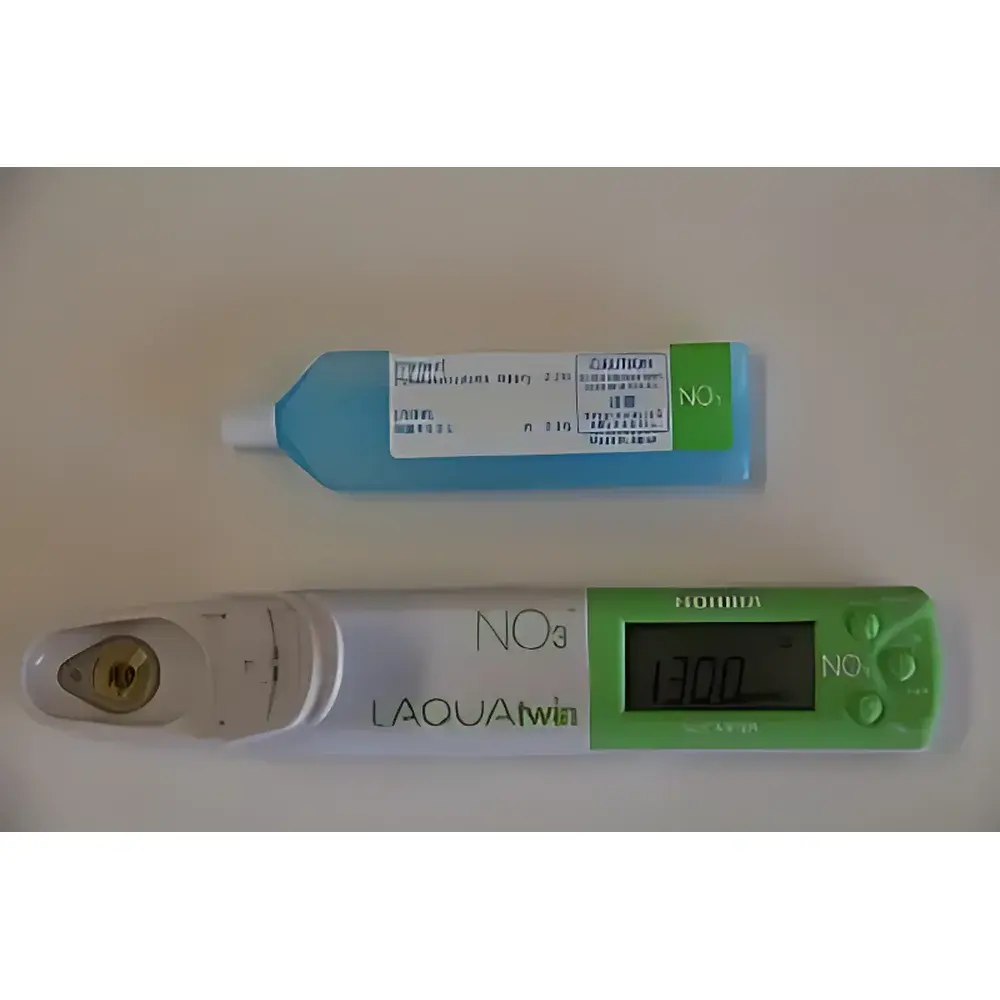
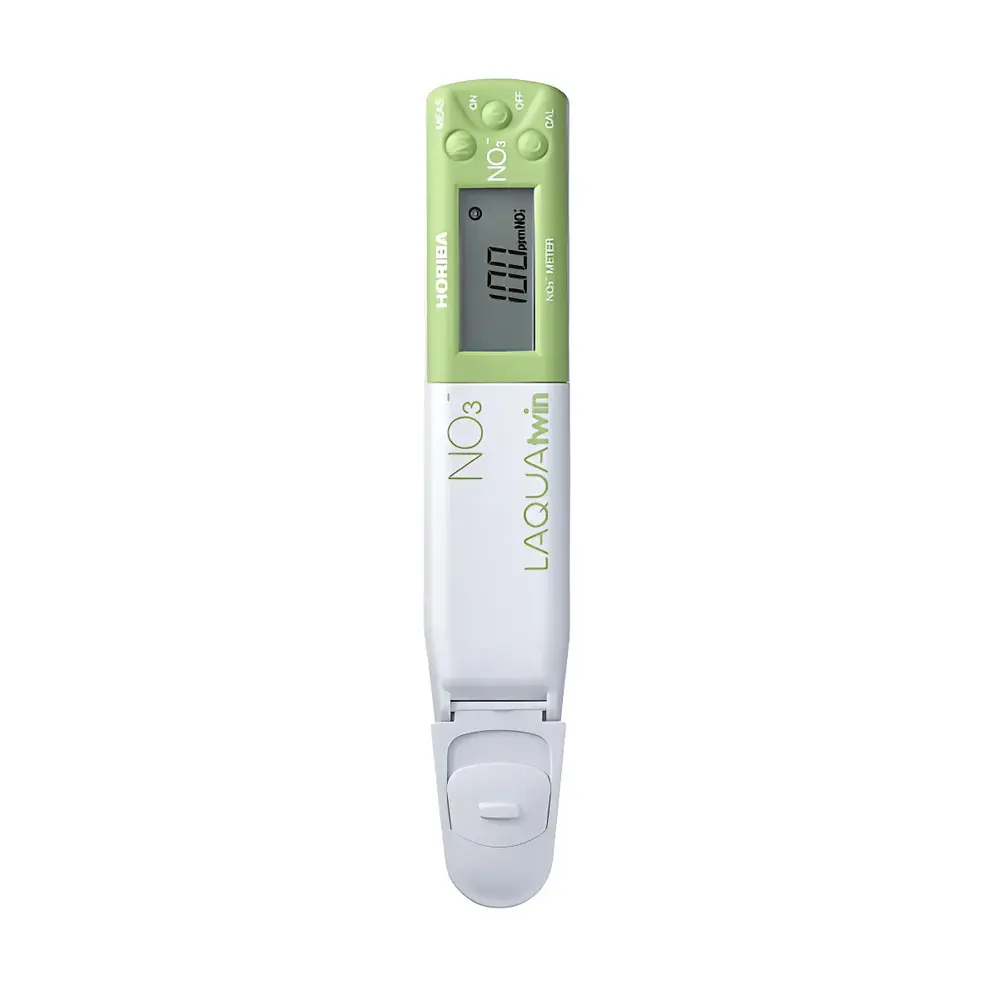
HORIBA B-741/B-742/B-743 Nitrate Ion Meter
| Brand | HORIBA |
|---|---|
| Origin | Japan |
| Model | B-741/B-742/B-743 |
| Detection Parameter | Nitrate (NO₃⁻) only |
| Portability | Pen-type |
| Temperature Measurement Range | 5–40 °C |
| Temperature Accuracy | ±0.1 °C |
| Temperature Resolution | 0.1 °C |
| NO₃⁻ Measurement Range | 62–6200 mg/L (10⁻³–10⁻¹ mol/L) |
| NO₃⁻-N Range | 14–1400 mg/L |
| Calibration | Two-point calibration |
| Accuracy | ±10% of reading |
| IP Rating | IP67 |
| Power Source | Two CR2032 batteries |
| Dimensions | 164 × 29 × 20 mm (excl. protrusions) |
| Weight | ~50 g (instrument only) |
Overview
The HORIBA B-741/B-742/B-743 Nitrate Ion Meter is a compact, pen-style electrochemical analyzer engineered for rapid, on-site quantification of nitrate ion (NO₃⁻) concentration in aqueous samples. It operates on the principle of potentiometric ion-selective electrode (ISE) measurement, utilizing a solid-state nitrate-selective membrane that generates a Nernstian response proportional to the logarithm of NO₃⁻ activity in solution. Designed for field deployment and routine lab spot-checks, the instrument delivers reliable single-parameter analysis without requiring external power supplies or complex setup. Its measurement range spans 62–6200 mg/L NO₃⁻ (equivalent to 10⁻³–10⁻¹ mol/L), with parallel reporting in NO₃⁻-N units (14–1400 mg/L), supporting compliance with environmental monitoring standards such as EPA Method 300.5 and ISO 10304-1 for anion determination in drinking water, wastewater, and agricultural runoff.
Key Features
- Pen-form factor with ergonomic, one-handed operation—ideal for field technicians, agronomists, and environmental inspectors.
- IP67-rated enclosure ensures full protection against dust ingress and immersion in water up to 1 m for 30 minutes—validated per IEC 60529.
- Integrated temperature sensor with automatic temperature compensation (ATC) across 5–40 °C, applying a fixed 2 %/°C coefficient for accurate ion activity correction.
- Two-point calibration protocol using certified nitrate standard solutions (e.g., 100 mg/L and 1000 mg/L NO₃⁻), enabling traceable adjustment per ISO/IEC 17025 calibration practices.
- Auto-hold function freezes stable readings on-screen, minimizing operator-induced variability during handheld use.
- Low sample volume requirement: as little as 0.05 mL per measurement (dual-point sampling recommended), reducing reagent consumption and waste generation.
- CR2032 battery-powered design (2 × 3 V) supports >5000 measurements per set; low-battery indicator alerts prior to performance degradation.
Sample Compatibility & Compliance
The B-741/B-742/B-743 is validated for direct measurement in clarified, low-turbidity aqueous matrices including drinking water, surface water, irrigation water, hydroponic nutrient solutions, and pretreated wastewater effluents. Samples must be free of suspended solids (>5 µm) and oils to prevent membrane fouling. Ionic strength should remain within 0.01–0.1 M to maintain Nernstian slope fidelity; high-background electrolyte samples (e.g., seawater, brines) require matrix-matched calibration or dilution. The device meets CE marking requirements under the EU Electromagnetic Compatibility Directive 2014/30/EU and RoHS 2011/65/EU. While not FDA 21 CFR Part 11 compliant (as it lacks audit trail or user authentication), its calibration records and measurement outputs support GLP documentation when paired with controlled lab notebooks or LIMS-integrated data capture workflows.
Software & Data Management
This meter operates as a standalone, firmware-controlled instrument with no embedded Bluetooth, USB, or cloud connectivity. All data are displayed in real time on a high-contrast LCD screen and retained only until power-off. For regulatory traceability, users are advised to manually log serial number, calibration dates, standard concentrations, ambient temperature, and measured values in accordance with internal QA procedures. The device’s simplicity eliminates firmware update dependencies or cybersecurity vulnerabilities associated with networked instruments—making it suitable for ISO 17025-accredited labs where hardware stability and operational transparency are prioritized over digital integration.
Applications
- Monitoring nitrate levels in municipal drinking water distribution systems to verify compliance with WHO (50 mg/L NO₃⁻) and EU Drinking Water Directive (50 mg/L) limits.
- Field assessment of leaching risk in agricultural soils via pore-water extraction analysis.
- Quality control of fertilizer stock solutions and nutrient dosing accuracy in greenhouse and vertical farming operations.
- Educational laboratory demonstrations of ion-selective electrode theory, Nernst equation derivation, and selectivity coefficient evaluation.
- Rapid screening of aquarium and aquaculture water health, particularly in recirculating systems where nitrate accumulation threatens aquatic life.
FAQ
What sample preparation is required before measurement?
Samples must be filtered through a 0.45 µm membrane filter to remove particulates. No pH adjustment or ionic strength conditioning is needed for typical freshwater matrices; however, high-salinity or high-Ca²⁺/SO₄²⁻ samples may require calibration in a matching background electrolyte.
Can this meter measure nitrate in soil extracts?
Yes—when used with standardized extraction protocols (e.g., 2 M KCl or CaCl₂ extraction followed by filtration), provided extract conductivity remains below 5 mS/cm and pH is between 4–8.
Is temperature compensation adjustable or fixed?
Compensation is fixed at 2 %/°C, consistent with the theoretical temperature coefficient of nitrate ISEs under dilute aqueous conditions.
How often should calibration be performed?
Calibrate before each measurement session and after every 10–15 samples in variable-field conditions; daily calibration is recommended for regulated QC environments.
Does the device store calibration history or measurement logs?
No—it retains no internal memory. All calibration and measurement metadata must be recorded externally per laboratory quality management system requirements.





