
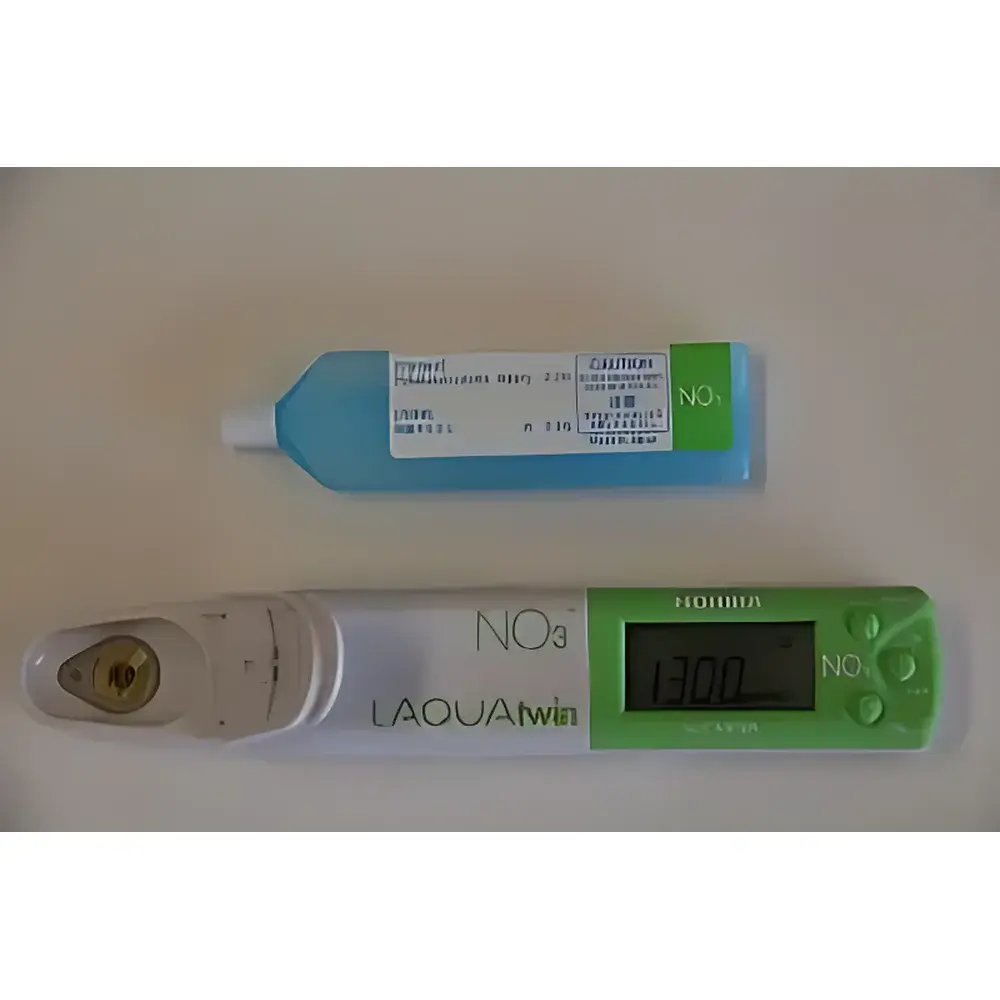
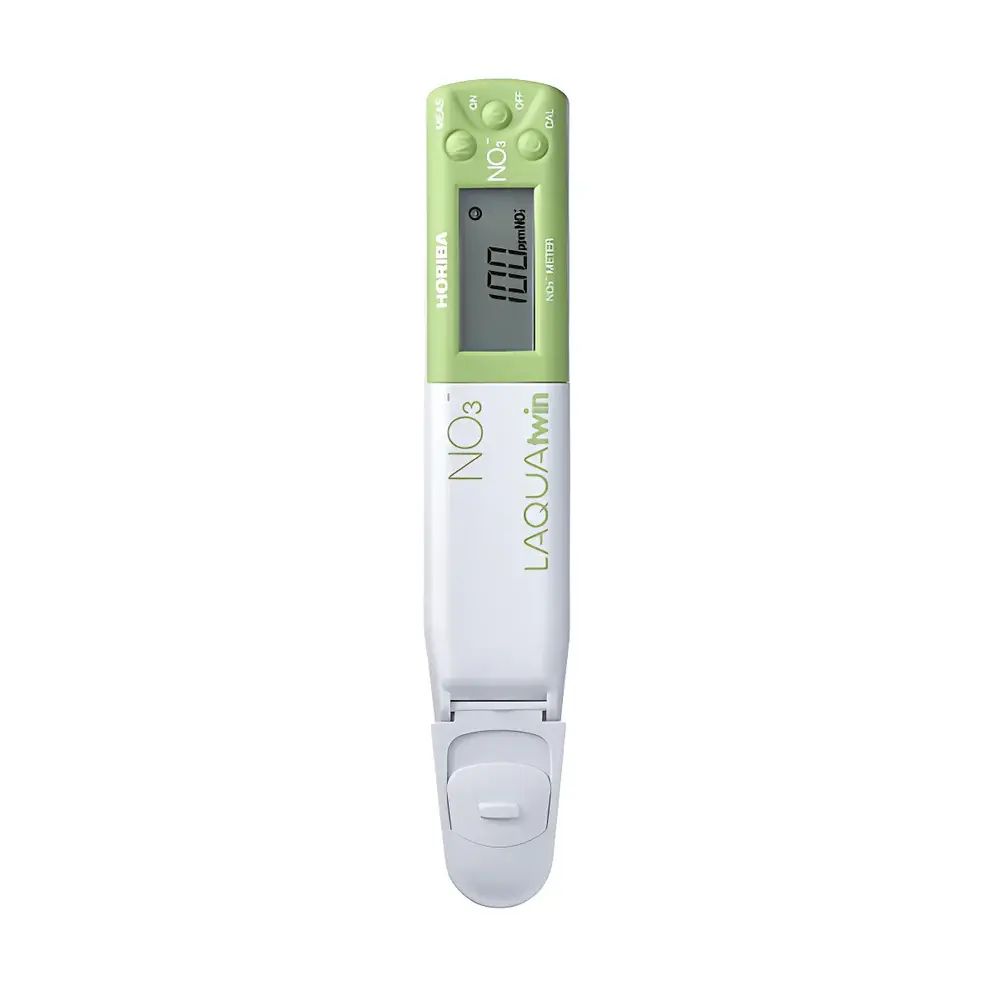
HORIBA B-743 Compact Nitrate Ion Meter
| Brand | HORIBA |
|---|---|
| Origin | Japan |
| Model | B-743 |
| Measurement Principle | Ion-Selective Electrode (ISE) Method |
| Measuring Range | NO₃⁻: 62–6200 ppm (mg/L) [1.0 × 10⁻³ – 1.0 × 10⁻¹ mol/L] |
| NO₃⁻-N | 14–1400 ppm (mg/L) |
| Minimum Sample Volume | 0.05 mL × 2 or ≥0.3 mL |
| Calibration | Two-point calibration |
| Accuracy | ±10% of reading |
| Temperature Compensation | Automatic, with coefficient fixed at 2%/°C |
| Environmental Rating | IP67 |
| Operating Temperature | 5–40 °C |
| Power Supply | Two CR2032 batteries |
| Dimensions | 164 × 29 × 20 mm (excl. protrusions) |
| Weight | ~50 g (instrument only) |
Overview
The HORIBA B-743 Compact Nitrate Ion Meter is a handheld, field-deployable ion-selective electrode (ISE)-based analyzer engineered for rapid, on-site quantification of nitrate (NO₃⁻) concentration in aqueous environmental samples. Designed in accordance with electrochemical potentiometric measurement principles, the instrument detects the potential difference generated across a solid-state nitrate-selective membrane in response to NO₃⁻ activity, converting it into a stable, temperature-compensated concentration reading in ppm (mg/L) or as nitrate-nitrogen (NO₃⁻-N). Its compact pen-style form factor—measuring just 164 mm in length and weighing approximately 50 g—enables single-hand operation in wastewater outfalls, surface water monitoring stations, agricultural runoff sites, and drinking water distribution points. The device operates without external power sources or data loggers, relying solely on two standard CR2032 coin-cell batteries, making it suitable for extended battery life in remote or resource-constrained field deployments.
Key Features
- Ion-selective electrode (ISE) technology optimized for selective nitrate detection in complex matrices, minimizing interference from common anions such as chloride and sulfate under typical environmental pH conditions.
- Two-point calibration protocol supporting traceable accuracy across the full operational range (62–6200 ppm NO₃⁻), with user-accessible calibration standards compliant with ISO 5667-3 and ASTM D3370 guidelines for field water sampling.
- Automatic temperature compensation using a fixed 2%/°C coefficient—aligned with NIST-traceable ISE response models for nitrate in natural waters—ensuring consistent reporting across ambient thermal gradients (5–40 °C).
- IP67-rated enclosure providing full protection against dust ingress and immersion in up to 1 m of water for 30 minutes, validated per IEC 60529, enabling reliable use in rain, splashing, or humid environments without housing degradation.
- Auto-hold function freezes stable readings after signal stabilization, reducing operator variability during manual sampling; integrated LCD display with backlight ensures legibility under low-light field conditions.
- Minimal sample requirement of only 0.05 mL × 2 (dual measurement mode) or ≥0.3 mL for single-point analysis—ideal for low-volume sampling in microcosms, porewater extraction, or small-bore tubing applications.
Sample Compatibility & Compliance
The B-743 is validated for direct measurement in clarified freshwater, treated effluent, groundwater, and irrigation return flows with total dissolved solids (TDS) ≤ 5000 ppm and pH between 4.0 and 10.0. It is not recommended for highly turbid, viscous, or organic-rich samples (e.g., raw sewage or algal blooms) without prior filtration (0.45 µm membrane) to prevent membrane fouling. The device meets functional requirements outlined in EPA Method 300.0 (Ion Chromatography) for field screening and supports data integrity practices aligned with GLP and ISO/IEC 17025:2017 Annex A.2. While not a regulated analytical instrument per se, its two-point calibration traceability and documented repeatability (±10% of reading under controlled lab validation per HORIBA Application Note AN-B743-01) support its use in Tier-1 environmental monitoring programs and pre-screening workflows preceding laboratory confirmation.
Software & Data Management
As a standalone field meter, the B-743 does not interface with proprietary software or cloud platforms. All measurements are displayed in real time on the integrated LCD screen and retained only as visual readouts. Users are expected to manually record results in field notebooks or digital logs compliant with 21 CFR Part 11 requirements if used within regulated quality systems. For audit readiness, operators should document calibration date/time, standard concentrations used, ambient temperature, and sample identification per internal SOPs. HORIBA provides printable calibration verification worksheets and blank field log templates (available upon request via technical support) to assist laboratories in maintaining ALCOA+ (Attributable, Legible, Contemporaneous, Original, Accurate) data governance.
Applications
- Routine nitrate surveillance in municipal drinking water sources and distribution networks, particularly where seasonal leaching or fertilizer runoff poses regulatory risk (e.g., compliance with WHO Guideline Value of 50 mg/L NO₃⁻).
- On-farm nutrient management—rapid assessment of tile drain effluent or lagoon discharge to inform nitrogen application rates and mitigate eutrophication risks.
- Ecological monitoring of streams, lakes, and wetlands under EPA’s National Aquatic Resource Surveys (NARS), supporting trend analysis of anthropogenic nitrogen loading.
- Educational field labs and undergraduate environmental chemistry courses requiring robust, low-cost ISE instrumentation for hands-on potentiometric analysis training.
- Pre-screening of industrial process water or cooling tower makeup water prior to sending high-value samples to certified labs for IC or UV-Vis confirmation.
FAQ
What sample preparation is required before measurement?
Samples should be free of particulates (filtered through 0.45 µm membrane if turbid) and at equilibrium temperature (5–40 °C). No acidification or dilution is needed within the specified range; however, samples exceeding 6200 ppm NO₃⁻ must be diluted with deionized water and results multiplied by the dilution factor.
Can the B-743 measure nitrate in seawater or high-salinity brines?
No. Elevated chloride and sodium concentrations cause significant ISE interference and deviation beyond ±10%. For saline matrices, use HORIBA’s LAQUA twin series or laboratory-grade ion chromatography per ASTM D4327.
How often should calibration be performed?
Calibrate before each measurement session and re-calibrate if ambient temperature shifts >5 °C or after every 10–15 samples, especially when transitioning between low- and high-concentration ranges.
Is the electrode replaceable or serviceable?
The B-743 employs an integrated, non-replaceable nitrate ISE sensor. Device longevity is rated for ≥2 years of typical field use; end-of-life units must be returned to authorized HORIBA service centers for recycling per WEEE Directive Annex VII.
Does the instrument comply with FDA or CLIA regulations?
It is not intended for clinical diagnostics or human specimen analysis. Its design scope is limited to environmental water testing and does not meet CLIA waiver criteria or FDA 510(k) requirements for medical devices.







